Class 10
NCERT Solutions for Class 10 Mathematics
Get chapter-wise mathematics solutions with clear explanations and step-by-step answers.
Explore Solutions →Get a quick overview of the important concepts in this chapter.
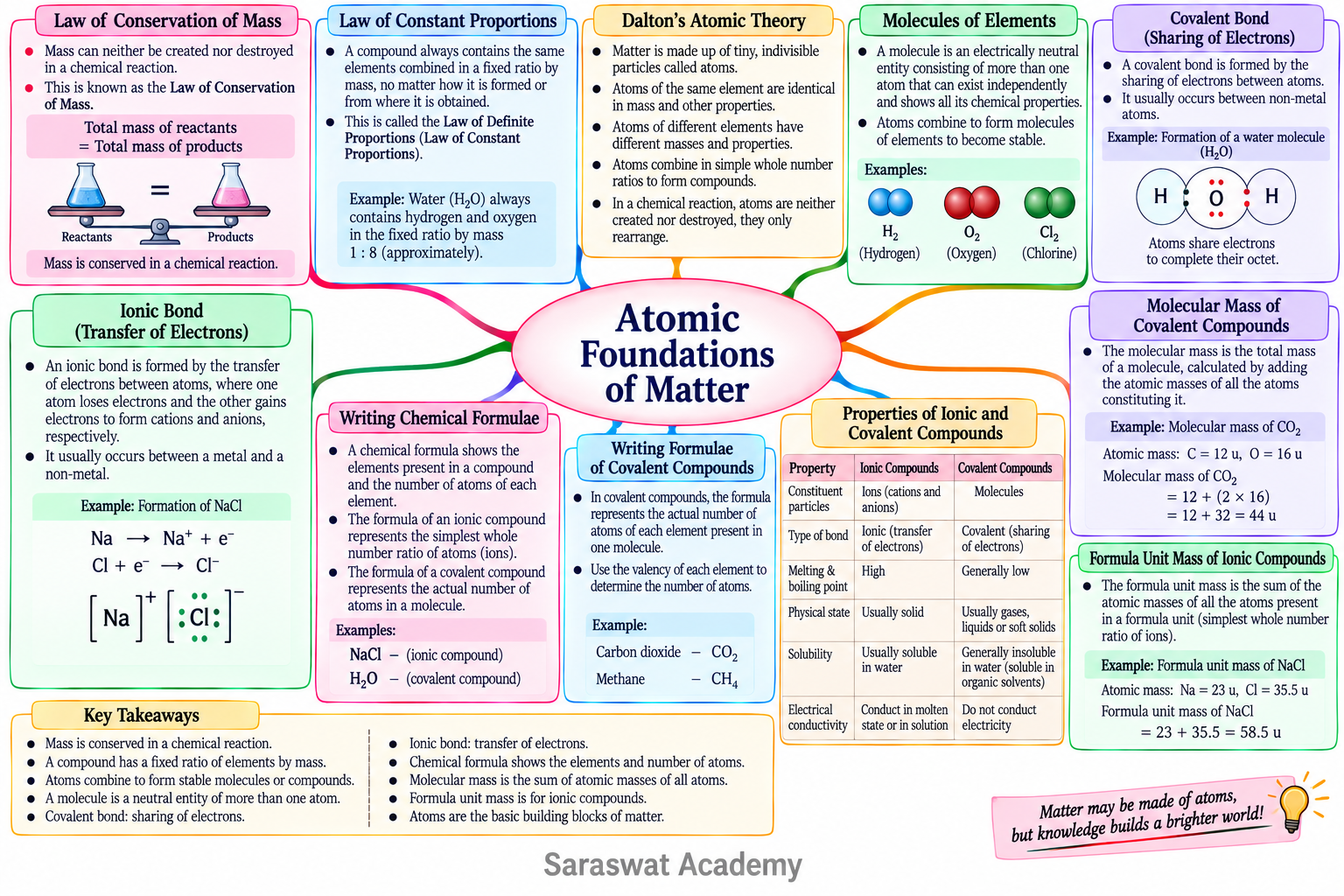
Explore the mind map to revise the main ideas before starting the chapter.
Chapter 9: Atomic Foundations of Matter explains the fundamental principles that govern the formation of matter. Building on the concepts of atomic structure from the previous chapter, this chapter explores how atoms combine, why chemical reactions obey fixed rules, and how these ideas gave rise to modern chemistry. It introduces three important scientific laws—the Law of Conservation of Mass, the Law of Constant Proportions, and Dalton's Atomic Theory—which explain why matter behaves in a predictable manner during chemical changes. :contentReference[oaicite:0]{index=0}
| Topic | What You Will Learn |
|---|---|
| ⚖️ Law of Conservation of Mass | Understand that matter can neither be created nor destroyed during a chemical reaction. The total mass of reactants always remains equal to the total mass of products when the reaction takes place in a closed system. |
| 📏 Law of Constant Proportions | Learn that every pure compound always contains the same elements combined in a fixed ratio by mass, irrespective of its source or method of preparation. |
| ⚛️ Dalton's Atomic Theory | Study Dalton's postulates explaining that all matter is made of tiny atoms, atoms combine in simple whole-number ratios, and atoms are rearranged—not created or destroyed—during chemical reactions. |
| 🧪 Molecules and Chemical Bonding | Discover how atoms combine to form molecules by either sharing electrons (covalent bonding) or transferring electrons (ionic bonding) to achieve stable electronic configurations. |
| 🤝 Covalent Bond | Learn how atoms such as hydrogen, oxygen, chlorine and carbon share electrons to form molecules like H₂, O₂, H₂O, CO₂ and NH₃. |
| 🔋 Ionic Bond | Understand how metals lose electrons and non-metals gain electrons to form positively and negatively charged ions that attract each other to form ionic compounds like NaCl and MgCl₂. |
| 📝 Naming Compounds | Learn the systematic naming of covalent and ionic compounds using internationally accepted chemical nomenclature. |
| ✍️ Writing Chemical Formulae | Practice writing the correct chemical formulae of compounds using the valencies of ions and elements. |
| 🧮 Numerical Problems | Apply the laws of chemistry to solve mass-based numerical questions involving chemical reactions and compound formation. |
| Daily Life Example | Scientific Concept |
|---|---|
| Dissolving salt in water | Mass remains unchanged during a physical change. |
| Burning fuels | Law of Conservation of Mass applies when all products are considered. |
| Common salt (NaCl) | Formation of an ionic compound by electron transfer. |
| Water (H₂O) | Formation of a covalent compound through electron sharing. |
| Carbon dioxide (CO₂) | Atoms combine in fixed proportions to form compounds. |
Atomic Structure → Laws of Chemical Combination → Dalton's Atomic Theory → Molecules → Chemical Bonds → Covalent Bond → Ionic Bond → Naming Compounds → Writing Chemical Formulae
After completing this chapter, you will understand why matter follows definite laws during chemical reactions, how atoms combine to form stable molecules and compounds, and how chemical formulae represent the composition of substances. These concepts provide the foundation for almost every topic in chemistry studied in higher classes.
This chapter introduces the fundamental laws that govern chemical reactions and explains how atoms combine to form molecules and compounds. Mastering these concepts will help you understand almost every topic in chemistry studied in higher classes.
| Concept | Key Point |
|---|---|
| Definition | Matter can neither be created nor destroyed during a chemical reaction. |
| Main Idea | Total mass of reactants = Total mass of products (in a closed system). |
| Scientist | Antoine Lavoisier (1789). |
| Importance | Explains why the total amount of matter always remains constant during physical and chemical changes. |
| Concept | Key Point |
|---|---|
| Definition | A pure compound always contains the same elements combined in a fixed ratio by mass. |
| Scientist | Joseph Louis Proust. |
| Example | Pure water always contains hydrogen and oxygen in the same mass ratio, irrespective of its source. |
| Importance | Explains why the composition of every pure compound is always fixed. |
| Type | Example |
|---|---|
| Molecule of an Element | H₂, O₂, Cl₂ |
| Molecule of a Compound | H₂O, CO₂, NH₃, HCl |
A molecule is an electrically neutral particle made up of two or more atoms that can exist independently and shows the properties of that substance.
A chemical bond is the force of attraction that holds atoms together to form molecules or compounds. Atoms combine because the combined arrangement is more stable than the individual atoms.
| Concept | Description |
|---|---|
| Formation | Formed by sharing of electrons. |
| Usually Between | Two non-metals. |
| Examples | H₂, O₂, Cl₂, H₂O, CO₂, NH₃, HCl. |
| Types | Single bond, Double bond and Triple bond. |
| Concept | Description |
|---|---|
| Formation | Formed by transfer of electrons. |
| Usually Between | A metal and a non-metal. |
| Positive Ion | Cation |
| Negative Ion | Anion |
| Example | NaCl, MgCl₂, CaO. |
| Ion | Description |
|---|---|
| Cation | Positively charged ion formed by losing electrons. |
| Anion | Negatively charged ion formed by gaining electrons. |
| Prefix | Number of Atoms |
|---|---|
| Mono | 1 |
| Di | 2 |
| Tri | 3 |
| Tetra | 4 |
| Penta | 5 |
| Hexa | 6 |
The second element in a covalent compound usually ends with -ide.
| Scientist | Contribution |
|---|---|
| Antoine Lavoisier | Law of Conservation of Mass. |
| Joseph Louis Proust | Law of Constant Proportions. |
| John Dalton | Dalton's Atomic Theory. |
Matter → Chemical Reactions → Law of Conservation of Mass → Law of Constant Proportions → Dalton's Atomic Theory → Molecules → Chemical Bond → Covalent Bond → Ionic Bond → Ions → Naming Compounds → Writing Chemical Formulae
The concepts of chemical combination, atomic theory, chemical bonding, and chemical formulae are used in almost every aspect of our daily lives. From drinking water and cooking food to manufacturing medicines and developing advanced materials, these principles help scientists understand how atoms combine to form useful substances.
| Real-Life Application | How the Concept is Applied |
|---|---|
| 💧 Drinking Water (H₂O) | Water is formed when hydrogen and oxygen atoms combine in a fixed ratio. This demonstrates the Law of Constant Proportions and the formation of covalent bonds. |
| 🧂 Common Salt (NaCl) | Table salt is formed by the transfer of electrons between sodium and chlorine atoms, resulting in an ionic bond. It is essential for cooking and maintaining electrolyte balance in the human body. |
| 🍳 Cooking Food | Cooking involves numerous chemical reactions in which atoms rearrange to form new substances. Throughout these reactions, the Law of Conservation of Mass remains valid. |
| 💊 Medicines | Medicines are chemical compounds formed by atoms combining in definite proportions. Understanding chemical bonding helps scientists design safe and effective drugs. |
| 🌿 Photosynthesis | Plants combine carbon dioxide and water to produce glucose and oxygen. The atoms are simply rearranged into new compounds without being created or destroyed. |
| 🫁 Respiration | During respiration, glucose reacts with oxygen to produce carbon dioxide, water, and energy through chemical reactions involving atoms and molecules. |
| 🔥 Burning Fuels | When fuels burn, atoms combine with oxygen to form new compounds. The total mass remains conserved when all reactants and products are considered. |
| 🧪 Chemical Industries | Industries manufacture fertilizers, plastics, detergents, paints, acids, and medicines by combining atoms according to the principles of chemical bonding and fixed composition. |
| 🔋 Batteries | Chemical reactions involving ions convert chemical energy into electrical energy, making batteries work. |
| 🏗️ Building Materials | Compounds such as cement, glass, and ceramics are produced by combining different elements in fixed proportions. |
| 🌾 Agriculture | Fertilizers like urea and ammonium compounds are manufactured using chemical reactions based on atomic theory and chemical bonding. |
| 🧼 Soaps and Detergents | These cleaning agents are chemical compounds formed through controlled chemical reactions between different substances. |
| 🦷 Toothpaste | Toothpaste contains compounds such as calcium carbonate and sodium fluoride, prepared using fixed chemical compositions. |
| 🏥 Medical Laboratories | Preparation of medicines and laboratory chemicals requires accurate chemical formulae and correct proportions of elements. |
| 🌍 Environmental Protection | Scientists study chemical reactions to reduce pollution, treat wastewater, and develop eco-friendly materials. |
| ⚙️ Manufacturing Industries | Industries use chemical formulae to calculate the exact quantities of raw materials needed for manufacturing products efficiently. |
| 🎨 Paints and Dyes | Colour pigments and dyes are chemical compounds produced by combining atoms in fixed proportions. |
| 🧴 Cosmetics | Creams, perfumes, shampoos, and lotions are prepared using carefully formulated chemical compounds. |
| 🚗 Automobile Industry | Batteries, fuels, lubricants, and protective coatings all depend on chemical compounds formed through atomic bonding. |
| 🛰️ Modern Technology | Advanced materials used in electronics, aerospace, and communication devices are designed by understanding how atoms combine to form stable compounds. |
Every glass of water you drink, every meal you eat, every medicine you take, and every battery you use is possible because atoms combine in fixed proportions to form stable compounds. Understanding these simple atomic principles helps explain the chemistry behind everyday life.
Scientists carefully observe chemical changes, ask questions, perform experiments, and explain their observations using scientific laws and evidence. In this chapter, you learned how atoms combine to form compounds and why chemical reactions always follow fixed scientific laws. Now, think like a scientist and apply these concepts to real-life situations.
| 🔬 | Think Like a Scientist |
|---|---|
| 1 | When a candle burns, it appears to become smaller. Has the matter disappeared? Explain your answer using the Law of Conservation of Mass. |
| 2 | Why does pure water always contain hydrogen and oxygen in the same fixed ratio, whether it comes from a river, rain, or laboratory? |
| 3 | If atoms cannot be seen with the naked eye, how do scientists know that atoms and molecules actually exist? |
| 4 | Why do sodium and chlorine become stable after combining to form common salt (NaCl)? Explain using the concept of electron transfer. |
| 5 | Why do hydrogen atoms share electrons to form a hydrogen molecule (H₂) instead of transferring electrons? |
| 6 | Imagine a world where atoms could be created or destroyed during chemical reactions. How would this affect nature and everyday life? |
| 7 | Two colourless gases, hydrogen and oxygen, combine to form water. Why are the properties of water completely different from those of its constituent elements? |
| 8 | Why is it important for chemists to write correct chemical formulae before preparing medicines or chemicals in a laboratory? |
| 9 | Why do scientists use internationally accepted chemical symbols instead of writing the complete names of elements in chemical equations? |
| 10 | Look around your home and identify five compounds. Can you explain how the atoms in each compound are chemically bonded? |
| Challenge |
|---|
Imagine you are a chemist developing a new eco-friendly cleaning product.
|
| Question |
|---|
Suppose scientists discover a new element with unusual chemical properties.
|
"A scientist never guesses the composition of a substance. They perform experiments, observe carefully, measure accurately, and use scientific laws to explain how atoms combine to form matter."
Choose any five common compounds found at home (such as water, common salt, baking soda, carbon dioxide, or sugar). Write their chemical formulae, identify whether they contain ionic or covalent bonds, and explain one everyday use of each compound in a neat table.
These frequently asked questions will help you quickly revise the important concepts of Chapter 9: Atomic Foundations of Matter.
| Q.No. | Question | Answer |
|---|---|---|
| 1 | What does the Law of Conservation of Mass state? | It states that matter can neither be created nor destroyed during a chemical reaction. The total mass of reactants is always equal to the total mass of products. |
| 2 | Who proposed the Law of Conservation of Mass? | Antoine Lavoisier proposed the Law of Conservation of Mass. |
| 3 | What is the Law of Constant Proportions? | It states that a pure compound always contains the same elements combined in a fixed ratio by mass, regardless of its source or method of preparation. |
| 4 | Who proposed the Law of Constant Proportions? | Joseph Louis Proust proposed the Law of Constant Proportions. |
| 5 | Who proposed the first scientific atomic theory? | John Dalton proposed the first scientific atomic theory. |
| 6 | State one important postulate of Dalton's Atomic Theory. | All matter is made up of tiny particles called atoms, which cannot be created or destroyed during chemical reactions. |
| 7 | What is a molecule? | A molecule is the smallest particle of an element or compound that can exist independently and retains the chemical properties of that substance. |
| 8 | What is a chemical bond? | A chemical bond is the force of attraction that holds atoms together in a molecule or compound. |
| 9 | What is a covalent bond? | A covalent bond is formed when atoms share electrons with one another. |
| 10 | What is an ionic bond? | An ionic bond is formed when one atom transfers electrons to another atom, producing oppositely charged ions. |
| 11 | What is a cation? | A cation is a positively charged ion formed by the loss of electrons. |
| 12 | What is an anion? | An anion is a negatively charged ion formed by the gain of electrons. |
| 13 | How is sodium chloride (NaCl) formed? | Sodium loses one electron and chlorine gains one electron. The resulting oppositely charged ions attract each other to form an ionic bond. |
| 14 | How is a hydrogen molecule (H₂) formed? | Two hydrogen atoms share one pair of electrons to form a single covalent bond. |
| 15 | What is the difference between ionic and covalent bonds? | Ionic bonds are formed by the transfer of electrons, whereas covalent bonds are formed by the sharing of electrons. |
| 16 | Why do atoms form chemical bonds? | Atoms form chemical bonds to achieve a stable electronic configuration. |
| 17 | How are chemical formulae written? | Chemical formulae are written using the symbols and valencies of the combining elements or ions. |
| 18 | What is the crossover method? | It is a method used to write chemical formulae by exchanging the valencies of the combining elements or ions. |
| 19 | How are ionic compounds named? | The name of the cation is written first, followed by the name of the anion. |
| 20 | How are covalent compounds named? | Covalent compounds are named using prefixes such as mono-, di-, tri-, tetra-, and penta- to indicate the number of atoms. |
| 21 | Why is the Law of Conservation of Mass important? | It explains that the total amount of matter remains constant during every chemical reaction. |
| 22 | Why is the Law of Constant Proportions important? | It proves that every pure compound always has a fixed chemical composition. |
| 23 | Why are chemical formulae important? | Chemical formulae show the types and numbers of atoms present in a compound and help scientists communicate accurately. |
| 24 | Where are ionic and covalent compounds used in daily life? | Ionic compounds are found in substances like common salt, while covalent compounds are present in water, carbon dioxide, sugar, and many medicines. |
| 25 | Why is this chapter important? | This chapter forms the foundation of chemistry by explaining the laws of chemical combination, atomic theory, chemical bonding, and the formation of compounds. |
While solving questions from this chapter, always remember this order:
Laws of Chemical Combination → Dalton's Atomic Theory → Molecules → Chemical Bonds → Ionic & Covalent Bonds → Ions → Chemical Formulae.
Understanding this sequence will help you answer both theory and application-based questions confidently.
Continue learning with other Class 9 Exploration chapters.
Explore more NCERT solutions and other resources with Saraswat Academy.
Get chapter-wise mathematics solutions with clear explanations and step-by-step answers.
Explore Solutions →Study important concepts, exercise solutions and chapter-wise mathematics answers.
Explore Solutions →Understand science concepts with detailed answers to textbook questions.
Explore Solutions →Explore chapter-wise science solutions, explanations and useful study resources.
Explore Solutions →Improve your English skills with detailed answers to textbook questions.
Explore Solutions →Improve your English skills with detailed answers to textbook questions.
Explore Resources →Improve your Hindi skills with detailed answers to textbook questions.
Explore Resources →Improve your Hindi skills with detailed answers to textbook questions.
Explore Resources →Improve your Hindi skills with detailed answers to textbook questions.
Explore Resources →Improve your Social Science skills with detailed answers to textbook questions.
Explore Resources →Improve your Social Science skills with detailed answers to textbook questions.
Explore Resources →Improve your Social Science skills with detailed answers to textbook questions.
Explore Resources →Detailed NCERT solutions for class 9 sanskrit.
Explore Resources →