Class 10
NCERT Solutions for Class 10 Mathematics
Get chapter-wise mathematics solutions with clear explanations and step-by-step answers.
Explore Solutions →Get a quick overview of the important concepts in this chapter.
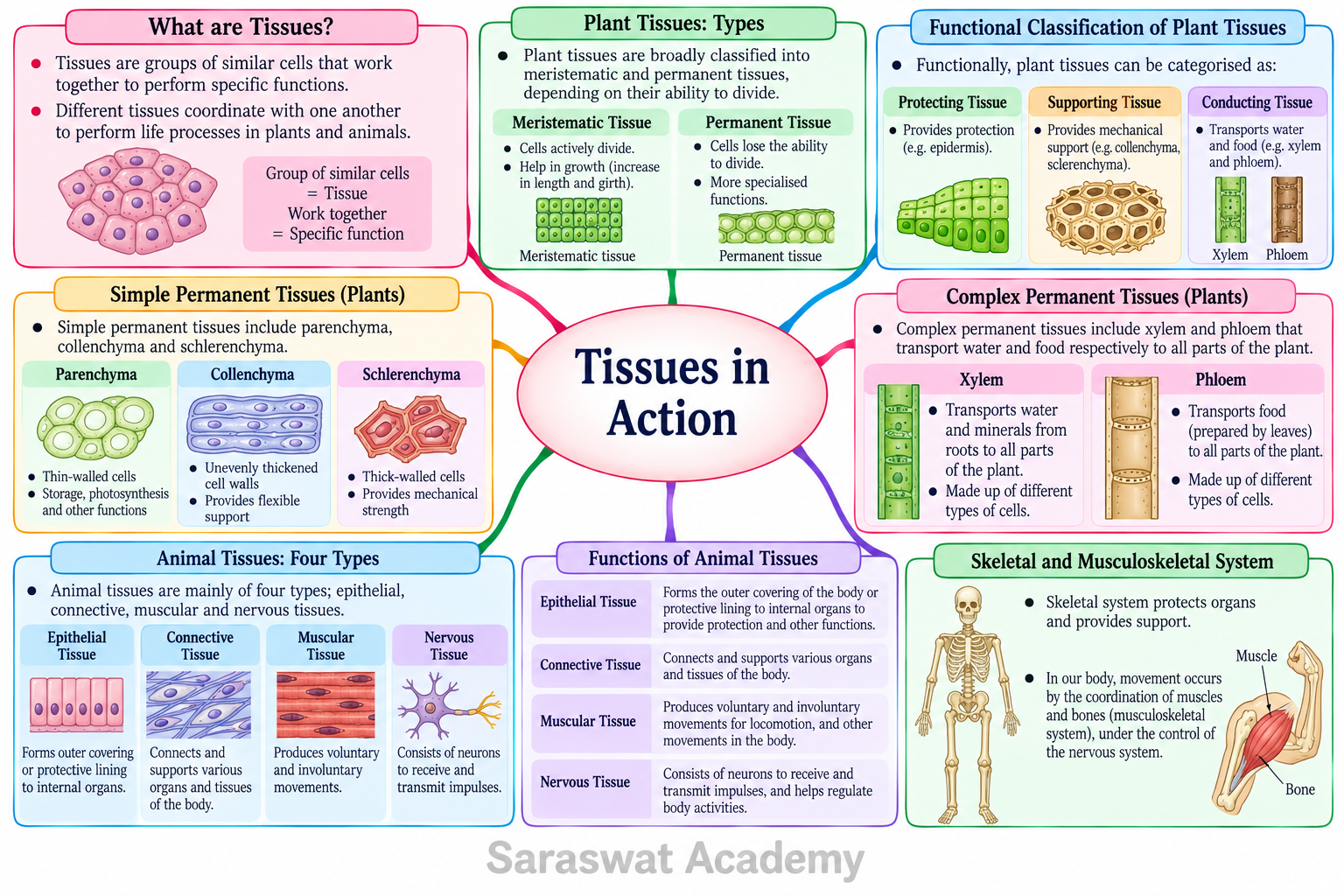
Explore the mind map to revise the main ideas before starting the chapter.
Every multicellular organism begins life as a single cell. As this cell divides repeatedly, millions of new cells are produced. Although all these cells originate from the same cell, they gradually become specialised to perform different functions. Cells with a similar structure and a common function group together to form a tissue. Different tissues combine to form organs, organs work together as organ systems, and organ systems together make a complete organism. This organisation creates an efficient division of labour, enabling plants and animals to perform complex life processes smoothly.
In this chapter, you will explore how tissues are organised in both plants and animals and discover how their structures are perfectly suited to the functions they perform. You will learn why plant tissues differ from animal tissues, how plants increase in length, thickness, and regenerate after being cut, and how specialised tissues provide protection, support, storage, and transportation. The chapter explains the different types of meristematic tissues, permanent tissues, simple and complex tissues, along with the important roles of epidermis, parenchyma, collenchyma, sclerenchyma, xylem, and phloem in maintaining plant life.
The chapter also introduces the major animal tissues and explains how epithelial tissue protects the body, connective tissue provides support and transport, muscular tissue enables movement, and nervous tissue controls coordination and communication. You will understand how bones, muscles, tendons, ligaments, cartilage, and joints work together to form the musculoskeletal system, allowing the human body to move, maintain posture, and protect delicate organs. The different types of joints, including ball-and-socket, hinge, pivot, and fixed joints, are explained through familiar daily-life movements.
The chapter "Tissues in Action" explains how multicellular organisms achieve efficiency through the division of labour. Cells with similar structures and functions group together to form tissues, tissues combine to form organs, organs work together as organ systems, and organ systems together make an organism. The chapter highlights the relationship between the structure of a tissue and the function it performs. It also explains why plant and animal tissues differ and how specialised tissues help in growth, protection, transport, movement, coordination, and survival.
| Concept | Explanation |
|---|---|
| Tissue | A tissue is a group of similar cells that work together to perform a specific function. Tissues improve the efficiency of multicellular organisms through division of labour. |
| Levels of Organisation | Cells → Tissues → Organs → Organ Systems → Organism. Each higher level performs more complex functions. |
| Division of Labour | Different tissues perform specialised functions, making life processes faster, more efficient, and better organised. |
| Plant and Animal Tissues | Plant tissues mainly provide growth, support, protection, food transport, and storage, whereas animal tissues enable movement, coordination, communication, and rapid responses. |
| Meristematic Tissue | Actively dividing tissue responsible for plant growth. It consists of small living cells with thin walls, dense cytoplasm, large nuclei, and almost no vacuoles. |
| Apical Meristem | Located at the tips of roots and shoots. It increases the length of plants by continuous cell division. |
| Lateral Meristem | Found along the sides of stems and roots. It increases the thickness (girth) of plants and forms annual growth rings. |
| Intercalary Meristem | Present near the nodes or at the base of internodes. It helps grasses and similar plants regrow after grazing or cutting. |
| Differentiation | The process by which meristematic cells lose the ability to divide and become specialised permanent tissues. |
| Permanent Tissue | Tissue formed after differentiation. These cells perform specialised functions such as support, storage, protection, and conduction. |
| Simple Permanent Tissues | Made of one type of cell. They include parenchyma, collenchyma, and sclerenchyma. |
| Parenchyma | Living tissue with thin cell walls. It stores food, performs photosynthesis, and provides buoyancy in aquatic plants. |
| Collenchyma | Living tissue with unevenly thickened corners. It provides mechanical support and flexibility to young stems and leaf stalks. |
| Sclerenchyma | Mostly dead tissue with thick lignified walls. It provides hardness, strength, and rigidity to plant parts. |
| Complex Permanent Tissues | Made of more than one type of cell. Xylem and phloem together form the conducting tissues of plants. |
| Xylem | Conducts water and minerals from roots to different parts of the plant and also provides mechanical support. |
| Phloem | Transports food prepared in leaves to all parts of the plant. |
| Plant Tissue Systems | The three tissue systems are Dermal Tissue System, Ground Tissue System, and Vascular Tissue System. |
| Epithelial Tissue | The protective covering of the body and internal organs. It performs protection, absorption, secretion, exchange, and sensory functions. |
| Connective Tissue | Connects, supports, binds, and transports materials within the body. Examples include blood, bone, cartilage, tendons, and ligaments. |
| Blood | A fluid connective tissue consisting of plasma, RBCs, WBCs, and platelets. It transports oxygen, nutrients, hormones, and protects against infections. |
| Bone | A hard connective tissue that supports the body, protects organs, and provides attachment to muscles. |
| Cartilage | A flexible connective tissue that cushions joints and provides flexibility to body parts. |
| Tendon | A strong connective tissue that connects muscles to bones. |
| Ligament | Connects one bone to another and stabilises joints. |
| Muscular Tissue | Responsible for body movements. It includes skeletal muscle, smooth muscle, and cardiac muscle. |
| Skeletal Muscle | Voluntary, striated muscle attached to bones that enables body movement. |
| Smooth Muscle | Involuntary muscle present in organs such as the stomach and intestine. It performs slow internal movements. |
| Cardiac Muscle | Special involuntary muscle found only in the heart. It contracts continuously throughout life. |
| Nervous Tissue | Controls coordination, communication, and responses by transmitting nerve impulses through neurons. |
| Neuron | The structural and functional unit of the nervous system consisting of the cell body, dendrites, and axon. |
| Musculoskeletal System | Made up of bones, muscles, joints, tendons, ligaments, and cartilage. It provides support, movement, posture, and protection. |
| Joint | The point where two or more bones meet, allowing different types of body movements. |
| Types of Joints | Ball-and-Socket Joint, Hinge Joint, Pivot Joint, and Fixed Joint. |
Understanding tissues helps explain how living organisms grow, repair themselves, transport materials, respond to their environment, and perform every life process efficiently. Every specialised tissue contributes to the proper functioning of the entire organism, making tissues one of the most important topics in biology.
The study of tissues is not limited to textbooks. Every tissue in plants and animals performs a specialised function that directly influences our daily life. From the food we eat and the medicines we use to the movement of our body and the growth of plants, tissues play an essential role in maintaining life. Understanding tissues helps scientists, doctors, engineers, farmers, and researchers solve real-world problems and improve the quality of life. The chapter also explains how the relationship between structure and function enables organisms to perform complex activities efficiently.
| Real-Life Application | How This Chapter Helps |
|---|---|
| Modern Medicine | Doctors study epithelial, connective, muscular, and nervous tissues to diagnose diseases, repair damaged organs, and perform surgeries more effectively. |
| Tissue Culture | Plant tissue culture allows scientists to produce thousands of healthy, disease-free plants from a small piece of tissue in a laboratory. |
| Crop Improvement | Knowledge of meristematic tissues helps develop high-yielding, disease-resistant, and fast-growing crop varieties. |
| Forestry and Tree Growth | Annual growth rings formed by lateral meristems help estimate the age of trees and study past climatic conditions. |
| Agriculture | Understanding xylem and phloem helps farmers manage irrigation, fertilizers, and plant health more efficiently. |
| Sports Science | Knowledge of muscles, tendons, ligaments, and joints helps athletes prevent injuries and improve physical performance. |
| Orthopaedic Treatment | Doctors treat bone fractures, ligament tears, cartilage damage, and tendon injuries using the concepts of connective tissues. |
| Physiotherapy | Physiotherapists restore movement by strengthening muscles and improving the function of joints after injuries or surgeries. |
| Blood Transfusion | Understanding the components of blood helps doctors perform safe blood transfusions and treat blood disorders. |
| Wound Healing | Epithelial tissues regenerate damaged skin, while platelets help in blood clotting and wound repair. |
| Organ Transplantation | Knowledge of different tissues helps surgeons replace damaged organs and monitor tissue compatibility. |
| Artificial Skin and Tissue Engineering | Scientists develop artificial skin, cartilage, and other tissues to treat severe burns and tissue damage. |
| Robotics and Prosthetics | The working of muscles, joints, and the nervous system inspires the design of robotic limbs and artificial prosthetic devices. |
| Veterinary Science | Veterinarians use tissue biology to diagnose and treat diseases in domestic and wild animals. |
| Plant Conservation | Rare and endangered plant species can be conserved by propagating them through tissue culture techniques. |
| Biotechnology Research | Scientists study tissues to improve food production, develop medicines, and understand the growth and development of living organisms. |
| Environmental Conservation | Healthy plant tissues improve oxygen production, reduce soil erosion, and maintain ecological balance. |
| Daily Life | Activities such as walking, writing, speaking, breathing, digesting food, and reacting to heat or cold are possible because different tissues work together. |
The study of tissues forms the foundation of biology because every organ and organ system is made up of specialised tissues working together. Whether it is the growth of a tiny seed into a giant tree, the healing of a wound, the beating of the heart, or the movement of our body, tissues make every life process possible. The knowledge gained from this chapter has applications in medicine, agriculture, biotechnology, sports science, environmental conservation, and many other fields that contribute to human welfare.
Revise this chapter in just one minute before your examination. Focus on the keywords, concepts, and functions given below.
| Topic | Quick Revision |
|---|---|
| Tissue | A group of similar cells performing a specific function. |
| Division of Labour | Different tissues perform different functions, increasing efficiency. |
| Levels of Organisation | Cells → Tissues → Organs → Organ Systems → Organism. |
| Meristematic Tissue | Actively dividing tissue responsible for plant growth. |
| Apical Meristem | Increases the length of roots and shoots. |
| Lateral Meristem | Increases the girth (thickness) of stems and roots. |
| Intercalary Meristem | Helps grasses and similar plants regrow after cutting. |
| Differentiation | Process by which meristematic cells become permanent tissues. |
| Simple Permanent Tissues | Parenchyma, Collenchyma and Sclerenchyma. |
| Parenchyma | Living tissue; stores food and performs photosynthesis. |
| Collenchyma | Living tissue; provides flexibility and mechanical support. |
| Sclerenchyma | Dead tissue; provides hardness and strength. |
| Xylem | Transports water and minerals from roots to the rest of the plant. |
| Phloem | Transports prepared food from leaves to all parts of the plant. |
| Plant Tissue Systems | Dermal, Ground and Vascular tissue systems. |
| Epithelial Tissue | Protects body surfaces and performs absorption, secretion and exchange. |
| Connective Tissue | Supports, connects and transports materials in the body. |
| Blood | Fluid connective tissue containing Plasma, RBCs, WBCs and Platelets. |
| Bone | Provides support and protects internal organs. |
| Cartilage | Provides flexibility and cushions joints. |
| Tendon | Connects muscles to bones. |
| Ligament | Connects one bone to another. |
| Muscular Tissue | Skeletal (voluntary), Smooth (involuntary) and Cardiac (heart). |
| Nervous Tissue | Controls coordination through neurons. |
| Neuron | Cell Body + Dendrites + Axon. |
| Musculoskeletal System | Bones, muscles, joints, tendons, ligaments and cartilage work together for movement. |
| Types of Joints | Ball-and-Socket, Hinge, Pivot and Fixed. |
Science is not just about memorising facts—it is about asking questions, observing carefully, experimenting, and discovering answers. Every great scientist began with a simple question: "Why?" or "How?" As you study this chapter, train your mind to think like a scientist. Observe the living world around you, connect classroom concepts with daily life, and never stop being curious.
1. Why do tall trees continue to grow for many years, while most animals stop growing after reaching adulthood?
Hint: Think about the location and activity of growth tissues.
2. Grass grows again after mowing, but a tree branch does not grow back from its cut tip. Why does this happen?
Observe the different types of meristematic tissues.
3. If xylem is made mostly of dead cells, how can it transport water to the top of a tree?
Can dead cells still perform an important function?
4. Why are coconut shells extremely hard while spinach leaves remain soft and flexible?
Which tissues are responsible for these differences?
5. Imagine humans had a rigid cell wall like plants. How would your daily activities such as walking, running, writing, or smiling change?
6. Your heart beats continuously from before birth until the end of life without getting tired. What makes cardiac muscle so special?
7. Why do athletes spend months strengthening muscles, while doctors focus on protecting ligaments and tendons after an injury?
Think about the different roles of these connective tissues.
8. If plants could move from one place to another like animals, how do you think their tissues would be different?
9. Scientists can grow thousands of new plants from a tiny piece of plant tissue in a laboratory. How is this possible?
Connect your answer with meristematic tissues and tissue culture.
10. Nature never wastes anything. Every tissue has a unique structure and a specific job. Can you identify one example from this chapter where the structure of a tissue perfectly matches its function?
For one day, become a "Tissue Detective." Observe the plants, animals, and even your own body around you. Ask yourself:
Write down your observations in a notebook and try to explain them using the concepts of this chapter. Remember, every observation is the beginning of a new discovery.
"The greatest discoveries begin with simple questions. Don't study Biology just to pass an examination—study it to understand how life works. Stay curious, observe carefully, ask meaningful questions, and never be afraid to explore the unknown. Today's curious student can become tomorrow's scientist."
A tissue is a group of similar cells that work together to perform a specific function in a multicellular organism.
Tissues provide division of labour. Different tissues perform specialised functions, making the body more efficient and capable of carrying out complex life processes.
Plants are fixed in one place and require tissues for support, growth, and transport, whereas animals move from place to place and require tissues for movement, coordination, and rapid response.
Meristematic tissues are actively dividing tissues responsible for the growth of plants. They produce new cells throughout the life of a plant.
The three types are Apical Meristem, Lateral Meristem, and Intercalary Meristem.
Differentiation is the process by which meristematic cells become specialised permanent tissues with specific functions.
Simple permanent tissues consist of only one type of cell. They are Parenchyma, Collenchyma, and Sclerenchyma.
Xylem transports water and minerals from the roots to different parts of the plant. It also provides mechanical support.
Phloem transports the food prepared in leaves to all parts of the plant.
The four major animal tissues are Epithelial Tissue, Connective Tissue, Muscular Tissue, and Nervous Tissue.
Blood transports oxygen, nutrients, hormones, and waste materials throughout the body, thereby connecting different organs and tissues.
Tendons connect muscles to bones, whereas ligaments connect one bone to another and help stabilise joints.
The three types are Skeletal Muscles, Smooth Muscles, and Cardiac Muscles.
A neuron is the structural and functional unit of the nervous system. It receives, processes, and transmits nerve impulses throughout the body.
The musculoskeletal system consists of bones, muscles, joints, tendons, ligaments, and cartilage. It provides support, movement, posture, and protection to the body.
The major types of joints are Ball-and-Socket Joint, Hinge Joint, Pivot Joint, and Fixed Joint.
Each tissue has a specialised structure that enables it to perform its function efficiently. This relationship between structure and function is one of the fundamental concepts of biology.
The study of tissues helps in medicine, agriculture, tissue culture, biotechnology, sports science, organ transplantation, wound healing, physiotherapy, and environmental conservation.
Intercalary meristem helps grasses and certain other plants regrow after grazing or cutting.
The most important concept is that structure determines function. Every tissue is specially designed to perform a particular function, and together all tissues ensure the proper growth, survival, movement, and coordination of living organisms.
Continue learning with other Class 9 Exploration chapters.
Explore more NCERT solutions and other resources with Saraswat Academy.
Get chapter-wise mathematics solutions with clear explanations and step-by-step answers.
Explore Solutions →Study important concepts, exercise solutions and chapter-wise mathematics answers.
Explore Solutions →Understand science concepts with detailed answers to textbook questions.
Explore Solutions →Explore chapter-wise science solutions, explanations and useful study resources.
Explore Solutions →Improve your English skills with detailed answers to textbook questions.
Explore Solutions →Improve your English skills with detailed answers to textbook questions.
Explore Resources →Improve your Hindi skills with detailed answers to textbook questions.
Explore Resources →Improve your Hindi skills with detailed answers to textbook questions.
Explore Resources →Improve your Hindi skills with detailed answers to textbook questions.
Explore Resources →Improve your Social Science skills with detailed answers to textbook questions.
Explore Resources →Improve your Social Science skills with detailed answers to textbook questions.
Explore Resources →Improve your Social Science skills with detailed answers to textbook questions.
Explore Resources →Detailed NCERT solutions for class 9 sanskrit.
Explore Resources →