Class 10
NCERT Solutions for Class 10 Mathematics
Get chapter-wise mathematics solutions with clear explanations and step-by-step answers.
Explore Solutions →Get a quick overview of the important concepts in this chapter.
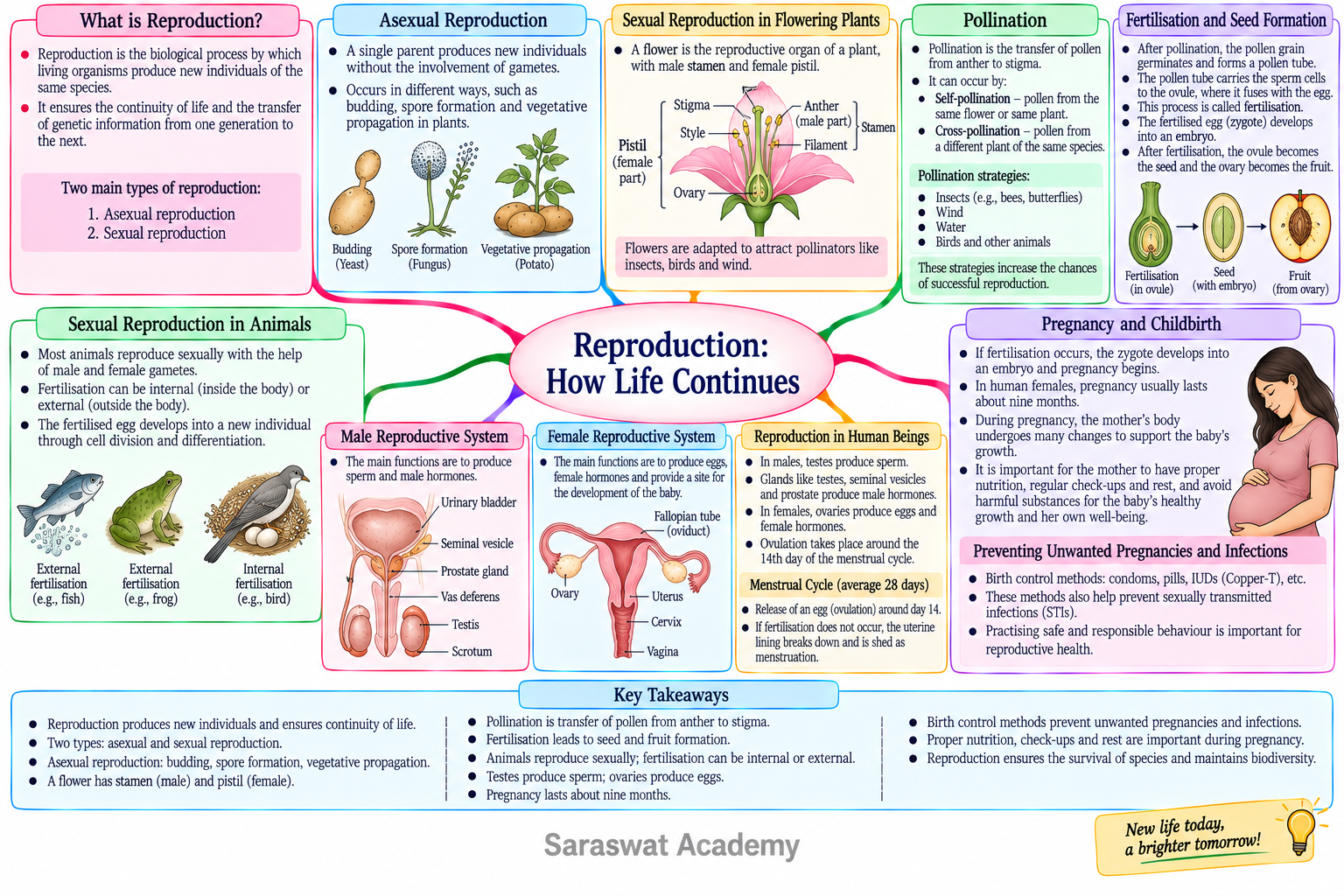
Explore the mind map to revise the main ideas before starting the chapter.
Reproduction is one of the most important characteristics of living organisms because it ensures the continuity of life on Earth. Every organism is born, grows, matures, reproduces, and eventually dies. Although individuals have a limited lifespan, reproduction allows their species to continue from one generation to the next. This chapter explores how different organisms reproduce, the biological significance of reproduction, and how it contributes to variation, adaptation, and evolution.
| 🌟 Main Topic | 📘 What You Will Learn |
|---|---|
| Asexual Reproduction | Understand how a single parent produces genetically identical offspring through methods such as vegetative propagation, budding, and spore formation. Learn how these methods are widely used in agriculture and horticulture. |
| Sexual Reproduction | Explore how two parents contribute genetic material to produce offspring with unique characteristics, creating variation that helps species survive changing environments. |
| Meiosis & Variation | Discover how meiosis forms gametes with half the chromosome number and creates countless genetic combinations, making every individual unique. |
| Reproduction in Flowering Plants | Study the structure of flowers, pollination, fertilisation, seed formation, fruit development, and the important role of pollinators like insects, birds, wind, and water. |
| Reproduction in Animals | Compare external and internal fertilisation, reproductive strategies of different animals, and how they increase the survival of their offspring. |
| Human Reproduction | Learn about the male and female reproductive systems, formation of gametes, fertilisation, embryo development, pregnancy, and birth. |
| Concept | Importance |
|---|---|
| 🧬 Reproduction | Ensures the continuation of every species. |
| 🌿 Variation | Helps organisms adapt to changing environments and supports evolution. |
| 🌸 Pollination | Essential for the formation of fruits and seeds in flowering plants. |
| 👶 Fertilisation | Marks the beginning of a new organism by forming a zygote. |
| 🌾 Agriculture | Vegetative propagation, tissue culture, grafting, and hybridisation improve crop quality and yield. |
| 🧑⚕️ Human Health | Understanding reproduction helps explain growth, puberty, pregnancy, and reproductive health. |
| Field | Application |
|---|---|
| 🌱 Farming | High-yield crops are produced using grafting, tissue culture, and selective breeding. |
| 🍎 Food Production | Pollination by bees and other insects increases fruit and vegetable production. |
| 🧬 Biotechnology | Artificial hybridisation and genetic engineering help develop disease-resistant crop varieties. |
| 🏥 Medicine | Knowledge of human reproduction supports reproductive healthcare and pregnancy management. |
| 🌎 Biodiversity | Genetic variation produced during sexual reproduction helps species survive environmental changes. |
Life continues because living organisms reproduce. This chapter explains how plants, animals, and humans produce new individuals through different reproductive methods. It highlights the importance of reproduction in maintaining species, creating genetic variation, supporting evolution, improving agriculture, and ensuring the survival of life on Earth.
This chapter explains the different methods of reproduction in plants, animals, and humans. It highlights how reproduction ensures the continuity of life, creates genetic variation, and helps organisms survive and adapt to changing environments.
| Concept | Description |
|---|---|
| 🌍 Reproduction | Reproduction is the biological process by which living organisms produce new individuals of their own kind, ensuring the continuity of life. |
| 🌱 Asexual Reproduction | A single parent produces genetically identical offspring (clones) without the formation or fusion of gametes. |
| 🌿 Vegetative Propagation | A type of asexual reproduction in plants where new plants develop from roots, stems, or leaves. Common methods include cutting, grafting, layering, and tissue culture. |
| 🦠 Budding | A new individual develops as a small outgrowth (bud) on the parent organism. It is commonly seen in yeast and hydra. |
| 🍄 Spore Formation | Fungi reproduce by producing millions of lightweight spores that germinate under favourable conditions to form new organisms. |
| 🧬 Mitosis | A type of cell division involved in asexual reproduction that produces genetically identical daughter cells. |
| ❤️ Sexual Reproduction | Two parents contribute male and female gametes, producing offspring that inherit characteristics from both parents. |
| 🔬 Meiosis | A special type of cell division that reduces the chromosome number by half and forms gametes, creating genetic variation. |
| 🧬 Variation | Differences among individuals produced during sexual reproduction. Variation helps organisms adapt and supports evolution. |
| 🌸 Flower as a Reproductive Organ | The flower is the reproductive organ of flowering plants and contains both male and female reproductive parts. |
| 🌼 Parts of a Flower | A complete flower consists of Sepals, Petals, Stamens (male part), and Pistil (female part). |
| 🌾 Pollination | Pollination is the transfer of pollen grains from the anther to the stigma of a flower. |
| 🔄 Self & Cross Pollination | Self-pollination occurs within the same flower or plant, while cross-pollination occurs between flowers of different plants of the same species. |
| 🐝 Pollinating Agents | Wind, water, insects, and birds help transfer pollen between flowers. |
| 🌱 Fertilisation | Fusion of the male gamete and female gamete forms a zygote, which develops into an embryo. |
| 🍎 Fruit and Seed Formation | After fertilisation, the ovary develops into a fruit, while the ovules develop into seeds. |
| 🐟 External Fertilisation | Fusion of gametes occurs outside the body, commonly seen in fish and frogs. |
| 🦎 Internal Fertilisation | Fusion of gametes occurs inside the female body, as seen in reptiles, birds, and mammals. |
| 👶 Human Reproductive System | The male reproductive system produces sperm, while the female reproductive system produces eggs and provides a suitable environment for the development of the embryo. |
| 🤰 Fertilisation in Humans | The sperm fuses with the egg to form a zygote, which develops into an embryo and later into a foetus inside the uterus. |
| 🌎 Importance of Reproduction | Reproduction maintains species, creates variation, supports biodiversity, improves agriculture, and ensures the continuation of life. |
Reproduction
⬇
Asexual & Sexual Reproduction
⬇
Mitosis • Meiosis
⬇
Variation
⬇
Pollination
⬇
Fertilisation
⬇
Zygote → Embryo → Foetus / New Plant
⬇
Continuation of Life
Reproduction is essential for the survival of all living organisms. The concepts learned in this chapter are widely applied in agriculture, horticulture, medicine, animal husbandry, biotechnology, conservation, and everyday life. Understanding reproduction helps improve food production, protect endangered species, and promote better human health.
| Real-Life Application | How It is Applied |
|---|---|
| 🌾 Crop Improvement | Farmers use vegetative propagation, grafting, and tissue culture to produce healthy, disease-free, and high-yield crop varieties. |
| 🍎 Fruit Production | Plants such as mango, apple, orange, and rose are commonly propagated by grafting or budding to maintain desirable characteristics. |
| 🥔 Rapid Plant Multiplication | Potato, ginger, onion, sugarcane, and banana are multiplied quickly through vegetative propagation instead of seeds. |
| 🌸 Pollination in Agriculture | Bees, butterflies, birds, wind, and water help pollinate flowers, increasing the production of fruits, vegetables, and seeds. |
| 🐝 Beekeeping | Honeybees not only produce honey but also improve crop yield by carrying out cross-pollination in flowering plants. |
| 🌱 Tissue Culture | Scientists grow thousands of identical plants in laboratories using tissue culture for agriculture, forestry, and conservation. |
| 🧬 Plant Breeding | Controlled pollination helps develop crop varieties that are disease-resistant, drought-tolerant, and more productive. |
| 🐄 Animal Husbandry | Selective breeding is used to improve the quality of dairy animals, poultry, sheep, goats, and fish for better production. |
| 🏥 Reproductive Healthcare | Knowledge of the human reproductive system helps doctors diagnose diseases, provide maternal care, and ensure healthy pregnancies. |
| 🤰 Pregnancy Care | Understanding fertilisation and embryo development helps monitor the growth and health of both the mother and the baby. |
| 🧪 Biotechnology | Scientists use reproductive biology in cloning, tissue culture, genetic improvement, and the conservation of useful plant varieties. |
| 🌍 Wildlife Conservation | Breeding programmes are used to increase the population of endangered animals and protect biodiversity. |
| 🌳 Forest Conservation | Rare and endangered plant species are multiplied through tissue culture and nursery techniques for reforestation. |
| 🌿 Home Gardening | Gardeners grow new plants from stem cuttings, bulbs, rhizomes, and tubers instead of using seeds. |
| 🍅 Seed Production | Controlled pollination is used to produce high-quality hybrid seeds with improved yield and better disease resistance. |
| 🌎 Biodiversity | Sexual reproduction creates genetic variation, helping species adapt to environmental changes and survive for future generations. |
| 🧬 Scientific Research | Scientists study reproduction to understand genetics, evolution, inheritance, and the development of living organisms. |
| 🏫 Science Education | Knowledge of reproduction helps students understand the life cycles of plants, animals, and humans. |
| Concept | Practical Use |
|---|---|
| Vegetative Propagation | Rapid multiplication of useful crop plants. |
| Grafting & Budding | Production of improved fruit and ornamental plants. |
| Tissue Culture | Large-scale production of disease-free plants. |
| Pollination | Essential for fruit, seed, and crop production. |
| Sexual Reproduction | Produces variation that helps species adapt and evolve. |
| Human Reproduction | Supports reproductive health, pregnancy, and family welfare. |
Every fruit you eat, every crop grown in the field, every flowering plant in a garden, and every new generation of living organisms exists because of the remarkable process of reproduction. It not only ensures the continuation of life but also supports agriculture, medicine, biodiversity, and the sustainable future of our planet.
Revise the complete chapter in just one minute using these important concepts and key facts.
| Topic | Quick Revision |
|---|---|
| 🌍 Reproduction | Reproduction is the process by which living organisms produce new individuals of their own kind. |
| 🌱 Asexual Reproduction | Only one parent is involved and the offspring are genetically identical (clones). |
| ❤️ Sexual Reproduction | Involves two parents and produces offspring with genetic variation. |
| 🧬 Mitosis | Produces genetically identical daughter cells. |
| 🧬 Meiosis | Produces gametes with half the chromosome number. |
| 🌸 Flower | The reproductive organ of flowering plants. |
| 🌾 Pollination | Transfer of pollen grains from the anther to the stigma. |
| 🌱 Fertilisation | Fusion of male and female gametes forms a zygote. |
| 🍎 Fruit & Seed | Ovary → Fruit and Ovule → Seed. |
| 🐟 External Fertilisation | Occurs outside the body, mainly in fish and frogs. |
| 🦅 Internal Fertilisation | Occurs inside the female body in reptiles, birds, and mammals. |
| 👶 Human Reproduction | Fertilisation forms a zygote that develops into an embryo and later a foetus. |
| Concept | Remember |
|---|---|
| Asexual Reproduction | One Parent • No Gametes • Identical Offspring |
| Sexual Reproduction | Two Parents • Gametes • Variation |
| Pollination | Anther → Stigma |
| Fertilisation | Male Gamete + Female Gamete = Zygote |
| Fruit Formation | Ovary → Fruit |
| Seed Formation | Ovule → Seed |
| Cell Division | Mitosis → Growth | Meiosis → Gamete Formation |
Reproduction
⬇
Asexual & Sexual
⬇
Mitosis • Meiosis
⬇
Flower
⬇
Pollination
⬇
Fertilisation
⬇
Zygote
⬇
Embryo
⬇
Foetus / Seed
⬇
New Organism
| Keyword | Remember |
|---|---|
| Reproduction | Continuation of Life |
| Asexual | One Parent |
| Sexual | Two Parents |
| Mitosis | Growth & Identical Cells |
| Meiosis | Gamete Formation |
| Pollination | Anther → Stigma |
| Fertilisation | Fusion of Gametes |
| Zygote | First Cell of New Life |
| Fruit | Develops from Ovary |
| Seed | Develops from Ovule |
Remember this simple sequence:
Reproduction → Asexual & Sexual → Pollination → Fertilisation → Zygote → Embryo → Foetus / Seed → New Life
If you remember this flow, you can confidently answer most conceptual and application-based questions from this chapter.
Scientists do not simply memorize facts—they observe nature, ask questions, perform experiments, and draw conclusions based on evidence. This chapter helps you understand how living organisms reproduce, how new life begins, and why reproduction is essential for the survival of every species. Now, think like a scientist and explore these fascinating biological processes.
| 🔬 | Think Like a Scientist |
|---|---|
| 1 | Why do plants like potato, ginger, and sugarcane reproduce through vegetative propagation instead of producing new plants only from seeds? |
| 2 | Why does sexual reproduction create greater variation among offspring than asexual reproduction? How does this help species survive? |
| 3 | Imagine a world where every organism reproduced only asexually. What advantages and disadvantages would this have for life on Earth? |
| 4 | Why are bees, butterflies, and other pollinating insects considered essential for agriculture and food production? |
| 5 | Observe two flowers in your surroundings. Which flower is more likely to attract insects for pollination? Explain your answer using its colour, fragrance, or nectar. |
| 6 | How does meiosis help maintain the chromosome number of a species generation after generation? |
| 7 | Why do fish and frogs produce a large number of eggs, while birds and mammals produce comparatively fewer offspring? |
| 8 | How would fruit production be affected if pollinating insects suddenly disappeared from the environment? |
| 9 | Why is tissue culture considered an important technique for producing disease-free plants on a large scale? |
| 10 | How does genetic variation produced during sexual reproduction contribute to evolution and biodiversity? |
| Challenge |
|---|
Imagine you are an agricultural scientist developing a new variety of mango.
|
| Question |
|---|
Suppose scientists develop a plant that can survive drought, diseases, and extreme temperatures.
|
"A scientist studies reproduction not only to understand how new life begins but also to improve agriculture, protect biodiversity, conserve endangered species, and ensure a healthier future for all living organisms."
Choose any five plants or animals found around you and prepare a table showing:
Present your observations like a real biologist and explain how reproduction helps maintain the continuity of life.
These frequently asked questions will help you quickly revise the important concepts of Chapter 11: Reproduction – How Life Continues.
| Q.No. | Question | Answer |
|---|---|---|
| 1 | What is reproduction? | Reproduction is the biological process by which living organisms produce new individuals of their own kind. |
| 2 | Why is reproduction important? | It ensures the continuity of species and maintains life on Earth. |
| 3 | What is asexual reproduction? | Asexual reproduction is a type of reproduction in which a single parent produces genetically identical offspring without the fusion of gametes. |
| 4 | What is sexual reproduction? | Sexual reproduction involves the fusion of male and female gametes to produce genetically varied offspring. |
| 5 | What is vegetative propagation? | Vegetative propagation is an asexual method in which new plants grow from roots, stems, or leaves of the parent plant. |
| 6 | Name some methods of vegetative propagation. | Cutting, grafting, layering, tissue culture, bulbs, rhizomes, tubers, and runners. |
| 7 | What is budding? | Budding is a method of asexual reproduction in which a new individual develops as a small outgrowth (bud) on the parent organism. |
| 8 | Which organisms reproduce by budding? | Yeast and Hydra. |
| 9 | What is spore formation? | Spore formation is a method of asexual reproduction in which spores develop into new individuals under favourable conditions. |
| 10 | What is meiosis? | Meiosis is a type of cell division that produces gametes with half the chromosome number. |
| 11 | Why is meiosis important? | It maintains the chromosome number in successive generations and creates genetic variation. |
| 12 | What is variation? | Variation refers to the differences among individuals of the same species. |
| 13 | What is pollination? | Pollination is the transfer of pollen grains from the anther to the stigma of a flower. |
| 14 | What are the two types of pollination? | Self-pollination and cross-pollination. |
| 15 | What is fertilisation? | Fertilisation is the fusion of the male and female gametes to form a zygote. |
| 16 | What develops into a fruit and a seed after fertilisation? | The ovary develops into a fruit, while the ovule develops into a seed. |
| 17 | What is external fertilisation? | External fertilisation is the fusion of gametes outside the body, as seen in fish and frogs. |
| 18 | What is internal fertilisation? | Internal fertilisation is the fusion of gametes inside the female body, as seen in reptiles, birds, and mammals. |
| 19 | Where does fertilisation occur in humans? | Fertilisation occurs inside the female reproductive tract, where the sperm fuses with the egg to form a zygote. |
| 20 | What is a zygote? | A zygote is the first cell formed after the fusion of male and female gametes. |
| 21 | What is an embryo? | An embryo is the early stage of development formed from the zygote. |
| 22 | Why is sexual reproduction advantageous? | It produces genetic variation, which helps organisms adapt to changing environments and supports evolution. |
| 23 | How does tissue culture benefit agriculture? | It helps produce large numbers of disease-free and genetically identical plants in a short time. |
| 24 | Why are pollinating insects important? | They help transfer pollen between flowers, increasing fruit, seed, and crop production. |
| 25 | Why is this chapter important? | This chapter explains how life continues through reproduction and provides the foundation for understanding genetics, heredity, evolution, agriculture, biotechnology, and reproductive health. |
Remember this sequence:
Reproduction → Asexual & Sexual Reproduction → Pollination → Fertilisation → Zygote → Embryo → Foetus / Seed → New Life
If you understand this flow, you can confidently answer most conceptual and application-based questions from this chapter.
Continue learning with other Class 9 Exploration chapters.
Explore more NCERT solutions and other resources with Saraswat Academy.
Get chapter-wise mathematics solutions with clear explanations and step-by-step answers.
Explore Solutions →Study important concepts, exercise solutions and chapter-wise mathematics answers.
Explore Solutions →Understand science concepts with detailed answers to textbook questions.
Explore Solutions →Explore chapter-wise science solutions, explanations and useful study resources.
Explore Solutions →Improve your English skills with detailed answers to textbook questions.
Explore Solutions →Improve your English skills with detailed answers to textbook questions.
Explore Resources →Improve your Hindi skills with detailed answers to textbook questions.
Explore Resources →Improve your Hindi skills with detailed answers to textbook questions.
Explore Resources →Improve your Hindi skills with detailed answers to textbook questions.
Explore Resources →Improve your Social Science skills with detailed answers to textbook questions.
Explore Resources →Improve your Social Science skills with detailed answers to textbook questions.
Explore Resources →Improve your Social Science skills with detailed answers to textbook questions.
Explore Resources →Detailed NCERT solutions for class 9 sanskrit.
Explore Resources →