Class 10
NCERT Solutions for Class 10 Mathematics
Get chapter-wise mathematics solutions with clear explanations and step-by-step answers.
Explore Solutions →Get a quick overview of the important concepts in this chapter.
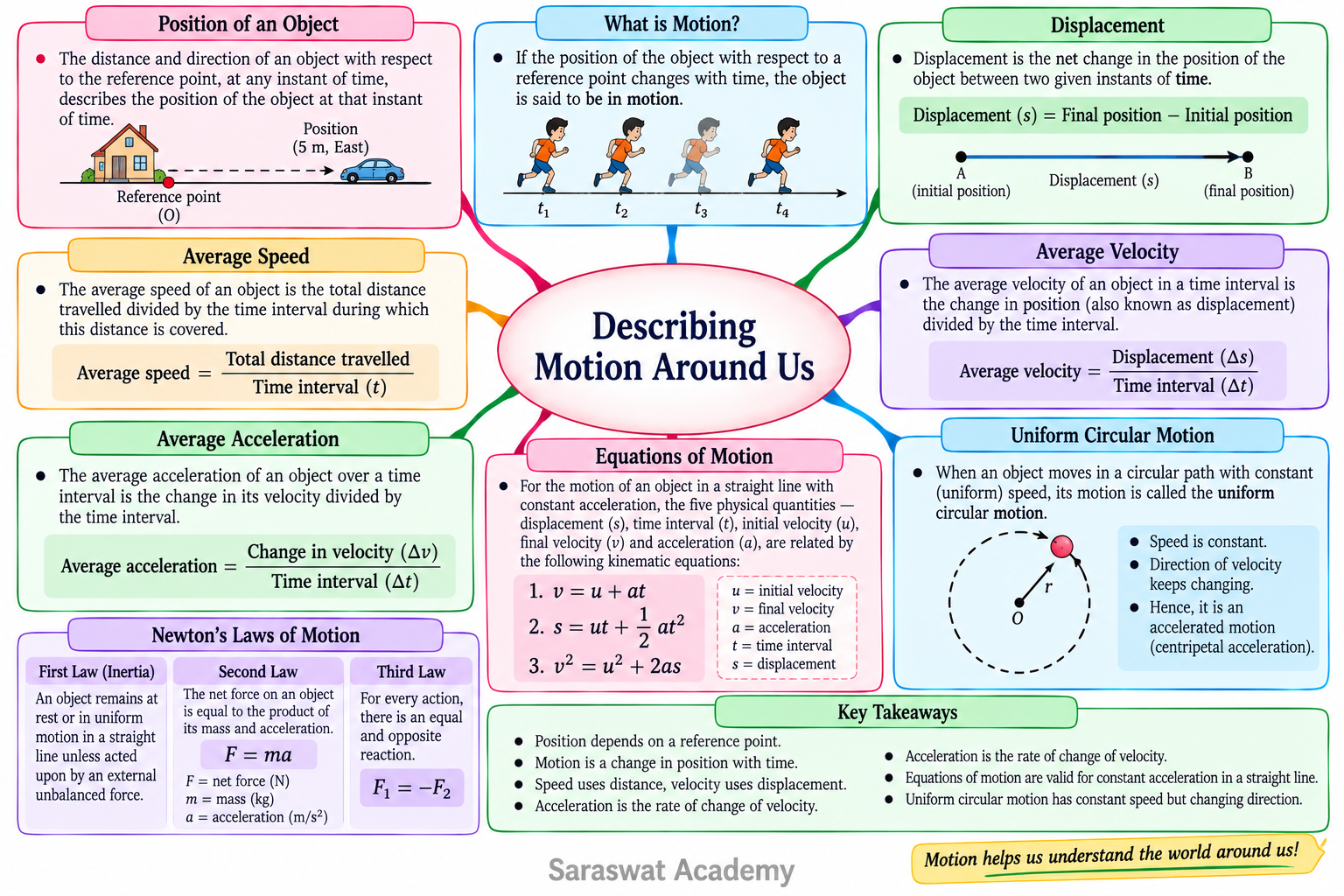
Explore the mind map to revise the main ideas before starting the chapter.
| Chapter Name | Chapter 4 – Describing Motion Around Us |
|---|---|
| Subject | Science (Physics) |
| Main Theme | Understanding how objects move and how motion can be measured, described, analysed, and represented using physical quantities, equations, and graphs. |
| Why This Chapter Matters | Motion is present everywhere in our surroundings—from walking humans and moving vehicles to flying birds, rotating planets, and satellites orbiting the Earth. This chapter helps us understand these motions scientifically and prepares us for advanced concepts in Physics. |
Everything around us is constantly moving. A football rolling across the ground, a train travelling on railway tracks, a child running in a playground, the Earth revolving around the Sun, and even tiny dust particles floating in air are all examples of motion. Scientists study these movements to understand how fast objects move, how their positions change, and why their motion changes with time. This chapter introduces the fascinating science behind everyday motion and teaches us how to describe it using scientific methods rather than simple observations.
The journey begins with motion in a straight line, the simplest form of motion. You will learn how to describe an object's position using a reference point, distinguish between distance and displacement, and understand why these two quantities are not always the same. The chapter further explains average speed, average velocity, and average acceleration, helping students understand how quickly an object moves and how its velocity changes over time.
One of the most interesting parts of this chapter is learning how graphs can describe motion. Instead of reading long tables of data, position-time graphs and velocity-time graphs allow us to understand the motion of an object at a glance. You will discover how the slope of a graph provides valuable information about velocity and acceleration, making graphs one of the most powerful tools used by scientists and engineers.
The chapter also introduces uniform circular motion, where an object moves in a circular path at a constant speed. Although the speed remains constant, the direction changes continuously, causing acceleration even without a change in speed. This concept helps explain the motion of satellites, ceiling fans, Ferris wheels, and planets.
| Concept | What You Will Understand |
|---|---|
| Motion | How to identify whether an object is moving or at rest using a reference point. |
| Position | How the location of an object is described with respect to an origin. |
| Distance & Displacement | The difference between the actual path travelled and the shortest path between two positions. |
| Average Speed | How fast an object covers the total distance travelled. |
| Average Velocity | The rate of change of displacement along with direction. |
| Average Acceleration | How rapidly the velocity of an object changes with time. |
| Graphs of Motion | How to interpret position-time and velocity-time graphs. |
| Uniform & Non-uniform Motion | Difference between constant and changing motion. |
| Uniform Circular Motion | Motion along a circular path with constant speed but continuously changing direction. |
| Scientific Skill | Importance |
|---|---|
| Observation | Recognising different types of motion around you. |
| Measurement | Calculating distance, displacement, speed, velocity, and acceleration accurately. |
| Data Interpretation | Reading and analysing graphs effectively. |
| Logical Reasoning | Comparing different types of motion and solving numerical problems. |
| Scientific Thinking | Connecting classroom concepts with real-life situations. |
After completing this chapter, you will be able to describe different kinds of motion, calculate important physical quantities such as distance, displacement, speed, velocity, and acceleration, analyse graphical representations of motion, and explain many real-life phenomena using the laws of motion. These concepts form the foundation for studying mechanics in higher classes and are essential for engineering, astronomy, transportation, robotics, sports science, and many other scientific fields.
This chapter introduces the scientific study of motion—one of the most common phenomena in nature. It explains how to describe motion using physical quantities such as position, distance, displacement, speed, velocity, and acceleration. It also teaches how graphs can be used to analyse motion and introduces uniform circular motion, where an object moves with constant speed but continuously changes its direction. Understanding these concepts helps explain the movement of vehicles, athletes, planets, satellites, and countless other objects around us.
| Concept | Explanation |
|---|---|
| Motion | Motion is the change in the position of an object with respect to a reference point as time passes. If an object's position changes with time, it is said to be in motion. |
| Rest | An object is said to be at rest when its position does not change with time relative to the chosen reference point. |
| Reference Point | A fixed point chosen to describe the position or motion of an object. Every measurement of motion depends upon a suitable reference point. |
| Position | The location of an object with respect to a reference point. In straight-line motion, both distance and direction are used to describe position. |
| Linear (Straight-Line) Motion | Motion in which an object moves along a straight path. It is the simplest type of motion studied in Physics. |
| Distance Travelled | The total length of the actual path travelled by an object, irrespective of direction. Distance is always positive and is a scalar quantity. |
| Displacement | The shortest straight-line distance between the initial and final positions of an object, along with its direction. Displacement is a vector quantity. |
| Magnitude | The numerical value of a physical quantity along with its unit. Vector quantities require both magnitude and direction. |
| Scalar Quantity | A physical quantity that has only magnitude and no direction, such as distance and speed. |
| Vector Quantity | A physical quantity that has both magnitude and direction, such as displacement, velocity, and acceleration. |
| Average Speed | The total distance travelled divided by the total time taken. It tells how fast an object moves without considering direction. |
| Uniform Motion | An object is in uniform motion when it covers equal distances in equal intervals of time. |
| Non-uniform Motion | An object is in non-uniform motion when it covers unequal distances in equal intervals of time or its speed changes continuously. |
| Average Velocity | The displacement divided by the corresponding time interval. It describes both the speed and direction of motion. |
| Velocity | The rate of change of position with time. Velocity always has both magnitude and direction. |
| Rate of Change | The amount by which one physical quantity changes with respect to another quantity, usually time. |
| Average Acceleration | The change in velocity divided by the time taken for that change. It measures how quickly velocity changes. |
| Positive Acceleration | Acceleration in the direction of motion that increases the magnitude of velocity. |
| Negative Acceleration (Retardation) | Acceleration opposite to the direction of motion that decreases the magnitude of velocity. |
| Constant Acceleration | When velocity changes by equal amounts in equal intervals of time, the acceleration remains constant. |
| Acceleration Due to Gravity (g) | The constant acceleration experienced by a freely falling object due to Earth's gravitational force. |
| Graphical Representation of Motion | Motion can be represented visually using graphs, making it easier to compare, analyse, and interpret different types of motion. |
| Position-Time Graph | A graph showing how the position of an object changes with time. |
| Straight Position-Time Graph | A straight line indicates constant velocity or uniform motion. |
| Curved Position-Time Graph | A curved graph indicates changing velocity, meaning the object is accelerating. |
| Slope of Position-Time Graph | The slope of a position-time graph gives the velocity of the object. |
| Velocity-Time Graph | A graph that shows how velocity changes with time. |
| Slope of Velocity-Time Graph | The slope of a velocity-time graph represents the acceleration of the object. |
| Area Under Velocity-Time Graph | The area enclosed between the graph and the time axis represents the displacement of the object. |
| Uniform Circular Motion | Motion along a circular path with constant speed. Although the speed remains constant, the direction changes continuously, so the object is accelerating. |
| Centripetal Acceleration | In uniform circular motion, acceleration is always directed towards the centre of the circular path because the direction of velocity keeps changing. |
| SI Units |
Distance & Displacement → metre (m) Time → second (s) Speed & Velocity → metre per second (m/s) Acceleration → metre per second squared (m/s²) |
| Quantity | Relationship |
|---|---|
| Average Speed | Total Distance Travelled ÷ Total Time |
| Average Velocity | Displacement ÷ Time Interval |
| Average Acceleration | Change in Velocity ÷ Time Interval |
| Position-Time Graph | Slope gives Velocity |
| Velocity-Time Graph | Slope gives Acceleration |
| Velocity-Time Graph | Area under the graph gives Displacement |
Motion is an essential part of our daily lives. Every moving object, from a walking person to a satellite orbiting the Earth, follows the principles discussed in this chapter. By understanding concepts such as distance, displacement, speed, velocity, acceleration, graphs of motion, and uniform circular motion, scientists and engineers develop safer transportation systems, faster communication networks, efficient sports techniques, and advanced space technologies. This chapter demonstrates that Physics is not limited to classrooms—it explains almost every movement we observe around us.
| Real-Life Application | How This Chapter Helps |
|---|---|
| Road Transportation | Drivers, traffic police, and engineers use concepts of speed, velocity, and acceleration to ensure safe driving, maintain speed limits, and reduce accidents. |
| GPS Navigation | Navigation systems calculate distance, displacement, speed, and estimated travel time to guide people along the shortest and fastest routes. |
| Railway Systems | Railway engineers use speed and acceleration calculations to schedule trains, maintain safe distances, and improve passenger safety. |
| Aviation | Pilots monitor velocity, acceleration, and displacement during take-off, flight, and landing to ensure safe and efficient air travel. |
| Space Exploration | Scientists calculate the motion of rockets, satellites, and spacecraft using concepts of velocity, acceleration, and circular motion. |
| Satellite Communication | Communication satellites move in nearly circular paths around Earth. Understanding uniform circular motion helps maintain stable communication networks. |
| Sports Science | Coaches analyse the speed, acceleration, and movement of athletes to improve performance in running, cycling, swimming, football, cricket, and other sports. |
| Automobile Industry | Car manufacturers study acceleration and braking performance to design safer, more fuel-efficient vehicles. |
| Traffic Management | Traffic signals and intelligent transportation systems are designed using vehicle speed and traffic flow analysis. |
| Roller Coasters | Engineers calculate speed, acceleration, and circular motion to design thrilling yet safe amusement park rides. |
| Medical Science | Motion sensors in medical equipment monitor patient movements, rehabilitation exercises, and walking patterns. |
| Robotics | Robots use motion calculations to move accurately, avoid obstacles, and perform complex industrial and medical tasks. |
| Computer Animation | Game developers and animation studios use mathematical models of motion to create realistic movement of characters and objects. |
| Weather Satellites | Meteorologists track the motion of satellites to observe weather systems, storms, and climate changes. |
| Delivery Drones | Drones calculate speed, direction, and displacement to deliver medicines, food, and essential goods accurately. |
| Maritime Navigation | Ships and submarines use velocity and displacement to determine their routes across oceans safely. |
| Construction Engineering | Cranes, elevators, and lifting machines are designed by analysing the motion and acceleration of heavy loads. |
| Scientific Research | Researchers study the motion of particles, planets, animals, and machines to make new scientific discoveries. |
| Everyday Life | Walking, running, cycling, driving, throwing a ball, riding a bicycle, using elevators, and travelling by bus or train all involve the concepts of motion. |
Look around and observe the motion in your surroundings. Try to identify the scientific concept involved in each situation.
| Daily Observation | Concept Involved |
|---|---|
| A car moving on a highway | Speed and Velocity |
| A runner speeding up during a race | Acceleration |
| A train moving at constant speed | Uniform Motion |
| A child riding a merry-go-round | Uniform Circular Motion |
| A satellite orbiting the Earth | Circular Motion and Continuous Change in Direction |
| Google Maps estimating arrival time | Distance, Speed, and Time |
| A cyclist applying brakes | Negative Acceleration (Retardation) |
| A position-time graph in a science experiment | Graphical Representation of Motion |
The concepts learned in this chapter form the foundation of Physics and are used extensively in transportation, engineering, sports, aviation, robotics, medicine, space science, and modern technology. Understanding motion enables us to describe, measure, predict, and improve the movement of objects, making everyday life safer, faster, and more efficient.
Need a quick recap before your class test or examination? Spend just one minute reading this section to revise the complete chapter. It covers all the important definitions, concepts, formulas, graph interpretations, and key facts from Chapter 4 – Describing Motion Around Us.
| Concept | Quick Revision |
|---|---|
| Motion | Motion is the change in the position of an object with respect to a reference point over time. |
| Rest | An object is at rest if its position does not change with time. |
| Reference Point | A fixed point used to describe the position of an object. |
| Linear Motion | Motion along a straight line. |
| Distance | Total length of the actual path travelled. It is a scalar quantity. |
| Displacement | Shortest straight-line distance between the initial and final positions along with direction. It is a vector quantity. |
| Distance vs Displacement | Distance depends on the actual path travelled, whereas displacement depends only on the initial and final positions. |
| Average Speed | Total Distance Travelled ÷ Total Time Taken. |
| Average Velocity | Displacement ÷ Time Interval. |
| Uniform Motion | Equal distances are covered in equal intervals of time. |
| Non-uniform Motion | Unequal distances are covered in equal intervals of time. |
| Average Acceleration | Change in Velocity ÷ Time Interval. |
| Positive Acceleration | Velocity increases with time. |
| Negative Acceleration | Velocity decreases with time (Retardation). |
| Constant Acceleration | Velocity changes by equal amounts in equal intervals of time. |
| Position-Time Graph | Shows how the position of an object changes with time. |
| Straight Position-Time Graph | Represents constant velocity. |
| Curved Position-Time Graph | Represents changing velocity (accelerated motion). |
| Slope of Position-Time Graph | Gives the velocity of the object. |
| Velocity-Time Graph | Shows how velocity changes with time. |
| Slope of Velocity-Time Graph | Represents acceleration. |
| Area Under Velocity-Time Graph | Represents displacement. |
| Uniform Circular Motion | Motion along a circular path with constant speed but continuously changing direction. |
| Centripetal Acceleration | Acceleration is always directed towards the centre of the circular path. |
| Acceleration due to Gravity | Freely falling objects accelerate due to Earth's gravity (g). |
| SI Units |
Distance/Displacement → metre (m) Time → second (s) Speed/Velocity → metre per second (m/s) Acceleration → metre per second squared (m/s²) |
| Physical Quantity | Formula |
|---|---|
| Average Speed | Total Distance Travelled ÷ Total Time |
| Average Velocity | Displacement ÷ Time Interval |
| Average Acceleration | Change in Velocity ÷ Time Interval |
| Position-Time Graph | Slope = Velocity |
| Velocity-Time Graph | Slope = Acceleration |
| Velocity-Time Graph | Area Under Graph = Displacement |
Revise these topics before entering the examination hall:
Motion → Position → Distance → Displacement → Speed → Velocity → Acceleration → Graphs → Uniform Circular Motion
If you remember this sequence, you have revised the entire chapter in one minute!
Science is much more than learning formulas and solving numerical problems. It begins with observing the world, asking meaningful questions, and finding logical explanations. Every moving object around you—from a falling leaf and a speeding train to a spinning fan and the Earth revolving around the Sun—follows the laws of motion. As you study this chapter, don't just remember the definitions. Train your mind to observe, analyse, predict, and think like a real scientist.
1. Why does a passenger suddenly move forward when a moving bus stops abruptly?
Think about how the body's motion changes and what happens to its velocity.
2. Two students walk from school to home using different roads but reach the same destination. Will their distance travelled and displacement always be the same? Why?
Compare the actual path with the shortest path.
3. Why does Google Maps sometimes suggest a shorter route but a different route takes less time?
Think about the relationship between distance, speed, and travel time.
4. A car is moving at a constant speed around a circular track. Is it accelerating even though its speed is not changing?
Focus on the direction of motion rather than only the speed.
5. Why do astronauts and satellites keep moving around the Earth instead of falling straight down?
Relate this to circular motion and continuous change in direction.
6. Imagine there were no friction between the tyres and the road. Would a car be able to stop safely by applying brakes?
Think about motion, acceleration, and safety.
7. Why do Formula One racing cars take wide curved turns instead of making sharp turns?
Consider speed, circular motion, and control of the vehicle.
8. If the Earth suddenly stopped rotating, what changes would you observe in your daily life?
Think beyond the classroom and connect motion with nature.
9. Why is it important for engineers to study graphs of motion instead of simply looking at numbers?
How can graphs help us understand motion more easily?
10. Can two vehicles have the same speed but different velocities? Can they have the same velocity but different speeds? Explain your reasoning.
Become a "Motion Detective" for one day. Observe at least five moving objects around you and answer the following questions for each one:
Record your observations in a notebook. You will begin to see that Physics is happening everywhere around you.
Choose a bicycle, toy car, or rolling ball and perform this simple investigation:
This is exactly how scientists collect data before drawing conclusions.
| Question | Think Before You Answer |
|---|---|
| Can an object have zero displacement but still travel a long distance? | Imagine completing one full lap on a circular track. |
| Can an object move with constant speed but changing velocity? | Think about a satellite or a ceiling fan. |
| Can an object have zero acceleration while moving? | Consider a vehicle travelling at constant velocity in a straight line. |
| Can acceleration exist even when speed remains constant? | Focus on the change in direction. |
| Why do scientists prefer graphs instead of long tables of data? | Think about how quickly graphs reveal patterns. |
"The greatest scientific discoveries begin with a simple observation. Never stop asking 'Why?', 'How?', or 'What if?'. Every graph you draw, every measurement you take, and every question you ask brings you one step closer to thinking like a scientist. Curiosity is the engine of discovery, and observation is its first step."
Motion is the change in the position of an object with respect to a reference point as time passes.
A reference point is a fixed point used to describe the position or motion of an object. Motion can only be described relative to a reference point.
Linear motion, also called straight-line motion, is the motion of an object along a straight path.
Distance is the total length of the actual path travelled by an object, whereas displacement is the shortest straight-line distance between the initial and final positions along with direction.
Yes. They are equal when an object moves in a straight line without changing its direction.
Yes. If an object returns to its starting point, its displacement becomes zero while the distance travelled remains positive.
Average speed is the total distance travelled divided by the total time taken.
Average velocity is the displacement divided by the corresponding time interval. It has both magnitude and direction.
Speed is a scalar quantity and depends on distance travelled, whereas velocity is a vector quantity and depends on displacement.
Uniform motion is the motion in which an object covers equal distances in equal intervals of time.
Non-uniform motion is the motion in which an object covers unequal distances in equal intervals of time or its velocity changes with time.
Average acceleration is the change in velocity divided by the corresponding time interval.
Positive acceleration means the velocity of an object increases with time in the direction of motion.
Negative acceleration or retardation occurs when the velocity of an object decreases with time because the acceleration acts opposite to the direction of motion.
Acceleration due to gravity (g) is the constant acceleration experienced by a freely falling object due to Earth's gravitational force.
A position-time graph shows how the position of an object changes with time.
The slope of a position-time graph represents the velocity of the object.
A straight position-time graph indicates that the object is moving with constant velocity.
A curved position-time graph indicates that the velocity of the object is changing, which means the object is accelerating.
The slope of a velocity-time graph represents the acceleration of the object.
The area enclosed between the velocity-time graph and the time axis represents the displacement of the object.
Uniform circular motion is the motion of an object along a circular path with constant speed. Although the speed remains constant, the direction changes continuously.
Because its direction of motion changes continuously, its velocity changes even though its speed remains constant.
Distance and Displacement → metre (m)
Time → second (s)
Speed and Velocity → metre per second (m/s)
Acceleration → metre per second squared (m/s²)
This chapter provides the foundation for understanding mechanics. The concepts of motion, speed, velocity, acceleration, and graphical representation are widely used in transportation, engineering, sports, astronomy, robotics, and many other fields of science and technology.
Continue learning with other Class 9 Exploration chapters.
Explore more NCERT solutions and other resources with Saraswat Academy.
Get chapter-wise mathematics solutions with clear explanations and step-by-step answers.
Explore Solutions →Study important concepts, exercise solutions and chapter-wise mathematics answers.
Explore Solutions →Understand science concepts with detailed answers to textbook questions.
Explore Solutions →Explore chapter-wise science solutions, explanations and useful study resources.
Explore Solutions →Improve your English skills with detailed answers to textbook questions.
Explore Solutions →Improve your English skills with detailed answers to textbook questions.
Explore Resources →Improve your Hindi skills with detailed answers to textbook questions.
Explore Resources →Improve your Hindi skills with detailed answers to textbook questions.
Explore Resources →Improve your Hindi skills with detailed answers to textbook questions.
Explore Resources →Improve your Social Science skills with detailed answers to textbook questions.
Explore Resources →Improve your Social Science skills with detailed answers to textbook questions.
Explore Resources →Improve your Social Science skills with detailed answers to textbook questions.
Explore Resources →Detailed NCERT solutions for class 9 sanskrit.
Explore Resources →