Class 10
NCERT Solutions for Class 10 Mathematics
Get chapter-wise mathematics solutions with clear explanations and step-by-step answers.
Explore Solutions →Get a quick overview of the important concepts in this chapter.
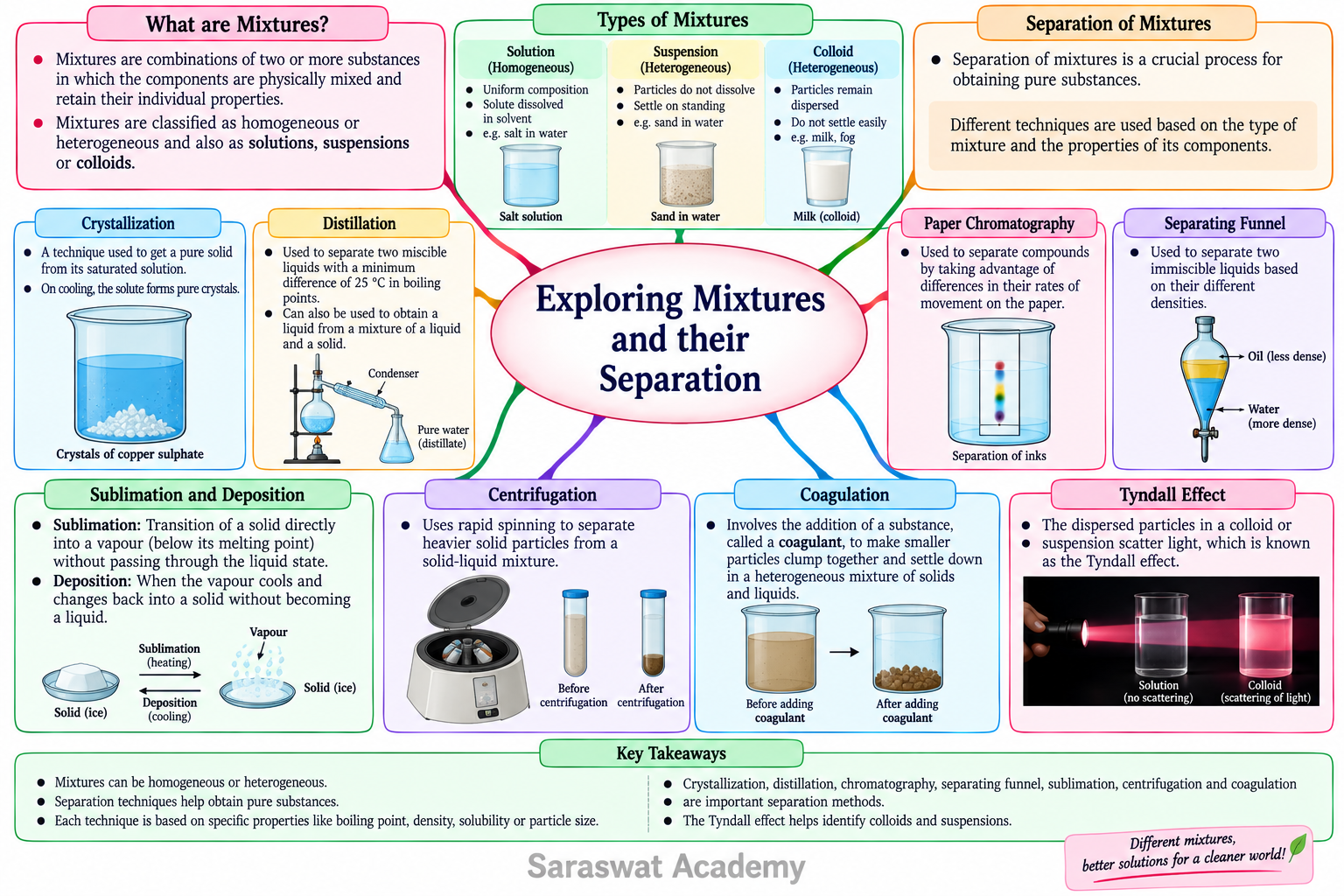
Explore the mind map to revise the main ideas before starting the chapter.
Have you ever wondered how sugar crystals are separated from sugarcane juice, how clean drinking water is prepared from muddy water, or how perfumes are extracted from flowers? Every day, we come across mixtures, and separating their components is an essential part of science, industry, medicine, agriculture, and our daily lives. This chapter takes you on an exciting journey to understand different types of mixtures and the scientific techniques used to separate them.
| What You Will Learn | Why It Matters |
|---|---|
| Classification of Mixtures | Understand the difference between homogeneous and heterogeneous mixtures by observing how substances behave when mixed together. |
| Solutions and Concentration | Learn about solutes, solvents, concentration, and different ways of expressing concentration such as % m/m, % m/v and % v/v. |
| Solubility | Explore how temperature affects the amount of substance that can dissolve and how solubility helps in separating mixtures. |
| Methods of Separation | Study scientific techniques such as crystallization, distillation, paper chromatography, filtration, centrifugation, sublimation, decantation, separating funnel, coagulation and magnetic separation. |
| Real-Life Applications | Discover how these techniques are used in hospitals, laboratories, industries, petroleum refineries, food processing, perfume making and water purification. |
| Journey Through the Chapter | |
|---|---|
| Step 1 | Identify different kinds of mixtures and understand why some appear uniform while others do not. |
| Step 2 | Learn how solutions are formed and why the correct concentration is important in medicines, agriculture and everyday life. |
| Step 3 | Understand solubility and study how temperature influences the amount of solute that dissolves. |
| Step 4 | Explore scientific methods used to separate homogeneous mixtures such as crystallization, distillation and paper chromatography. |
| Step 5 | Study techniques used for separating heterogeneous mixtures including separating funnels, sublimation, centrifugation, coagulation, filtration and magnetic separation. |
| Step 6 | Connect these concepts with real-world applications in healthcare, environmental science, food technology, forensic science and chemical industries. |
The science of separating mixtures is one of the most practical branches of chemistry. From preparing safe medicines and clean drinking water to manufacturing sugar, petroleum products, perfumes, and food items, separation techniques are used everywhere. Scientists, doctors, engineers, pharmacists, environmentalists, forensic experts and food technologists rely on these methods every day to obtain pure substances and analyse unknown samples.
| Everyday Situation | Scientific Concept |
|---|---|
| Making tea | Filtration separates tea leaves from the liquid. |
| Preparing ORS | Correct concentration of solutes is essential for effective rehydration. |
| Obtaining salt from seawater | Evaporation and crystallization produce salt crystals. |
| Purifying drinking water | Sedimentation, filtration, coagulation and centrifugation remove impurities. |
| Separating perfume from flowers | Distillation extracts fragrant compounds. |
| Separating colours in ink | Paper chromatography separates different pigments. |
| Petroleum refinery | Fractional distillation separates crude oil into useful fuels. |
After completing this chapter, you will be able to identify different kinds of mixtures, explain the concepts of solution, concentration and solubility, choose suitable methods for separating various mixtures, understand how these techniques work in laboratories and industries, and appreciate the role of chemistry in improving everyday life. Most importantly, you will begin to observe the world around you like a scientist—finding science in a glass of milk, a cup of tea, a bottle of perfume, a packet of salt, and even a drop of muddy water.
This chapter introduces the science of mixtures and explains how their components can be separated using different physical methods. You will learn how mixtures are classified, how solutions are formed, how concentration and solubility are measured, and why different separation techniques are chosen for different kinds of mixtures. These concepts form the foundation of analytical chemistry and have numerous applications in medicine, food processing, environmental science, agriculture and industry.
| Concept | Explanation |
|---|---|
| Mixture | A mixture is formed when two or more substances are combined physically without undergoing any chemical change. Each component retains its own properties. |
| Homogeneous Mixture | A mixture having a uniform composition throughout. Its components cannot be distinguished by the naked eye. It is also called a solution. |
| Heterogeneous Mixture | A mixture in which the composition is not uniform. The different components remain distinguishable. |
| Solution | A homogeneous mixture formed when one substance dissolves completely in another. |
| Solute | The substance that dissolves in a solvent to form a solution. |
| Solvent | The substance that dissolves the solute and is usually present in a larger quantity. |
| Concentration of a Solution | The amount of solute present in a given quantity of solvent or solution. |
| Mass by Mass Percentage (% m/m) | The mass of solute present in 100 g of the solution. |
| Mass by Volume Percentage (% m/v) | The mass of solute present in 100 mL of the solution. |
| Volume by Volume Percentage (% v/v) | The volume of solute present in 100 mL of the solution. |
| Solubility | The maximum amount of a solute that can dissolve in a fixed quantity of solvent at a given temperature. |
| Saturated Solution | A solution that cannot dissolve any more solute at a particular temperature. |
| Solubility Curve | A graph showing how the solubility of a substance changes with temperature. |
| Crystallization | A method of obtaining pure crystals from a saturated solution by cooling or evaporation. It is widely used for purification of solids. |
| Crystal | A solid whose particles are arranged in a regular geometric pattern. |
| Distillation | A separation technique based on differences in boiling points. It separates miscible liquids or recovers a solvent from a solution. |
| Fractional Distillation | A method used to separate liquids having small differences in their boiling points, such as petroleum fractions. |
| Paper Chromatography | A technique used to separate coloured substances or other components based on their movement through paper with a solvent. |
| Immiscible Liquids | Liquids that do not mix with each other and form separate layers, such as oil and water. |
| Separating Funnel | A laboratory apparatus used to separate two immiscible liquids based on their densities. |
| Sublimation | The direct conversion of a solid into vapour without passing through the liquid state. |
| Deposition | The direct conversion of vapour into solid without becoming a liquid. |
| Alloy | A homogeneous mixture of two or more metals, or a metal with a non-metal, prepared by melting and mixing the components. |
| Suspension | A heterogeneous mixture in which insoluble particles remain dispersed in a liquid and can settle on standing. |
| Centrifugation | A method of separating suspended particles by spinning the mixture at high speed. |
| Coagulation | A process in which tiny suspended particles combine to form larger particles that settle more easily. |
| Sedimentation | The settling down of heavier suspended particles at the bottom of a liquid due to gravity. |
| Decantation | The process of carefully pouring the clear liquid into another container without disturbing the settled particles. |
| Filtration | A method of separating insoluble solids from liquids using a filter medium such as filter paper or cloth. |
| Residue | The insoluble solid left on the filter paper after filtration. |
| Filtrate | The clear liquid that passes through the filter paper during filtration. |
| Magnetic Separation | A method used to separate magnetic substances, such as iron filings, from non-magnetic materials. |
| Tyndall Effect | The scattering of light by colloidal particles, making the path of light visible. |
| Colloid | A mixture in which particles are intermediate in size between those of a solution and a suspension. The particles do not settle on standing and can scatter light. |
Understanding these concepts helps explain how scientists obtain pure substances, analyse unknown samples, manufacture medicines, purify water, process food, refine petroleum, and perform countless laboratory and industrial operations efficiently.
The separation of mixtures is one of the most useful applications of chemistry in everyday life. Whether we prepare food, purify water, manufacture medicines, refine petroleum, or conduct scientific research, different separation techniques help us obtain pure substances and remove unwanted materials. The concepts learned in this chapter are used in homes, schools, hospitals, industries, agriculture, forensic laboratories, and environmental conservation.
| Real-Life Application | How This Chapter Helps |
|---|---|
| Water Purification | Filtration, sedimentation, coagulation, and centrifugation are used to remove suspended impurities and make water safe for drinking. |
| Preparing Tea and Coffee | Filtration separates tea leaves or coffee powder from the prepared beverage. |
| Sugar Industry | Crystallization is used to obtain pure sugar crystals from concentrated sugar solutions. |
| Salt Production | Sea water is evaporated and crystallized to obtain common salt on a large scale. |
| Petroleum Refining | Fractional distillation separates crude oil into petrol, diesel, kerosene, lubricants, and other useful products. |
| Perfume Manufacturing | Distillation helps extract fragrant oils from flowers, herbs, and aromatic plants. |
| Hospitals and Medical Laboratories | Centrifugation is used to separate blood into plasma, red blood cells, white blood cells, and platelets for medical testing. |
| Clinical Testing | Doctors use centrifugation to separate serum from blood samples for disease diagnosis. |
| Food Processing Industry | Filtration, crystallization, and centrifugation are used to prepare edible oils, juices, dairy products, and processed foods. |
| Dairy Industry | Cream separators use centrifugation to separate cream from milk efficiently. |
| Ink and Dye Analysis | Paper chromatography separates different coloured pigments present in inks, dyes, and food colours. |
| Forensic Science | Chromatography helps forensic experts identify inks, drugs, poisons, and other chemical substances during investigations. |
| Pharmaceutical Industry | Pure chemicals and medicines are prepared using crystallization, filtration, and distillation techniques. |
| Chemical Laboratories | Scientists choose suitable separation methods to isolate pure substances for experiments and research. |
| Mining Industry | Magnetic separation is used to separate magnetic iron ore from non-magnetic materials. |
| Agriculture | Farmers separate healthy seeds from damaged ones and prepare correctly concentrated fertilizer and pesticide solutions. |
| Wastewater Treatment | Sedimentation, coagulation, and filtration help remove impurities before water is released back into the environment. |
| Environmental Protection | Scientists analyse pollutants in water, soil, and air using separation techniques like chromatography. |
| Jewellery Industry | Alloys are prepared by mixing metals to improve strength, durability, and appearance. |
| Home Kitchen | Sieving flour, straining soups, washing rice, separating stones from grains, and filtering fruit juice all involve separation techniques. |
Observe your surroundings and identify where the concepts of this chapter are being used every day.
| Everyday Activity | Concept Used |
|---|---|
| Making tea | Filtration |
| Separating cream from milk | Centrifugation |
| Obtaining salt from seawater | Evaporation and Crystallization |
| Purifying muddy water | Sedimentation, Coagulation and Filtration |
| Separating oil from water | Separating Funnel |
| Separating camphor from sand | Sublimation |
| Separating iron filings from sand | Magnetic Separation |
| Testing food colours | Paper Chromatography |
| Petrol production | Fractional Distillation |
| Preparing medicines | Crystallization and Filtration |
From a cup of tea in your kitchen to petroleum refineries, pharmaceutical industries, hospitals, and space research laboratories, the principles of separating mixtures play an important role everywhere. Understanding these concepts helps us appreciate how chemistry contributes to cleaner water, safer medicines, better food, advanced technologies, and a healthier environment.
Need a quick revision before your exam? Go through this summary to refresh the important concepts, formulas, and separation techniques covered in this chapter. It is designed to help you revise the entire chapter in just one minute.
| Topic | Quick Revision |
|---|---|
| Mixture | A physical combination of two or more substances in which each substance retains its own properties. |
| Homogeneous Mixture | Has a uniform composition throughout. Also called a solution. |
| Heterogeneous Mixture | Has a non-uniform composition with visible components. |
| Solution | A homogeneous mixture consisting of a solute dissolved in a solvent. |
| Solute | The substance that gets dissolved. |
| Solvent | The substance that dissolves the solute. |
| Concentration | The amount of solute present in a given quantity of solvent or solution. |
| % m/m | Mass of solute present in 100 g of solution. |
| % m/v | Mass of solute present in 100 mL of solution. |
| % v/v | Volume of solute present in 100 mL of solution. |
| Solubility | Maximum amount of solute that dissolves in a fixed amount of solvent at a given temperature. |
| Saturated Solution | Cannot dissolve any more solute at a particular temperature. |
| Crystallization | Obtains pure crystals from a saturated solution by cooling or evaporation. |
| Distillation | Separates miscible liquids based on differences in boiling points. |
| Fractional Distillation | Separates liquids having small differences in boiling points. |
| Paper Chromatography | Separates coloured substances based on their movement through paper. |
| Immiscible Liquids | Liquids that do not mix with each other, such as oil and water. |
| Separating Funnel | Used to separate immiscible liquids based on density. |
| Sublimation | Direct conversion of solid into vapour without becoming liquid. |
| Deposition | Direct conversion of vapour into solid. |
| Suspension | A heterogeneous mixture containing visible insoluble particles. |
| Centrifugation | Separates suspended particles by rapid spinning. |
| Sedimentation | Heavier particles settle at the bottom due to gravity. |
| Decantation | Carefully pouring the clear liquid without disturbing the sediment. |
| Filtration | Separates insoluble solids using filter paper or cloth. |
| Residue | Solid left on the filter paper. |
| Filtrate | Liquid collected after filtration. |
| Magnetic Separation | Separates magnetic substances from non-magnetic substances. |
| Colloid | Particles are larger than those in a solution but smaller than those in a suspension and scatter light. |
| Tyndall Effect | Scattering of light by colloidal particles. |
| Formula | Meaning |
|---|---|
| % m/m = (Mass of Solute / Mass of Solution) × 100 | Mass by Mass Percentage |
| % m/v = (Mass of Solute / Volume of Solution) × 100 | Mass by Volume Percentage |
| % v/v = (Volume of Solute / Volume of Solution) × 100 | Volume by Volume Percentage |
| Mixture | Method Used |
|---|---|
| Salt + Water | Crystallization / Evaporation |
| Oil + Water | Separating Funnel |
| Acetone + Water | Distillation |
| Petroleum Products | Fractional Distillation |
| Ink Colours | Paper Chromatography |
| Camphor + Sand | Sublimation |
| Muddy Water | Sedimentation → Decantation → Filtration |
| Blood Components | Centrifugation |
| Iron + Sand | Magnetic Separation |
Mixture → Homogeneous & Heterogeneous → Solution → Solute → Solvent → Concentration → Solubility → Saturated Solution → Crystallization → Distillation → Fractional Distillation → Paper Chromatography → Separating Funnel → Sublimation → Suspension → Sedimentation → Decantation → Filtration → Centrifugation → Magnetic Separation.
Identify the type of mixture first, then choose the separation method based on differences in physical properties such as solubility, boiling point, density, particle size, magnetism, or ability to sublime. This single approach helps solve most questions from this chapter.
Scientists do much more than perform experiments—they carefully observe, ask questions, identify patterns, test ideas, and draw conclusions based on evidence. In this chapter, you explored different types of mixtures and the methods used to separate them. Now it's your turn to think beyond the textbook and apply these concepts to real-life situations, just like a scientist.
1. Why does muddy water become clearer when it is left undisturbed for some time?
Think about the size and weight of the suspended particles.
2. Why can't oil and water be mixed permanently even after stirring them continuously?
Consider the properties of immiscible liquids.
3. Why is crystallization preferred over simple evaporation when scientists want to obtain pure crystals?
Think about purity and the removal of impurities.
4. Doctors separate blood into different components before many laboratory tests. Why is this necessary?
Which separation technique makes this possible?
5. Why does perfume contain only the fragrant compounds extracted from flowers and not the entire flower?
Think about the role of distillation.
6. Why do petroleum refineries separate crude oil into different products instead of using it directly?
Consider the different boiling points and uses of petroleum fractions.
7. Why do different colours appear when water moves through black ink on filter paper?
How does paper chromatography separate different pigments?
8. If camphor and sand are mixed together, why is sublimation a better method than filtration?
Think about the physical properties of camphor.
9. A scientist receives an unknown mixture containing iron filings, sand and common salt. How would you separate all three substances one by one?
Arrange the separation methods in the correct order.
10. Why is selecting the correct separation method more important than simply trying random techniques?
Think about the physical properties of each component.
Become a "Mixture Detective" at home for one day. Observe at least five mixtures around you and record your observations.
Examples you may observe include tea, milk, fruit juice, muddy water, cooking oil and water, flour, pulses, sugar solution, soft drinks, or soil.
Perform this simple investigation using materials available at home or in school.
This activity demonstrates that scientists first study the properties of a mixture before deciding how to separate its components.
| Question | Think Before You Answer |
|---|---|
| Can every mixture be separated by filtration? | Compare a sugar solution with muddy water. |
| Why is a separating funnel not useful for sugar solution? | Think about miscible and immiscible liquids. |
| Can two liquids with almost the same boiling points be separated by ordinary distillation? | Which advanced method would be more suitable? |
| Why are crystals usually larger when a saturated solution is cooled slowly? | Consider how particles arrange themselves during crystal formation. |
| Why do scientists classify mixtures before separating them? | Think about how physical properties determine the choice of method. |
"A scientist never begins with the question 'How do I separate this mixture?' Instead, the first question is 'What are the properties of its components?' Once you understand properties such as solubility, density, boiling point, particle size, and magnetism, the correct separation method becomes clear. Observation always comes before experimentation."
A mixture is a physical combination of two or more substances in which each substance retains its own properties and can usually be separated by physical methods.
A homogeneous mixture has a uniform composition throughout, whereas a heterogeneous mixture has a non-uniform composition with visible components.
A solution is a homogeneous mixture formed when a solute dissolves completely in a solvent.
The solute is the substance that gets dissolved, while the solvent is the substance that dissolves the solute.
Concentration is the amount of solute present in a given amount of solvent or solution.
It expresses the number of grams of solute present in 100 g of the solution.
It expresses the number of grams of solute present in 100 mL of the solution.
It expresses the number of millilitres of solute present in 100 mL of the solution.
Solubility is the maximum amount of a solute that can dissolve in a fixed amount of solvent at a given temperature.
A saturated solution is one that cannot dissolve any more solute at a particular temperature.
Heating provides more energy to the particles, allowing more solute to dissolve in the solvent.
Crystallization is the process of obtaining pure crystals from a saturated solution by cooling or controlled evaporation.
Crystallization produces purer solids because many impurities remain dissolved in the solution.
Distillation is a method of separating liquids based on differences in their boiling points by heating and condensing the vapour.
Fractional distillation is used to separate liquids whose boiling points are close to each other, such as the components of crude petroleum.
Paper chromatography is a technique used to separate coloured substances or other components of a mixture based on their different rates of movement through paper.
Immiscible liquids are liquids that do not mix with each other and form separate layers, such as oil and water.
A separating funnel is used to separate two immiscible liquids based on the difference in their densities.
Sublimation is the direct conversion of a solid into vapour without passing through the liquid state.
Deposition is the direct conversion of vapour into a solid without becoming a liquid.
A suspension is a heterogeneous mixture in which insoluble solid particles remain suspended in a liquid and settle on standing.
Centrifugation is a separation technique in which a mixture is spun rapidly so that heavier particles separate from lighter ones.
Sedimentation is the settling of heavier particles at the bottom of a liquid, while decantation is the careful pouring of the clear liquid into another container without disturbing the sediment.
Filtration is the process of separating insoluble solids from liquids by using a filter medium such as filter paper or cloth.
The residue is the solid left on the filter paper, while the filtrate is the liquid that passes through the filter paper.
Magnetic separation is a method used to separate magnetic substances, such as iron filings, from non-magnetic materials.
The Tyndall effect is the scattering of light by colloidal particles, making the path of light visible.
A colloid is a mixture in which particles are larger than those in a true solution but smaller than those in a suspension. These particles do not settle on standing.
Scientists study the physical properties of the components, such as solubility, boiling point, density, particle size, magnetism, and the ability to sublime, before selecting the most suitable separation method.
This chapter explains the scientific principles behind obtaining pure substances from mixtures. These concepts are widely used in water purification, food processing, medicine, agriculture, petroleum refining, environmental protection, forensic science, and chemical industries.
These FAQs summarize the major ideas covered in Chapter 5 – Exploring Mixtures and their Separation, including classification of mixtures, solutions, concentration, solubility, crystallization, distillation, chromatography, and various methods for separating homogeneous and heterogeneous mixtures.
Continue learning with other Class 9 Exploration chapters.
Explore more NCERT solutions and other resources with Saraswat Academy.
Get chapter-wise mathematics solutions with clear explanations and step-by-step answers.
Explore Solutions →Study important concepts, exercise solutions and chapter-wise mathematics answers.
Explore Solutions →Understand science concepts with detailed answers to textbook questions.
Explore Solutions →Explore chapter-wise science solutions, explanations and useful study resources.
Explore Solutions →Improve your English skills with detailed answers to textbook questions.
Explore Solutions →Improve your English skills with detailed answers to textbook questions.
Explore Resources →Improve your Hindi skills with detailed answers to textbook questions.
Explore Resources →Improve your Hindi skills with detailed answers to textbook questions.
Explore Resources →Improve your Hindi skills with detailed answers to textbook questions.
Explore Resources →Improve your Social Science skills with detailed answers to textbook questions.
Explore Resources →Improve your Social Science skills with detailed answers to textbook questions.
Explore Resources →Improve your Social Science skills with detailed answers to textbook questions.
Explore Resources →Detailed NCERT solutions for class 9 sanskrit.
Explore Resources →