Class 10
NCERT Solutions for Class 10 Mathematics
Get chapter-wise mathematics solutions with clear explanations and step-by-step answers.
Explore Solutions →Get a quick overview of the important concepts in this chapter.
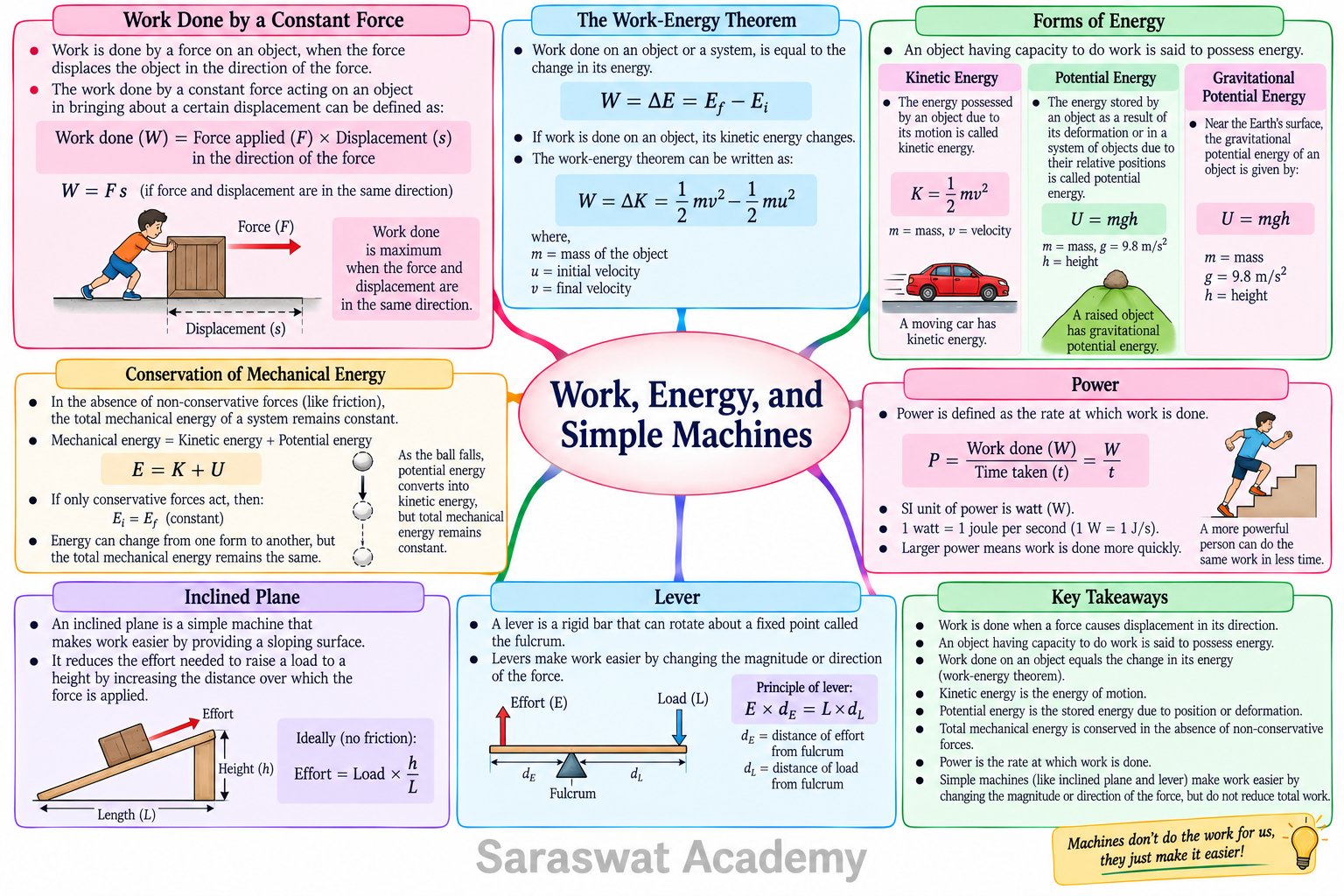
Explore the mind map to revise the main ideas before starting the chapter.
In this chapter, we will explore the concepts of work, energy, and simple machines. We will learn how work is defined in physics, the different forms of energy, and how simple machines help us perform tasks more efficiently. The chapter will also cover the principles of conservation of energy and the practical applications of these concepts in everyday life.
| Chapter Name | Chapter 7 : Work, Energy and Simple Machines |
|---|---|
| Subject | Physics |
| Main Theme | Understanding how work is done, how energy changes from one form to another, and how simple machines make our work easier. |
| Real-Life Applications | Lifting loads, riding bicycles, hydroelectric dams, cranes, elevators, scissors, bottle openers, ramps, pulleys, wheelbarrows and many everyday tools. |
Have you ever wondered why climbing stairs makes you tired, why a moving cricket ball can break a window, or how a simple pulley helps lift heavy objects? Every one of these situations involves work, energy, and machines. This chapter explains the science behind these everyday activities and helps you understand how energy is transferred, stored, and used in the world around us.
| ✓ | Meaning of Work and the conditions required for work to be done. |
|---|---|
| ✓ | Positive Work, Negative Work and Zero Work with real-life examples. |
| ✓ | Work-Energy Theorem and the relationship between work and energy. |
| ✓ | Kinetic Energy and the factors affecting it. |
| ✓ | Potential Energy and gravitational potential energy. |
| ✓ | Conservation of Mechanical Energy. |
| ✓ | Power and its importance in everyday life. |
| ✓ | Simple Machines, Mechanical Advantage, Velocity Ratio and Efficiency. |
| Concept | Formula |
|---|---|
| Work | W = F × s |
| Kinetic Energy | KE = ½mv² |
| Potential Energy | PE = mgh |
| Power | P = W/t |
| Mechanical Advantage | MA = Load / Effort |
| Efficiency | Efficiency = (Useful Work Output / Work Input) × 100% |
After studying this chapter, you will be able to:
|
| Did You Know? |
|---|
|
| Concept | Description |
|---|---|
| Work | Work is said to be done when a force acts on an object and produces a displacement in the direction of the force. If there is no displacement, no work is done. |
| Conditions for Work Done |
|
| Positive Work | Work is positive when the applied force and the displacement are in the same direction. |
| Negative Work | Work is negative when the applied force acts in the opposite direction to the displacement. |
| Zero Work | Work is zero when there is no displacement, no force, or when the force acts perpendicular to the displacement. |
| Energy | Energy is the capacity of an object or system to do work. Work done on an object changes its energy. |
| Work-Energy Theorem | The work done on an object is equal to the change in its energy. |
| Kinetic Energy | Kinetic energy is the energy possessed by an object due to its motion. A stationary object has zero kinetic energy. |
| Potential Energy | Potential energy is the energy possessed by an object due to its position or deformation. In this chapter, the focus is on gravitational potential energy. |
| Mechanical Energy | Mechanical energy is the sum of kinetic energy and potential energy of an object. |
| Conservation of Mechanical Energy | When only gravitational force acts and friction is neglected, the total mechanical energy of an object remains constant. Potential energy converts into kinetic energy and vice versa. |
| Power | Power is the rate of doing work. It tells how quickly a task is completed. |
| Simple Machines | Simple machines help us perform work with less effort or by changing the direction of the applied force. They make work easier but do not reduce the total work done. |
| Mechanical Advantage (MA) | Mechanical Advantage tells how many times a machine multiplies the applied effort. |
| Velocity Ratio (VR) | Velocity Ratio compares the distance moved by the effort with the distance moved by the load. |
| Efficiency | Efficiency indicates how effectively a machine converts the input work into useful output work. The efficiency of a real machine is always less than 100%. |
| Concept | Remember This |
|---|---|
| Work | Force × Displacement |
| Energy | Capacity to do work |
| Kinetic Energy | Energy due to motion |
| Potential Energy | Energy due to position |
| Mechanical Energy | Kinetic Energy + Potential Energy |
| Power | Rate of doing work |
| Simple Machines | Reduce effort and make work easier |
| Efficiency | Useful Output Work ÷ Input Work × 100% |
The concepts of Work, Energy, Power, and Simple Machines are used in almost every aspect of our daily lives. From lifting heavy objects to generating electricity, these principles help us understand how machines and natural systems work efficiently.
| Real-Life Situation | Application of the Concept |
|---|---|
| 🏋️ Lifting Heavy Objects | Workers use cranes, elevators, and forklifts to lift heavy loads. These machines perform work by applying force over a distance while reducing human effort. |
| 🏗️ Construction Sites | Tower cranes, pulleys, and inclined planes are used to transport bricks, cement, and steel to higher floors safely and efficiently. |
| ⚡ Hydroelectric Power Plants | Water stored at a height possesses gravitational potential energy. As it falls, this energy changes into kinetic energy, which rotates turbines to generate electricity. |
| 🎢 Roller Coasters | At the highest point, the coaster has maximum potential energy. During the descent, potential energy changes into kinetic energy, increasing its speed. |
| 🏏 Sports | Cricket, football, badminton, tennis, and hockey involve continuous conversion of muscular energy into kinetic energy. Players perform work while throwing, kicking, or hitting the ball. |
| 🚲 Cycling | The cyclist's muscles perform work on the pedals. This energy is transferred to the bicycle, allowing it to move forward. |
| 🚗 Vehicles | The engine converts the chemical energy stored in fuel into mechanical energy, which moves the vehicle from one place to another. |
| 🪜 Climbing Stairs | While climbing, a person does work against gravity, increasing their gravitational potential energy. |
| 🛗 Elevators and Lifts | Electric motors perform work to raise passengers and goods to different floors by increasing their potential energy. |
| 🏹 Bow and Arrow | When the bow is stretched, elastic potential energy is stored. On release, this energy converts into the kinetic energy of the arrow. |
| 🧸 Springs and Toys | Compressed or stretched springs store elastic potential energy, which is released to perform useful work in toys and mechanical devices. |
| ⚙️ Machines in Factories | Machines use electric motors to perform work efficiently while increasing productivity and reducing human effort. |
| 🪣 Drawing Water from a Well | A pulley changes the direction of the applied force, making it easier to lift a bucket of water. |
| ✂️ Scissors and Pliers | These tools act as levers, allowing a small effort to produce a larger force for cutting or gripping objects. |
| 🪛 Screws and Screwdrivers | A screw is a simple machine that converts rotational motion into forward motion, making fastening easier. |
| 🪵 Ramps | Inclined planes reduce the effort needed to move heavy loads to a higher level by increasing the distance over which the force is applied. |
| 🛒 Wheelbarrows and Trolleys | These machines combine the principles of levers and wheels to transport heavy materials with less effort. |
| 🏥 Hospitals | Wheelchairs, stretchers, and patient lifts use simple machine principles to move patients safely and comfortably. |
| 🚪 Opening Doors | A door works as a lever. Applying force farther from the hinge requires less effort to open or close it. |
| 🌍 Everyday Human Activities | Walking, running, lifting objects, pushing furniture, carrying school bags, and playing games all involve work, energy transformation, and power. |
Revise the complete chapter in just one minute using the key points given below.
| Topic | Quick Revision |
|---|---|
| Work | Work is done only when a force causes displacement in its direction. |
| Formula | W = F × s |
| SI Unit of Work | Joule (J) |
| Energy | Energy is the capacity to do work. |
| Work-Energy Theorem | Work done on an object equals the change in its energy. |
| Kinetic Energy | Energy possessed by a moving object. KE = ½mv² |
| Potential Energy | Energy possessed due to an object's position. PE = mgh |
| Mechanical Energy | ME = KE + PE |
| Conservation of Mechanical Energy | Total mechanical energy remains constant if friction is neglected. |
| Power | Rate of doing work. P = W/t |
| SI Unit of Power | Watt (W) |
| Simple Machines | They make work easier by reducing effort or changing the direction of force. |
| Mechanical Advantage | MA = Load ÷ Effort |
| Velocity Ratio | VR = Distance moved by Effort ÷ Distance moved by Load |
| Efficiency | Efficiency = (Useful Work Output ÷ Work Input) × 100% |
| Concept | Formula |
|---|---|
| Work | W = Fs |
| Kinetic Energy | KE = ½mv² |
| Potential Energy | PE = mgh |
| Mechanical Energy | ME = KE + PE |
| Power | P = W/t |
| Mechanical Advantage | MA = L/E |
| Velocity Ratio | VR = Distance by Effort ÷ Distance by Load |
| Efficiency | (Useful Output ÷ Input) × 100% |
W = Fs → KE = ½mv² → PE = mgh → ME = KE + PE → P = W/t → MA = Load/Effort → VR = Distance by Effort/Distance by Load → Efficiency = (Useful Output/Input) × 100%
"Force does Work, Work changes Energy, Energy becomes Motion or Height, Machines reduce Effort, and Power tells how Fast the Work is Done."
Science is not just about remembering formulae—it is about observing, questioning, experimenting, and applying ideas to solve real-life problems. This chapter encourages you to think like a scientist by connecting the concepts of Work, Energy, Power, and Simple Machines with situations you encounter every day.
| 🔍 | Think Like a Scientist |
|---|---|
| 1 | Why do people use a ramp instead of lifting heavy boxes directly onto a truck? Explain your answer using the concepts of work and simple machines. |
| 2 | A person climbs the stairs while another person uses a lift to reach the same floor. Who gains more gravitational potential energy? Explain your reasoning. |
| 3 | Two students carry identical school bags to the same classroom. One walks slowly while the other runs. Compare the work done and the power developed by both students. |
| 4 | When a cricket ball is hit into the air, its speed decreases while its height increases. Which forms of energy are changing during this motion? |
| 5 | Why do cranes and pulleys allow workers to lift very heavy loads even though the amount of work done remains nearly the same? |
| 6 | A cyclist stops pedalling while riding downhill, yet the bicycle continues to move. What is the source of the bicycle's energy during this motion? |
| 7 | Why is it easier to open a door by pushing near the handle instead of near the hinges? Which simple machine principle explains this? |
| 8 | Imagine there were no friction on Earth. Would the principle of conservation of mechanical energy become easier to observe? Explain your answer. |
| 9 | Engineers try to design machines with higher efficiency. Why is it impossible for most real machines to achieve 100% efficiency? |
| 10 | Look around your home and identify five simple machines. Explain how each one makes work easier. |
| Challenge |
|---|
Imagine you have been asked to design a machine that can lift a 200 kg object with minimum effort.
|
"A scientist doesn't just ask What happened? They also ask Why did it happen?, How can it be measured?, and Can it be explained using scientific principles?"
Choose any one simple machine from your home or school, observe how it works, identify the type of energy involved, explain how it reduces effort, and describe where the work is being done. Present your observations with a neat labelled diagram.
These frequently asked questions will help you quickly revise the most important concepts of Chapter 7: Work, Energy and Simple Machines.
| Q.No. | Question | Answer |
|---|---|---|
| 1 | What is work in Physics? | Work is done when a force acting on an object causes displacement in the direction of the applied force. |
| 2 | What are the conditions necessary for work to be done? | There must be an applied force, the object must move, and the displacement should have a component in the direction of the force. |
| 3 | What is the SI unit of work? | The SI unit of work is Joule (J). |
| 4 | What is energy? | Energy is the capacity of an object or system to do work. |
| 5 | What is the Work-Energy Theorem? | It states that the work done on an object is equal to the change in its energy. |
| 6 | What is kinetic energy? | Kinetic energy is the energy possessed by an object due to its motion. |
| 7 | What is gravitational potential energy? | It is the energy possessed by an object due to its position or height above the ground. |
| 8 | What is mechanical energy? | Mechanical energy is the sum of kinetic energy and potential energy of an object. |
| 9 | What is the law of conservation of mechanical energy? | In the absence of friction and other non-conservative forces, the total mechanical energy of a system remains constant. |
| 10 | What is power? | Power is the rate at which work is done or energy is transferred. |
| 11 | What is the SI unit of power? | The SI unit of power is Watt (W). |
| 12 | What is a simple machine? | A simple machine is a device that makes work easier by reducing the effort required or changing the direction of the applied force. |
| 13 | Name the six classical simple machines. | Lever, Pulley, Wheel and Axle, Inclined Plane, Screw, and Wedge. |
| 14 | What is Mechanical Advantage (MA)? | Mechanical Advantage is the ratio of load to effort and indicates how much a machine multiplies the applied force. |
| 15 | What is Velocity Ratio (VR)? | Velocity Ratio is the ratio of the distance moved by the effort to the distance moved by the load. |
| 16 | What is the efficiency of a machine? | Efficiency is the percentage of useful output work obtained from the total input work. |
| 17 | Can the efficiency of a real machine be 100%? | No. Due to friction and other energy losses, the efficiency of a real machine is always less than 100%. |
| 18 | Why do we use simple machines? | Simple machines help us perform work more easily by reducing effort or changing the direction of the applied force. |
| 19 | Can work be negative or zero? | Yes. Work is negative when the force acts opposite to the displacement and zero when there is no displacement or the force is perpendicular to the displacement. |
| 20 | Give two everyday examples of energy transformation. | A falling object converts potential energy into kinetic energy, and a hydroelectric power plant converts the potential energy of water into electrical energy. |
Before solving numerical problems, always identify the given quantities, write the correct formula, substitute the values with proper SI units, and write the final answer with the correct unit.
Continue learning with other Class 9 Exploration chapters.
Explore more NCERT solutions and other resources with Saraswat Academy.
Get chapter-wise mathematics solutions with clear explanations and step-by-step answers.
Explore Solutions →Study important concepts, exercise solutions and chapter-wise mathematics answers.
Explore Solutions →Understand science concepts with detailed answers to textbook questions.
Explore Solutions →Explore chapter-wise science solutions, explanations and useful study resources.
Explore Solutions →Improve your English skills with detailed answers to textbook questions.
Explore Solutions →Improve your English skills with detailed answers to textbook questions.
Explore Resources →Improve your Hindi skills with detailed answers to textbook questions.
Explore Resources →Improve your Hindi skills with detailed answers to textbook questions.
Explore Resources →Improve your Hindi skills with detailed answers to textbook questions.
Explore Resources →Improve your Social Science skills with detailed answers to textbook questions.
Explore Resources →Improve your Social Science skills with detailed answers to textbook questions.
Explore Resources →Improve your Social Science skills with detailed answers to textbook questions.
Explore Resources →Detailed NCERT solutions for class 9 sanskrit.
Explore Resources →