Class 10
NCERT Solutions for Class 10 Mathematics
Get chapter-wise mathematics solutions with clear explanations and step-by-step answers.
Explore Solutions →Get a quick overview of the important concepts in this chapter.
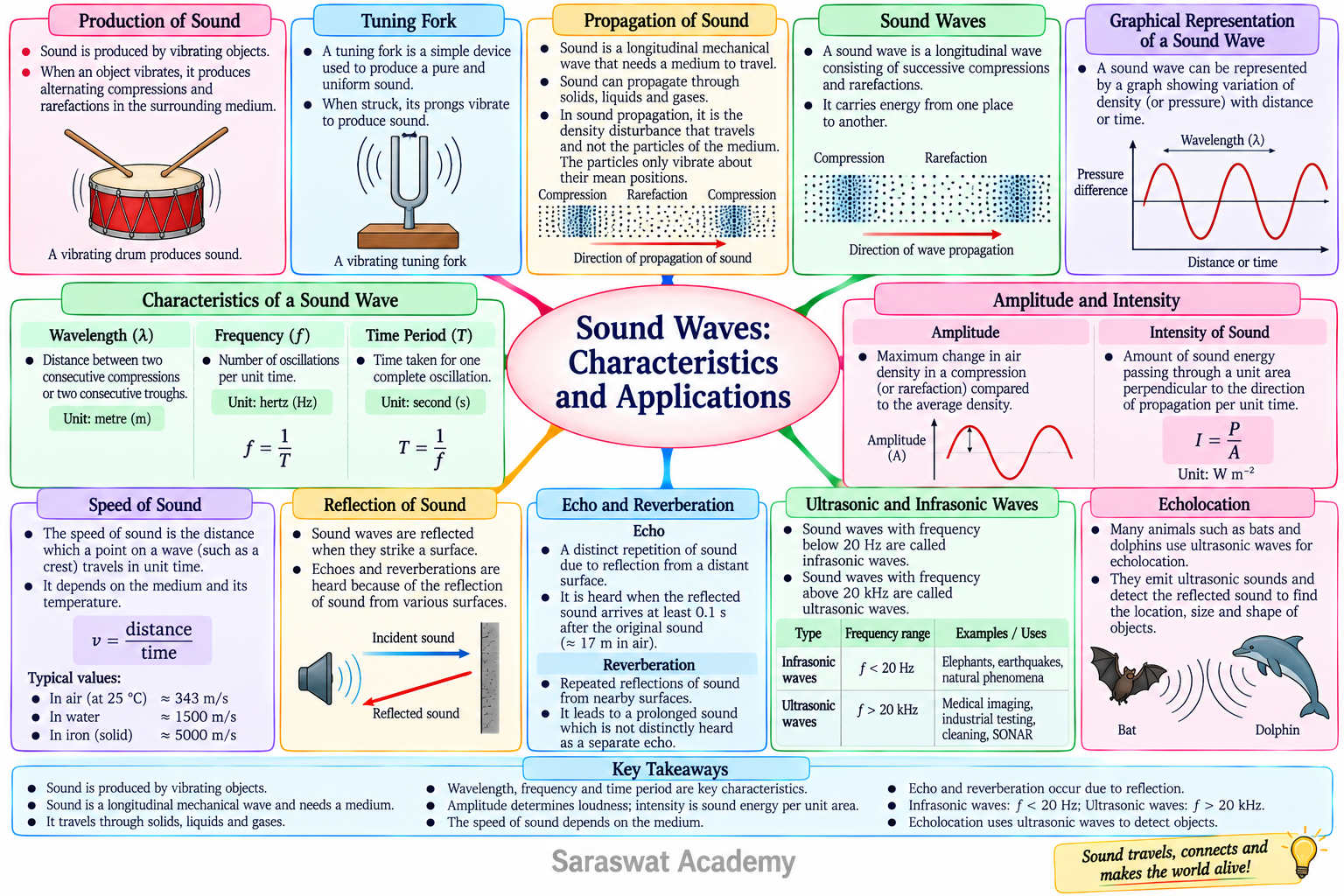
Explore the mind map to revise the main ideas before starting the chapter.
Chapter 10: Sound Waves – Characteristics and Applications takes you on an exciting journey into the fascinating world of sound. Every day, we hear countless sounds—people talking, birds singing, musical instruments playing, vehicles moving, mobile phones ringing, and thunder roaring. But have you ever wondered how sound is produced, why it travels through air, why it cannot travel through space, or how bats find their way in complete darkness?
In this chapter, you will discover that sound is a form of mechanical energy produced by vibrations. You will explore how sound travels through different materials, understand the nature of sound waves, learn about their important characteristics, and see how these concepts are applied in modern technology such as microphones, loudspeakers, SONAR, medical ultrasound, and musical instruments. The chapter beautifully combines scientific theory with real-life applications, making the study of sound both interesting and practical.
| Topic | Learning Outcome |
|---|---|
| 🎵 Production of Sound | Learn that every sound is produced due to vibrations. Study how vibrating strings, membranes, air columns, vocal cords, and other objects generate sound. |
| 🌍 Propagation of Sound | Understand how sound travels through solids, liquids, and gases, and why it cannot travel through vacuum because it requires a material medium. |
| 🌊 Sound as a Mechanical Wave | Discover that sound is a mechanical longitudinal wave in which particles of the medium vibrate parallel to the direction of wave propagation. |
| 🔄 Compressions and Rarefactions | Learn how alternate regions of high density (compressions) and low density (rarefactions) are formed and travel through a medium. |
| ⚡ Transfer of Energy | Understand that sound transfers energy from one place to another without transferring the particles of the medium. |
| 📈 Graphical Representation | Interpret sound waves using graphs and identify wavelength, compressions, rarefactions, amplitude, and other wave properties. |
| 📏 Characteristics of Sound | Study wavelength, frequency, time period, amplitude, intensity, pitch, loudness, and the speed of sound with their SI units and relationships. |
| 🎼 Musical Sound | Differentiate between tone, musical note, pitch, loudness, timbre, overtones, and octave to understand why musical instruments produce unique sounds. |
| 🪞Reflection of Sound | Explore how sound reflects from surfaces and learn about echo and the laws of reflection of sound. |
| 📡 Applications of Sound | Study practical applications of sound in microphones, loudspeakers, SONAR, ultrasound imaging, communication systems, and navigation. |
| Concept | Key Understanding |
|---|---|
| Source of Sound | Every sound originates from a vibrating object. |
| Medium | Sound always requires a material medium for propagation. |
| Vacuum | Sound cannot travel through vacuum because there are no particles to transfer vibrations. |
| Longitudinal Wave | Particles vibrate parallel to the direction of wave propagation. |
| Mechanical Wave | Sound belongs to the class of mechanical waves. |
| Energy Transfer | Only energy moves with the wave; the particles simply oscillate about their mean positions. |
| Reflection | Sound obeys the same laws of reflection as light. |
| Everyday Situation | Scientific Concept |
|---|---|
| 🎤 Speaking and Singing | Vibration of vocal cords produces sound. |
| 🎸 Guitar or Violin | Vibrating strings generate musical sound. |
| 🥁 Tabla and Drum | Vibrating stretched membranes produce sound. |
| 🎺 Flute and Bansuri | Vibration of the air column inside the instrument produces sound. |
| ⚡ Thunder | Rapid expansion of heated air creates powerful sound waves. |
| 🦇 Bats | Bats use reflected sound waves to locate prey and obstacles. |
| 🚢 SONAR | Reflection of sound helps measure underwater distance and locate objects. |
| 🏥 Ultrasound | High-frequency sound waves help doctors examine internal organs without surgery. |
| 🎙️ Microphone | Converts sound energy into electrical energy. |
| 🔊 Loudspeaker | Converts electrical energy back into sound energy. |
Vibrations → Production of Sound → Material Medium → Longitudinal Waves → Compressions & Rarefactions → Wave Characteristics → Speed of Sound → Musical Sound → Reflection of Sound → Echo → SONAR → Ultrasound → Everyday Applications
"Sound is produced by vibrations, travels as a longitudinal mechanical wave through a material medium, transfers energy without transferring matter, and plays an essential role in communication, music, medicine, navigation, and modern technology."
This chapter explains how sound is produced, how it travels, and how it helps us communicate and explore the world. It introduces the nature of sound waves, their characteristics, reflection, and important applications such as SONAR and ultrasound.
| Concept | Key Point |
|---|---|
| Definition | Sound is produced whenever an object vibrates. |
| Examples | Vibrating guitar strings, tuning forks, vocal cords, drum membranes and air columns inside musical instruments. |
| Important Fact | When vibrations stop, the sound also stops. |
| Concept | Key Point |
|---|---|
| Medium | Sound requires a material medium (solid, liquid or gas) to travel. |
| Vacuum | Sound cannot travel through vacuum because there are no particles to transfer vibrations. |
| Speed | Sound travels fastest in solids, slower in liquids and slowest in gases. |
| Region | Description |
|---|---|
| Compression (C) | Region where particles are close together and the density is maximum. |
| Rarefaction (R) | Region where particles are farther apart and the density is minimum. |
| Characteristic | Meaning |
|---|---|
| Wavelength (λ) | Distance between two consecutive compressions or two consecutive rarefactions. |
| Frequency (ν) | Number of complete oscillations produced in one second. |
| Time Period (T) | Time taken to complete one oscillation. |
| Amplitude | Maximum change in density of the medium from its average value. |
| Intensity | Amount of sound energy passing through unit area in one second. |
| Speed of Sound | Distance travelled by sound in one second. |
| Property | Depends On |
|---|---|
| Loudness | Amplitude of the sound wave. |
| Pitch | Frequency of the sound wave. |
An echo is the repetition of a sound heard after it is reflected from a distant surface. It is produced when the reflected sound reaches the listener after a short time interval.
SONAR works by sending ultrasonic waves into water and receiving their reflected waves. It is used to determine the distance, direction and location of underwater objects such as submarines, rocks and shipwrecks.
| Application | Purpose |
|---|---|
| 🎤 Microphone | Converts sound energy into electrical energy. |
| 🔊 Loudspeaker | Converts electrical energy into sound energy. |
| 🏥 Ultrasound | Used for medical imaging and diagnosis. |
| 🚢 SONAR | Used to detect underwater objects and measure ocean depth. |
| 🦇 Echolocation | Bats and dolphins use reflected sound to locate objects. |
| Formula | Description |
|---|---|
| ν = 1/T | Relationship between frequency and time period. |
| v = νλ | Speed of sound = Frequency × Wavelength. |
| Distance = Speed × Time | Basic relation used in sound problems. |
| Distance by SONAR = (v × t)/2 | Used because the sound travels to the object and back. |
Vibrations → Sound Production → Medium → Longitudinal Wave → Compressions & Rarefactions → Wavelength → Frequency → Amplitude → Loudness → Reflection → Echo → Ultrasonic Waves → SONAR
The concepts of sound waves are used in almost every aspect of our daily lives. From communication and entertainment to healthcare, navigation, industry, and scientific research, sound plays an essential role in modern technology. Understanding how sound is produced, transmitted, reflected, and detected helps us explain many natural phenomena and develop useful inventions.
| Real-Life Application | How Sound is Used |
|---|---|
| 🎤 Human Communication | Speaking, listening, classroom teaching, telephone conversations, and public announcements all depend on the production and transmission of sound waves. |
| 🎼 Music and Musical Instruments | Guitars, pianos, violins, flutes, tablas, drums, and other musical instruments produce sound through vibrations to create pleasant musical notes. |
| 🔊 Loudspeakers | Loudspeakers convert electrical signals into sound waves, allowing us to hear music, speeches, and announcements in homes, schools, theatres, and stadiums. |
| 🎙️ Microphones | Microphones convert sound waves into electrical signals for recording, broadcasting, video calls, podcasts, and live performances. |
| 📱 Mobile Phones & Video Calls | Your voice is converted into electrical and digital signals and then reproduced as sound at the receiver's end. |
| 🏥 Medical Ultrasound | Ultrasonic waves are used to examine internal organs, monitor pregnancy, detect kidney stones, and diagnose various medical conditions without surgery. |
| ❤️ Echocardiography | Doctors use ultrasonic waves to examine the heart's structure, valves, and blood flow safely and accurately. |
| 🚢 SONAR | Ships and submarines use SONAR to measure sea depth, locate underwater rocks, detect submarines, and find schools of fish. |
| 🦇 Echolocation in Animals | Bats and dolphins emit ultrasonic sounds and detect their echoes to locate prey, avoid obstacles, and navigate even in complete darkness. |
| 🏗️ Crack Detection | Industries use ultrasonic waves to detect tiny cracks and defects inside railway tracks, bridges, aircraft parts, and metal structures. |
| 🧼 Ultrasonic Cleaning | Jewellery, surgical instruments, watches, lenses, and electronic components are cleaned using ultrasonic vibrations that remove dirt from tiny spaces. |
| 🚗 Vehicle Parking Sensors | Modern cars use ultrasonic sensors to detect nearby obstacles and help drivers park safely. |
| 📢 Public Address Systems | Schools, railway stations, airports, and stadiums use microphones and loudspeakers to communicate with large groups of people. |
| 🎬 Cinema and Home Theatres | Advanced speaker systems use sound wave technology to provide clear and immersive audio experiences. |
| 🏫 School Bells & Alarm Systems | Sound signals are used to indicate class timings, emergencies, and important announcements. |
| 🌩️ Thunder | The loud sound of thunder is produced by the rapid expansion of air heated by lightning. |
| 🚨 Emergency Sirens | Police, ambulance, and fire brigade sirens produce loud sounds that can be heard from long distances to warn people. |
| 🏗️ Auditorium Design | Architects design theatres, classrooms, and conference halls by considering the reflection and absorption of sound to improve sound quality. |
| 🌊 Ocean Research | Scientists use sound waves to study the ocean floor, map underwater mountains, and explore marine life. |
| 🚀 Scientific Research | Sound waves help researchers study materials, investigate vibrations, and develop advanced technologies in engineering and medicine. |
| Application | Purpose |
|---|---|
| Ultrasound Imaging | Produces images of internal organs for medical diagnosis. |
| SONAR | Measures sea depth and detects underwater objects. |
| Echolocation | Helps bats and dolphins navigate using reflected sound waves. |
| Echo | Used to determine the distance of distant objects by measuring the reflected sound. |
| Microphones & Loudspeakers | Convert sound energy into electrical energy and vice versa. |
Every conversation you have, every song you enjoy, every phone call you make, every ultrasound scan in a hospital, and every ship navigating the ocean depends on the fascinating science of sound waves. Understanding sound helps us connect, communicate, explore, and innovate.
Revise the complete chapter in just one minute using these important concepts, formulae, and key facts.
| Topic | Quick Revision |
|---|---|
| 🎵 Sound | Sound is produced by the vibration of an object. |
| 🌍 Medium | Sound requires a material medium and cannot travel through a vacuum. |
| 🌊 Nature of Sound | Sound is a mechanical longitudinal wave. |
| 📦 Compression | Region where particles are close together. |
| 📭 Rarefaction | Region where particles are far apart. |
| 📏 Wavelength (λ) | Distance between two consecutive compressions or rarefactions. |
| 🔄 Frequency (f) | Number of vibrations completed in one second. |
| ⏱️ Time Period (T) | Time taken to complete one vibration. |
| 📢 Amplitude | Determines the loudness of sound. |
| 🎼 Pitch | Depends on the frequency of the sound wave. |
| 🚀 Speed of Sound | Fastest in solids, slower in liquids, and slowest in gases. |
| 🪞 Echo | Produced due to the reflection of sound. |
| 📡 Ultrasonic Waves | Frequency greater than 20,000 Hz; used in medicine and SONAR. |
| 🚢 SONAR | Uses reflected ultrasonic waves to detect underwater objects and measure sea depth. |
| Formula | Meaning |
|---|---|
| v = fλ | Speed of Sound = Frequency × Wavelength |
| f = 1/T | Frequency and Time Period are inversely related. |
| T = 1/f | Time Period is the reciprocal of Frequency. |
| Distance = Speed × Time | Basic equation for sound travel. |
| Distance by SONAR = (v × t)/2 | Sound travels to the object and returns back. |
Vibration
⬇
Sound Produced
⬇
Material Medium
⬇
Longitudinal Wave
⬇
Compression & Rarefaction
⬇
Amplitude • Frequency • Wavelength
⬇
Reflection
⬇
Echo
⬇
Ultrasound
⬇
SONAR
| Keyword | Remember |
|---|---|
| Vibration | Source of Sound |
| Medium | Required for Sound |
| Longitudinal Wave | Particles vibrate parallel to wave motion |
| Amplitude | Loudness |
| Frequency | Pitch |
| Compression | Particles Close Together |
| Rarefaction | Particles Far Apart |
| Echo | Reflection of Sound |
| Ultrasound | Frequency > 20,000 Hz |
| SONAR | Underwater Detection |
Remember this sequence:
Vibration → Sound → Medium → Longitudinal Wave → Wave Properties → Reflection → Echo → Ultrasonic Waves → SONAR
If you remember this flow along with the formulas v = fλ and f = 1/T, you can confidently answer most theory and numerical questions from this chapter.
Scientists do much more than memorize facts—they observe carefully, ask questions, perform experiments, collect evidence, and draw logical conclusions. This chapter teaches you to understand sound by exploring vibrations, wave motion, reflection, and their applications in everyday life. Now, put yourself in the role of a scientist and investigate the fascinating world of sound.
| 🔬 | Think Like a Scientist |
|---|---|
| 1 | Why do you hear the sound of thunder after seeing lightning? Explain your answer using the speed of light and the speed of sound. |
| 2 | Strike a steel spoon and a wooden spoon gently. Which one produces sound for a longer time? What does this tell you about vibrations? |
| 3 | Why can astronauts communicate only through radio devices while working outside a spacecraft in space? |
| 4 | If sound could travel through a vacuum, how would communication in space be different? Explain your reasoning. |
| 5 | Observe a guitar, rubber band, or ruler. What happens to the sound when the vibration becomes faster or slower? |
| 6 | Why do bats and dolphins use ultrasonic waves instead of ordinary sound for navigation? |
| 7 | Why is it easier to hear a train approaching by placing your ear near a railway track than through the air? |
| 8 | How does increasing the amplitude of vibration affect the loudness of sound? Can you observe this using a musical instrument? |
| 9 | Why are large empty halls designed with sound-absorbing materials on the walls and ceiling? |
| 10 | How does SONAR help ships detect underwater objects even when they cannot be seen? |
| Challenge |
|---|
Imagine you are an engineer designing a new concert hall.
|
| Question |
|---|
Imagine scientists invent a device that allows humans to hear ultrasonic sounds.
|
"A scientist doesn't just hear a sound—they ask what produced the vibration, how the sound travelled, why its loudness or pitch changed, and how this knowledge can solve real-world problems."
Choose any five sources of sound around your home or school. For each source, identify:
Present your observations in a neat table like a real scientist.
These frequently asked questions will help you quickly revise the important concepts of Chapter 10: Sound Waves – Characteristics and Applications.
| Q.No. | Question | Answer |
|---|---|---|
| 1 | What is sound? | Sound is a form of mechanical energy produced by the vibration of an object. |
| 2 | How is sound produced? | Sound is produced when an object vibrates. |
| 3 | Can sound travel through a vacuum? | No. Sound requires a material medium such as a solid, liquid, or gas to travel. |
| 4 | Why is sound called a mechanical wave? | Because it requires a material medium for propagation. |
| 5 | What type of wave is sound? | Sound is a longitudinal wave. |
| 6 | What is a compression? | A compression is a region where the particles of the medium are closely packed. |
| 7 | What is a rarefaction? | A rarefaction is a region where the particles of the medium are far apart. |
| 8 | What is wavelength? | Wavelength is the distance between two consecutive compressions or two consecutive rarefactions. |
| 9 | What is frequency? | Frequency is the number of complete vibrations or oscillations made in one second. |
| 10 | What is the SI unit of frequency? | The SI unit of frequency is hertz (Hz). |
| 11 | What is time period? | Time period is the time taken to complete one vibration or oscillation. |
| 12 | What is amplitude? | Amplitude is the maximum displacement of vibrating particles from their mean position. |
| 13 | On what does loudness depend? | Loudness depends on the amplitude of the sound wave. |
| 14 | On what does pitch depend? | Pitch depends on the frequency of the sound wave. |
| 15 | What is the relationship between frequency and time period? | Frequency = 1 / Time Period (f = 1/T). They are inversely proportional. |
| 16 | What is the formula for the speed of sound? | v = fλ, where v is speed, f is frequency, and λ is wavelength. |
| 17 | In which medium does sound travel the fastest? | Sound travels fastest in solids, slower in liquids, and slowest in gases. |
| 18 | What is an echo? | An echo is the repetition of sound caused by the reflection of sound waves from a distant surface. |
| 19 | What are ultrasonic waves? | Ultrasonic waves are sound waves having a frequency greater than 20,000 Hz. |
| 20 | What is SONAR? | SONAR (Sound Navigation and Ranging) is a technique that uses ultrasonic waves to locate underwater objects and measure sea depth. |
| 21 | How do bats and dolphins find their way in darkness? | They use echolocation, in which ultrasonic waves are reflected back from objects. |
| 22 | How are ultrasonic waves used in hospitals? | They are used for ultrasound imaging to examine internal organs and monitor pregnancy. |
| 23 | What is the function of a microphone? | A microphone converts sound energy into electrical energy. |
| 24 | What is the function of a loudspeaker? | A loudspeaker converts electrical energy into sound energy. |
| 25 | Why is this chapter important? | This chapter explains the science behind sound and forms the foundation for understanding communication systems, musical instruments, ultrasound, SONAR, acoustics, and many modern technologies. |
Remember this sequence for quick revision:
Vibrations → Sound → Medium → Longitudinal Wave → Compression & Rarefaction → Wave Characteristics → Reflection → Echo → Ultrasonic Waves → SONAR
Also remember the two most important formulas:
v = fλ
f = 1/T
Continue learning with other Class 9 Exploration chapters.
Explore more NCERT solutions and other resources with Saraswat Academy.
Get chapter-wise mathematics solutions with clear explanations and step-by-step answers.
Explore Solutions →Study important concepts, exercise solutions and chapter-wise mathematics answers.
Explore Solutions →Understand science concepts with detailed answers to textbook questions.
Explore Solutions →Explore chapter-wise science solutions, explanations and useful study resources.
Explore Solutions →Improve your English skills with detailed answers to textbook questions.
Explore Solutions →Improve your English skills with detailed answers to textbook questions.
Explore Resources →Improve your Hindi skills with detailed answers to textbook questions.
Explore Resources →Improve your Hindi skills with detailed answers to textbook questions.
Explore Resources →Improve your Hindi skills with detailed answers to textbook questions.
Explore Resources →Improve your Social Science skills with detailed answers to textbook questions.
Explore Resources →Improve your Social Science skills with detailed answers to textbook questions.
Explore Resources →Improve your Social Science skills with detailed answers to textbook questions.
Explore Resources →Detailed NCERT solutions for class 9 sanskrit.
Explore Resources →