Class 10
NCERT Solutions for Class 10 Mathematics
Get chapter-wise mathematics solutions with clear explanations and step-by-step answers.
Explore Solutions →Get a quick overview of the important concepts in this chapter.
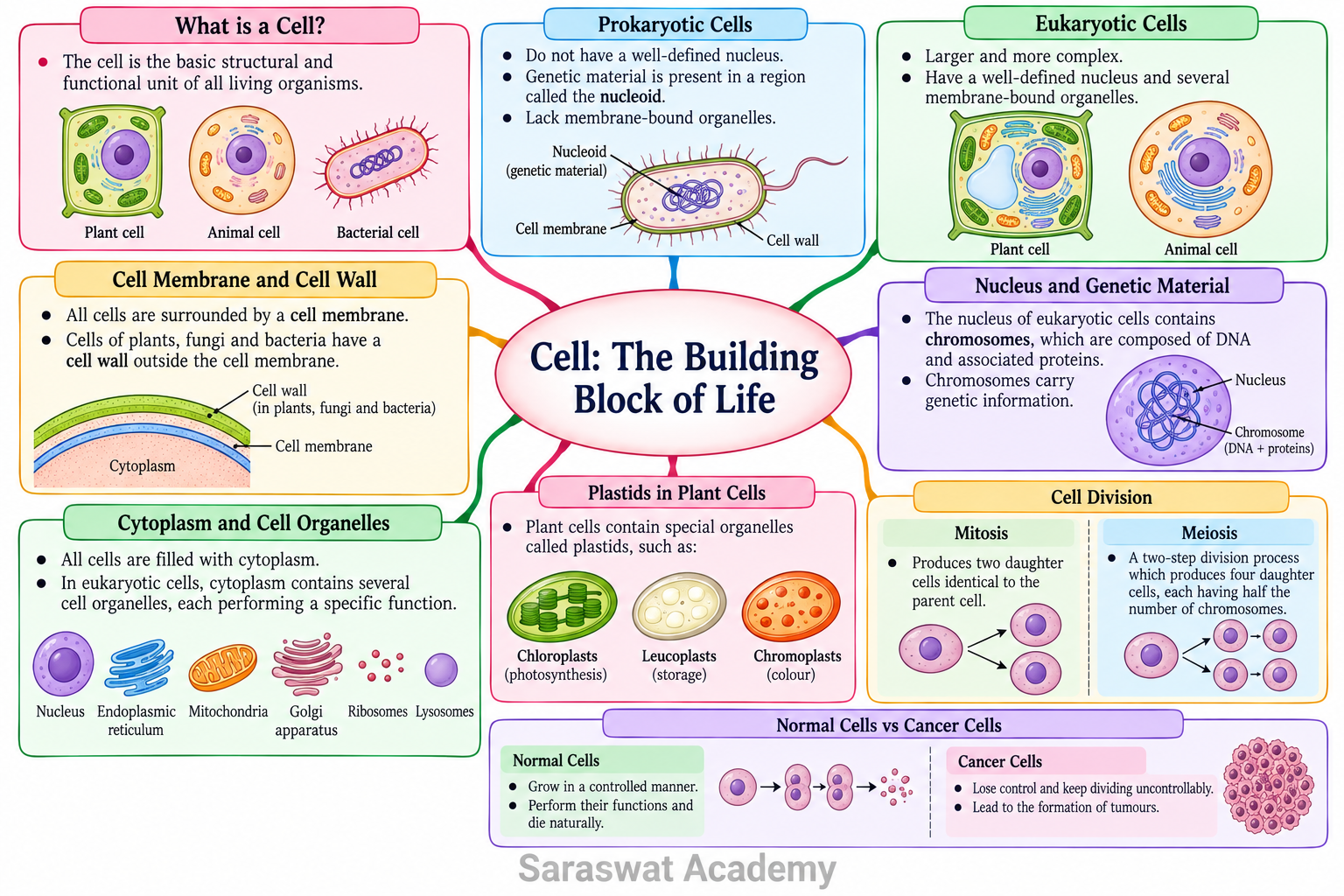
Explore the mind map to revise the main ideas before starting the chapter.
Every living organism, from tiny bacteria to giant trees and human beings, is made up of cells. This chapter introduces the cell as the basic structural and functional unit of life. It explains how the invention of the microscope opened a new world beyond the limits of the human eye and enabled scientists to discover the structure and organisation of cells.
The chapter explores the structure of cells, including the cell membrane, cell wall, cytoplasm, nucleus, and other important cell organelles. It explains how each organelle performs a specific function, such as energy production, protein synthesis, food preparation, storage, waste removal, and the control of cellular activities. It also compares plant cells, animal cells, and bacterial cells, highlighting the differences between prokaryotic and eukaryotic cells.
Finally, the chapter describes how cells communicate, transport materials through diffusion and osmosis, and divide to produce new cells for growth, repair, and reproduction. Through experiments, scientific investigations, and real-life examples, students develop a deeper understanding of how cells work together to sustain life and why they are called the building blocks of all living organisms.
| Concept | Description |
|---|---|
| Cell | The cell is the basic structural and functional unit of life. Every living organism is made up of one or more cells that perform all essential life processes. |
| Discovery of Cell | Robert Hooke discovered cells in 1665 while observing a thin slice of cork under a microscope. His discovery laid the foundation of cell biology. |
| Microscope | Cells are too small to be seen with the naked eye. Light and electron microscopes help scientists study cells and their internal structures in detail. |
| Cell Membrane (Plasma Membrane) | A thin, living, selectively permeable membrane that surrounds the cell. It protects the cell and controls the movement of substances into and out of the cell. |
| Diffusion | The movement of molecules from a region of higher concentration to a region of lower concentration until equilibrium is reached. |
| Osmosis | The movement of water molecules through a selectively permeable membrane from a region of higher water concentration to a region of lower water concentration. |
| Cell Wall | A rigid, non-living outer covering found in plant cells. It provides protection, support, strength, and maintains the shape of the cell. |
| Cytoplasm | A jelly-like substance present inside the cell membrane that contains various cell organelles and is the site of many metabolic activities. |
| Nucleus | The nucleus acts as the control centre of the cell. It contains chromosomes, DNA, and genes, which regulate all cellular activities and heredity. |
| Cell Organelles | Specialised structures inside the cell that perform specific functions such as energy production, protein synthesis, transport, storage, and waste removal. |
| Prokaryotic Cells | Simple cells that do not have a true nucleus or membrane-bound organelles. Bacteria are examples of prokaryotic cells. |
| Eukaryotic Cells | Complex cells having a well-defined nucleus and membrane-bound organelles. Plant and animal cells belong to this category. |
| Plant Cell and Animal Cell | Plant cells possess a cell wall, plastids, and a large vacuole, whereas animal cells lack a cell wall and plastids and usually have smaller vacuoles. |
| DNA, Genes and Chromosomes | DNA stores genetic information. Genes are segments of DNA responsible for inherited traits, while chromosomes carry DNA inside the nucleus. |
| Cell Theory | Cell Theory states that all living organisms are made of cells, the cell is the basic unit of life, and every new cell arises from a pre-existing cell. |
| Cell Division | Cell division produces new cells for growth, repair, and reproduction. Mitosis forms two identical daughter cells, while meiosis forms four reproductive cells with half the number of chromosomes. |
| Real-Life Application | How It Is Connected to This Chapter |
|---|---|
| Medical Diagnosis | Doctors examine blood cells, bacteria, and body tissues under microscopes to detect diseases such as malaria, tuberculosis, and cancer. |
| Healing of Wounds | When you get a cut or injury, damaged cells divide by mitosis to repair tissues and heal the wound. |
| Food Preservation | Salt and sugar preserve pickles, jams, and other foods by causing water to move out of microorganisms through osmosis, preventing their growth. |
| Plant Growth in Agriculture | Healthy plant cells, chloroplasts, and cell division help crops grow, produce food, and increase agricultural yield. |
| DNA Testing | DNA present inside the nucleus is used for forensic investigations, paternity testing, and identifying individuals. |
| Biotechnology and Genetic Engineering | Scientists study cells and DNA to develop improved crops, medicines, vaccines, and life-saving therapies. |
| Cancer Treatment | Understanding normal and abnormal cell division helps doctors diagnose and treat different types of cancer. |
| Organ Transplant and Tissue Culture | Knowledge of cells helps in growing tissues, repairing damaged organs, and improving transplant success. |
| Nutrition and Energy Production | Mitochondria release energy from food, allowing our body to perform activities such as walking, running, studying, and playing. |
| Scientific Research | Scientists use microscopes and advanced laboratory techniques to study cells, discover new medicines, and understand various life processes. |
| Topic | Quick Revision |
|---|---|
| Cell | The cell is the basic structural and functional unit of all living organisms. |
| Discovery of Cell | Robert Hooke discovered cells in 1665 while observing a thin slice of cork. |
| Microscope | Light and electron microscopes help us observe cells that are invisible to the naked eye. |
| Cell Membrane | A selectively permeable membrane that protects the cell and controls the movement of substances. |
| Cell Wall | A rigid outer covering present in plant cells that provides protection, support, and shape. |
| Diffusion | Movement of particles from a region of higher concentration to lower concentration. |
| Osmosis | Movement of water through a selectively permeable membrane from higher to lower water concentration. |
| Cytoplasm | Jelly-like substance that contains cell organelles and is the site of many life processes. |
| Nucleus | Controls all cell activities and contains DNA, genes, and chromosomes. |
| Major Cell Organelles | Ribosomes, ER, Golgi apparatus, Lysosomes, Mitochondria, Plastids, and Vacuoles perform specialised functions. |
| Prokaryotic Cell | Has no true nucleus and no membrane-bound organelles. |
| Eukaryotic Cell | Has a true nucleus and membrane-bound organelles. |
| Cell Theory | All living organisms are made of cells, cells are the basic unit of life, and new cells arise from pre-existing cells. |
| Cell Division | Mitosis helps in growth and repair, while meiosis produces reproductive cells. |
Scientists don't memorise facts—they ask questions, make observations, test ideas, and search for evidence. Read each challenge carefully, think deeply, and make your own prediction before checking the answer.
Place a drop of pond water on a glass slide. It looks completely clean to your eyes.
🤔 Think Like a Scientist:
Does "looking clean" mean there is nothing living inside it? How could you prove your answer scientifically?
A potato slice is kept in a bowl of concentrated salt solution for one hour.
🤔 Think Like a Scientist:
What will happen to the potato? Will it become bigger, smaller, or remain the same? Explain your prediction before performing the experiment.
You accidentally get a small cut on your finger. After a few days, the wound disappears.
🤔 Think Like a Scientist:
Where did the new skin come from? Which process inside your body repaired the damaged tissue?
A strong wind bends a tree, but it quickly becomes upright again. Humans, however, can bend their arms and legs easily.
🤔 Think Like a Scientist:
Why are plant cells rigid while animal cells are flexible? Which cell structure is responsible for this difference?
Imagine a cell is a huge factory.
🤔 Think Like a Scientist:
If the factory suddenly loses its power station, what activities inside the factory would stop first? Which cell organelle acts as this power station?
Some human red blood cells do not contain a nucleus.
🤔 Think Like a Scientist:
Why can these cells still perform their function? What limitation do they have because the nucleus is absent?
Every person has different facial features, fingerprints, and many unique characteristics.
🤔 Think Like a Scientist:
Where is this information stored inside the cell? Why do children resemble their parents?
Your body needs oxygen, water, and nutrients every second, but harmful substances should be kept out.
🤔 Think Like a Scientist:
How does a cell decide what enters and what leaves? Which cell structure acts like a security gate?
Animals cannot prepare their own food, but plants can.
🤔 Think Like a Scientist:
Which special organelle allows plants to make food? What would happen if this organelle suddenly disappeared?
Every human being begins life as a single fertilised cell, yet an adult body contains trillions of cells.
🤔 Think Like a Scientist:
How can one tiny cell produce an entire human body? Which biological process makes this possible?
Look around your home and find five objects or living things. For each one, write:
Remember, every great scientific discovery begins with a simple question: "Why?" or "How?" Curiosity is the first step towards becoming a scientist.
The cell is called the basic structural and functional unit of life because every living organism is made up of cells, and all life processes take place inside them.
Robert Hooke discovered the cell in 1665 while observing a thin slice of cork under a microscope. He named the tiny box-like structures "cells."
Most cells are extremely small and are below the resolving power of the human eye. Therefore, microscopes are required to observe them.
The cell membrane protects the cell, gives it shape, and controls the movement of substances into and out of the cell because it is selectively permeable.
Diffusion is the movement of particles from a region of higher concentration to lower concentration, whereas osmosis is the movement of water molecules through a selectively permeable membrane.
The cell wall provides strength, protection, and support to plant cells. It also helps maintain their shape and prevents them from bursting under high water pressure.
The nucleus acts as the control centre of the cell. It regulates all cellular activities and contains DNA, genes, and chromosomes responsible for heredity.
Cell organelles are specialised structures present inside the cell. Each organelle performs a specific function, such as energy production, protein synthesis, transport, storage, or waste removal.
Prokaryotic cells do not have a true nucleus or membrane-bound organelles, whereas eukaryotic cells possess a well-defined nucleus and membrane-bound organelles.
Mitochondria are called the powerhouse of the cell because they release energy from food and produce ATP, which is used to perform various cellular activities.
Cell Theory states that all living organisms are made up of cells, the cell is the basic structural and functional unit of life, and every new cell arises from a pre-existing cell.
Cell division helps organisms grow, repair damaged tissues, replace old or dead cells, and produce new cells for reproduction.
Mitosis produces two genetically identical daughter cells for growth and repair, whereas meiosis produces four daughter cells with half the number of chromosomes for sexual reproduction.
Plant cells have a cell wall, plastids, and a large central vacuole, while animal cells do not have a cell wall or plastids and usually contain smaller vacuoles.
This chapter forms the foundation of biology. Understanding cell structure, cell organelles, diffusion, osmosis, cell theory, and cell division is essential for answering board exam questions and studying advanced biology in higher classes.
Continue learning with other Class 9 Exploration chapters.
Explore more NCERT solutions and other resources with Saraswat Academy.
Get chapter-wise mathematics solutions with clear explanations and step-by-step answers.
Explore Solutions →Study important concepts, exercise solutions and chapter-wise mathematics answers.
Explore Solutions →Understand science concepts with detailed answers to textbook questions.
Explore Solutions →Explore chapter-wise science solutions, explanations and useful study resources.
Explore Solutions →Improve your English skills with detailed answers to textbook questions.
Explore Solutions →Improve your English skills with detailed answers to textbook questions.
Explore Resources →Improve your Hindi skills with detailed answers to textbook questions.
Explore Resources →Improve your Hindi skills with detailed answers to textbook questions.
Explore Resources →Improve your Hindi skills with detailed answers to textbook questions.
Explore Resources →Improve your Social Science skills with detailed answers to textbook questions.
Explore Resources →Improve your Social Science skills with detailed answers to textbook questions.
Explore Resources →Improve your Social Science skills with detailed answers to textbook questions.
Explore Resources →Detailed NCERT solutions for class 9 sanskrit.
Explore Resources →