Class 10
NCERT Solutions for Class 10 Mathematics
Get chapter-wise mathematics solutions with clear explanations and step-by-step answers.
Explore Solutions →Get a quick overview of the important concepts in this chapter.
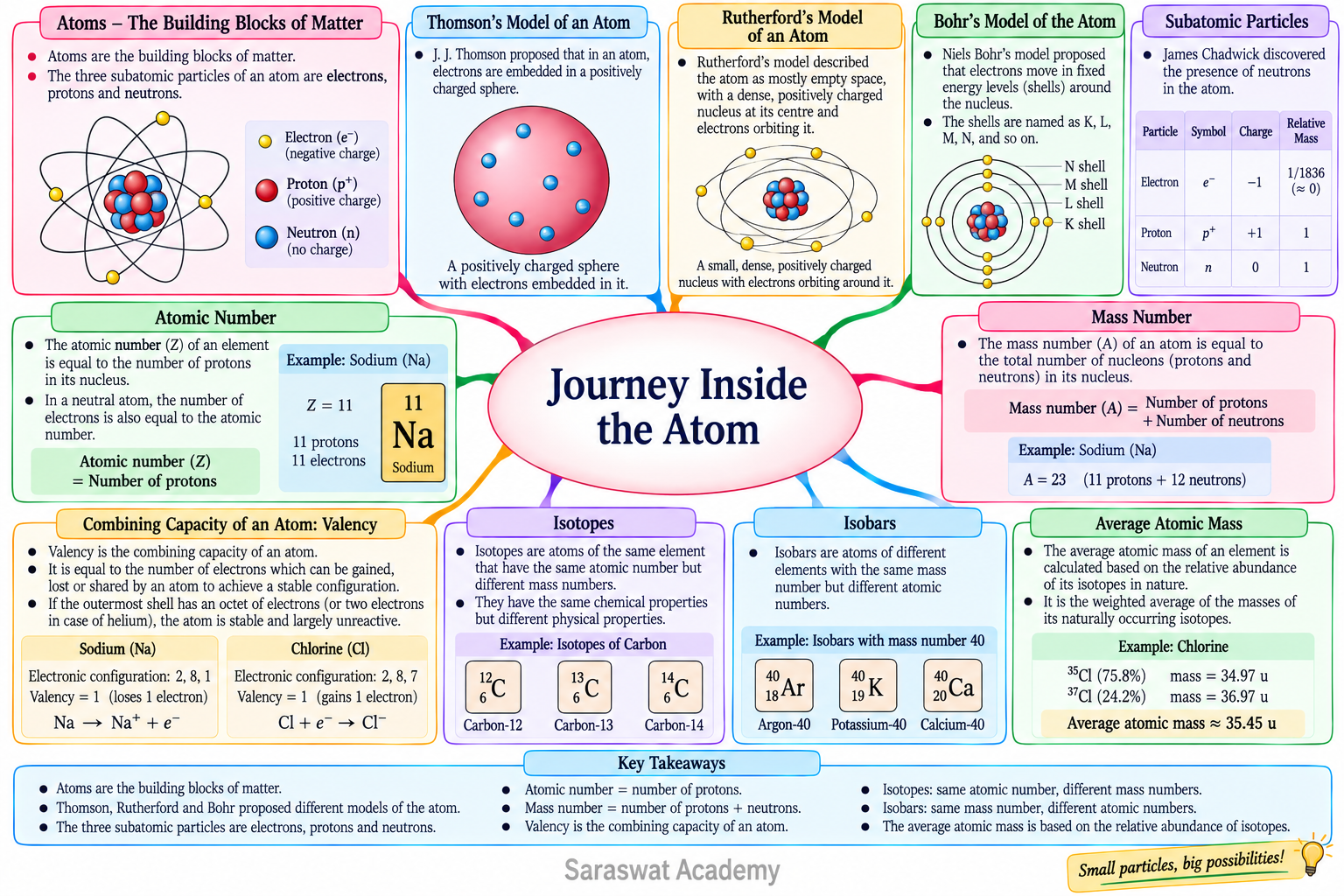
Explore the mind map to revise the main ideas before starting the chapter.
Chapter 8: Journey Inside the Atom takes you on an exciting journey into the invisible world of atoms—the tiny building blocks of all matter. Although atoms are too small to be seen with the naked eye, they make up everything around us, from the air we breathe and the water we drink to our own bodies and the stars in the universe. In this chapter, you will discover how scientists gradually uncovered the internal structure of the atom through careful observations, experiments, and logical reasoning. :contentReference[oaicite:0]{index=0}
| Topic | What You Will Learn |
|---|---|
| 🏛️ History of Atomic Theory | Learn how the idea of atoms began with ancient thinkers like Acharya Kanada, Leucippus, and Democritus, and how John Dalton transformed the concept into a scientific atomic theory. |
| ⚛️ Evolution of Atomic Models | Understand how scientists continuously improved their understanding of atoms through the models proposed by J. J. Thomson, Ernest Rutherford, and Niels Bohr. |
| 🔬 Discovery of Subatomic Particles | Explore the discovery and properties of the three fundamental particles of an atom—electrons, protons, and neutrons. |
| 🎯 Rutherford's Gold Foil Experiment | Study the famous experiment that revealed the existence of the atomic nucleus and proved that most of an atom is empty space. |
| 🌍 Bohr's Atomic Model | Learn how electrons revolve around the nucleus in fixed energy levels (shells) such as K, L, M, and N, making atoms stable. |
| 🧪 Atomic Number & Mass Number | Understand the meaning of atomic number (Z), mass number (A), and how to calculate the numbers of protons, neutrons, and electrons in an atom. |
| 📚 Electronic Configuration | Learn how electrons are arranged in different shells according to the Bohr–Bury rules and how this arrangement determines the properties of an element. |
| 🔗 Valency | Understand why atoms combine with one another and how valence electrons determine the combining capacity (valency) of an element. |
| 🧾 Symbols of Elements | Learn how chemical symbols are assigned according to IUPAC rules and why they are universally used by scientists across the world. |
| Concept | Importance |
|---|---|
| Atom | The smallest unit of an element that retains its chemical properties. |
| Atomic Models | Explain how scientists understood the internal structure of atoms over time. |
| Electron, Proton & Neutron | The three fundamental subatomic particles responsible for the structure and properties of atoms. |
| Atomic Number | Determines the identity of an element. |
| Mass Number | Represents the total number of protons and neutrons present in the nucleus. |
| Electronic Configuration | Shows how electrons are distributed among different shells. |
| Valency | Explains how and why atoms combine to form compounds. |
The knowledge gained from atomic structure is used in many fields, including medicine, nuclear energy, electronics, nanotechnology, material science, medical imaging, semiconductor technology, space research, and environmental science. Every modern technology—from smartphones and computers to MRI scanners and nuclear power plants—depends on our understanding of atoms and their structure.
After completing this chapter, you will be able to:
Ancient Atomic Ideas → Dalton's Atomic Theory → Thomson's Model → Rutherford's Gold Foil Experiment → Bohr's Model → Electron, Proton & Neutron → Atomic Number → Mass Number → Electronic Configuration → Valency
This chapter explains how scientists discovered the internal structure of the atom through experiments and developed different atomic models. It also introduces subatomic particles, atomic number, mass number, electronic configuration, and valency—the basic concepts that form the foundation of chemistry. :contentReference[oaicite:0]{index=0}
| Concept | Important Points |
|---|---|
| ⚛️ Atom | An atom is the smallest unit of an element that retains its chemical properties. Every substance around us is made up of atoms, although they are too small to be seen with the naked eye. |
| 🏛️ Origin of Atomic Theory | The idea of atoms was first proposed by Acharya Kanada in ancient India and by Leucippus and Democritus in Greece. Later, John Dalton presented the first scientific atomic theory based on experimental evidence. |
| 🔬 Thomson's Atomic Model | J. J. Thomson discovered the electron and proposed the Plum Pudding Model, where electrons are embedded in a positively charged sphere. This model explained the electrical neutrality of atoms but failed to explain later experimental observations. |
| 🥇 Rutherford's Gold Foil Experiment |
Rutherford's experiment showed that most alpha particles passed straight through the gold foil, while a few were deflected. This proved that:
|
| 🌍 Rutherford's Atomic Model |
According to Rutherford:
|
| 🪐 Bohr's Atomic Model | Bohr proposed that electrons move only in fixed circular paths called shells or energy levels. Electrons do not lose energy while moving in these allowed shells, making atoms stable. |
| 🔋 Energy Levels (Shells) | The shells are named K, L, M, N.... The K-shell is nearest to the nucleus and has the least energy. The energy of electrons increases as the distance from the nucleus increases. |
| ⚡ Electron | Electrons are negatively charged particles found outside the nucleus. They have very small mass and determine the chemical behaviour of an atom. |
| ➕ Proton | Protons are positively charged particles present inside the nucleus. The number of protons determines the identity of an element. |
| ⭕ Neutron | Neutrons are electrically neutral particles found inside the nucleus. Along with protons, they contribute almost all of the atom's mass. |
| 🔢 Atomic Number (Z) | Atomic number is the number of protons present in the nucleus of an atom. In a neutral atom, the number of electrons is equal to the atomic number. |
| ⚖️ Mass Number (A) | Mass number is the total number of protons and neutrons present in the nucleus. |
| 📝 Standard Atomic Notation |
An atom is represented by writing:
|
| 🧮 Electronic Configuration | The arrangement of electrons in different shells of an atom is called its electronic configuration. Electrons are filled from the innermost shell to the outer shells. |
| 📏 Bohr–Bury Rules |
Important rules:
|
| 🌟 Valence Shell | The outermost shell of an atom is called the valence shell. The electrons present in this shell are called valence electrons. |
| 🤝 Valency | Valency is the combining capacity of an atom. It depends on the number of electrons an atom loses, gains, or shares to achieve a stable electronic configuration. |
| 🧪 Chemical Symbols | Every element has a unique chemical symbol approved by IUPAC. Symbols may come from English, Latin, Greek, or German names and are used worldwide. |
| Scientist | Major Contribution |
|---|---|
| Acharya Kanada | Proposed the idea of indivisible particles called Parmanu. |
| John Dalton | Presented the first scientific atomic theory. |
| J. J. Thomson | Discovered the electron and proposed the Plum Pudding Model. |
| Ernest Rutherford | Discovered the atomic nucleus and proposed the nuclear model. |
| Niels Bohr | Introduced fixed energy levels (shells) for electrons. |
| James Chadwick | Discovered the neutron. |
Ancient Atomic Ideas → Dalton's Theory → Electron → Thomson's Model → Gold Foil Experiment → Nucleus → Rutherford's Model → Proton → Bohr's Model → Neutron → Atomic Number → Mass Number → Electronic Configuration → Valency
The study of atoms and their structure has completely transformed modern science and technology. Although atoms are incredibly small, understanding their structure has led to revolutionary developments in medicine, energy, agriculture, electronics, communication, environmental science, and space research. Every smartphone, computer, medical scanner, and nuclear power plant is built upon the knowledge gained from atomic science.
| Real-Life Application | How Atomic Structure Helps |
|---|---|
| 🏥 Cancer Treatment | Radioactive isotopes such as Cobalt-60 (⁶⁰Co) are used in radiation therapy to destroy cancer cells while minimizing damage to healthy tissues. |
| 🦋 Treatment of Thyroid Disorders | The isotope Iodine-131 (¹³¹I) is used to diagnose and treat thyroid diseases, including thyroid cancer and goitre. |
| ⚡ Nuclear Power Plants | The isotope Uranium-235 (²³⁵U) is used as fuel in nuclear reactors to generate large amounts of electricity. |
| 🏺 Archaeology and History | The isotope Carbon-14 (¹⁴C) is used to determine the age of ancient fossils, bones, wooden objects, and archaeological artefacts through carbon dating. |
| 🔬 Medical Imaging | Knowledge of atoms and radioactive isotopes helps doctors diagnose diseases using advanced imaging techniques in nuclear medicine. |
| 💻 Computers and Smartphones | Electronic devices use semiconductor materials such as silicon. Their functioning depends on the arrangement and behaviour of electrons inside atoms. |
| 📱 Electronic Devices | LEDs, transistors, computer chips, and microprocessors work because scientists understand the electronic structure of atoms. |
| 🌞 Solar Panels | Solar cells convert sunlight into electricity by using the movement of electrons inside semiconductor materials. |
| 🔋 Batteries | The working of rechargeable batteries depends on the movement of electrons between atoms during chemical reactions. |
| 🧪 Chemical Industries | Knowledge of electronic configuration and valency helps industries manufacture medicines, fertilizers, plastics, soaps, detergents, and many useful chemicals. |
| 🌾 Agriculture | Atomic science contributes to agriculture through the peaceful use of atomic energy, crop improvement, food preservation, and scientific research. |
| 🚀 Space Research | Scientists use knowledge of atoms while designing spacecraft materials, satellites, radiation shields, and advanced scientific instruments. |
| 🧱 Material Science | The properties of metals, ceramics, plastics, and alloys depend on the arrangement of atoms within the material. |
| 🔍 Electron Microscopes | Scanning Tunnelling Microscopes (STM) and Transmission Electron Microscopes (TEM) allow scientists to observe materials at the atomic level. |
| 🌍 Environmental Science | Radioactive isotopes help scientists study pollution, groundwater movement, climate change, and environmental processes. |
| 🏭 Manufacturing Industries | Understanding atomic structure helps engineers develop stronger, lighter, and more durable materials for construction and manufacturing. |
| 🛡️ Scientific Research | Research laboratories use particle accelerators and atomic models to understand matter and develop new technologies. |
| 🧬 Biology and Medicine | Knowledge of atoms helps scientists understand biomolecules such as proteins, DNA, and medicines at the molecular level. |
| ⚙️ Everyday Chemical Reactions | Cooking food, rusting of iron, burning fuels, digestion, and photosynthesis all involve the rearrangement of atoms and electrons. |
| 📚 Scientific Communication | Internationally accepted chemical symbols and atomic numbers allow scientists across the world to communicate accurately regardless of language differences. |
| Application | Purpose |
|---|---|
| Uranium-235 (²³⁵U) | Fuel used in nuclear reactors to generate electricity. |
| Cobalt-60 (⁶⁰Co) | Radiation treatment for cancer. |
| Iodine-131 (¹³¹I) | Treatment of goitre and thyroid cancer. |
| Carbon-14 (¹⁴C) | Determining the age of fossils and archaeological artefacts. |
Whenever you use a smartphone, switch on a light, visit a hospital, undergo an X-ray, use a battery, or hear about a nuclear power plant, you are experiencing the practical applications of the fascinating world of atoms.
Revise the complete chapter in just one minute using the important concepts, formulae, and key facts given below.
| Topic | Quick Revision |
|---|---|
| Atom | The smallest unit of an element that retains its chemical properties. |
| Atomic Theory | Developed from the ideas of Acharya Kanada → Dalton → Thomson → Rutherford → Bohr. |
| Electron | Negatively charged particle present outside the nucleus. |
| Proton | Positively charged particle present inside the nucleus. |
| Neutron | Neutral particle present inside the nucleus. |
| Rutherford's Experiment | Proved that most of the atom is empty space and the nucleus is positively charged. |
| Bohr's Model | Electrons revolve around the nucleus in fixed energy levels (K, L, M, N). |
| Atomic Number (Z) | Number of Protons in an atom. |
| Mass Number (A) | Total number of Protons + Neutrons. |
| Electronic Configuration | Arrangement of electrons in different shells according to the Bohr–Bury rules. |
| Valence Electrons | Electrons present in the outermost shell of an atom. |
| Valency | The combining capacity of an atom. |
| Concept | Formula / Rule |
|---|---|
| Atomic Number | Z = Number of Protons |
| Mass Number | A = Protons + Neutrons |
| Neutrons | N = A − Z |
| Neutral Atom | Protons = Electrons |
| Maximum Electrons in a Shell | 2n² |
| Outer Shell Rule | Maximum 8 electrons |
Atomic Number (Z) = Protons
Mass Number (A) = Protons + Neutrons
Neutrons = A − Z
Neutral Atom → Protons = Electrons
Maximum Electrons = 2n²
Atom → Electron → Proton → Neutron → Thomson → Rutherford → Bohr → Atomic Number → Mass Number → Electronic Configuration → Valency
| Keyword | Remember |
|---|---|
| Atom | Smallest unit of an element |
| Nucleus | Contains protons and neutrons |
| Electron | Negative charge |
| Proton | Positive charge |
| Neutron | No charge |
| Atomic Number | Number of Protons |
| Mass Number | Protons + Neutrons |
| Electronic Configuration | Arrangement of electrons in shells |
| Valency | Combining capacity of an atom |
Remember the sequence:
Scientists → Atom → Subatomic Particles → Atomic Models → Atomic Number → Mass Number → Electronic Configuration → Valency
If you understand this sequence, you can easily solve most conceptual and numerical questions from this chapter.
Scientists are naturally curious. They carefully observe the world around them, ask questions, perform experiments, and use evidence to explain their observations. In this chapter, you explored how scientists discovered the structure of the atom through experiments and logical thinking. Now it's your turn to think like a scientist!
| 🔬 | Think Like a Scientist |
|---|---|
| 1 | Imagine you cannot see atoms with your eyes. How would you convince someone that atoms really exist? Write your ideas using examples from everyday life. |
| 2 | Why do you think scientists continued improving atomic models even after one model had already been proposed? What does this tell you about the nature of scientific discoveries? |
| 3 | Rutherford found that most alpha particles passed straight through the gold foil, while only a few were deflected. What conclusion would you draw from these observations? |
| 4 | Suppose electrons were not arranged in fixed energy levels. How do you think this would affect the stability of atoms? |
| 5 | Why do different elements show different chemical properties even though all atoms contain electrons, protons, and neutrons? |
| 6 | Compare the electronic configurations of sodium and chlorine. How does their electronic arrangement explain why they combine easily to form a compound? |
| 7 | Imagine you have discovered a new element. What information would you need to determine its atomic number, mass number, electronic configuration, and valency? |
| 8 | Why do scientists use internationally accepted chemical symbols instead of writing the complete names of elements in scientific formulas? |
| 9 | How does understanding atomic structure help scientists develop new medicines, stronger materials, and advanced electronic devices? |
| 10 | If you were given only the atomic number of an element, what important information about that atom could you determine? |
| Challenge |
|---|
Imagine you are a scientist working in a research laboratory and you have discovered an unknown atom.
|
| Question |
|---|
Suppose scientists discover a new element with an atomic number greater than all known elements.
|
"A scientist does not believe something simply because it is written in a book. They observe carefully, ask questions, perform experiments, collect evidence, and improve their ideas whenever new discoveries are made."
Choose any five elements from the periodic table. Find their atomic numbers, write their electronic configurations, determine their valencies, and identify one important use of each element in everyday life. Present your findings in a neat table.
These frequently asked questions will help you quickly revise the important concepts of Chapter 8: Journey Inside the Atom.
| Q.No. | Question | Answer |
|---|---|---|
| 1 | What is an atom? | An atom is the smallest unit of an element that retains its chemical properties. |
| 2 | Who proposed the first scientific atomic theory? | John Dalton proposed the first scientific atomic theory based on experimental observations. |
| 3 | Who discovered the electron? | J. J. Thomson discovered the electron through cathode ray experiments. |
| 4 | What was Thomson's atomic model called? | It was called the Plum Pudding Model. |
| 5 | What did Rutherford's Gold Foil Experiment prove? | It showed that most of the atom is empty space and that the positive charge is concentrated in a small, dense nucleus. |
| 6 | Why did Rutherford's model fail? | It could not explain why electrons revolving around the nucleus do not lose energy and fall into the nucleus. |
| 7 | What did Niels Bohr propose? | Bohr proposed that electrons revolve around the nucleus in fixed energy levels or shells without losing energy. |
| 8 | Name the three subatomic particles. | The three subatomic particles are electron, proton, and neutron. |
| 9 | What is the charge on an electron? | An electron carries a negative (-1) charge. |
| 10 | What is the charge on a proton? | A proton carries a positive (+1) charge. |
| 11 | What is the charge on a neutron? | A neutron has no electrical charge. |
| 12 | What is the atomic number? | The atomic number (Z) is the number of protons present in the nucleus of an atom. |
| 13 | What is the mass number? | The mass number (A) is the total number of protons and neutrons present in the nucleus. |
| 14 | How do you calculate the number of neutrons? | Number of Neutrons = Mass Number − Atomic Number (A − Z). |
| 15 | How many electrons are present in a neutral atom? | In a neutral atom, the number of electrons is equal to the number of protons. |
| 16 | What is electronic configuration? | Electronic configuration is the arrangement of electrons in different shells of an atom. |
| 17 | What are the names of the first four electron shells? | The first four shells are K, L, M, and N. |
| 18 | What is the maximum number of electrons in a shell? | The maximum number of electrons in the nth shell is given by the formula 2n². |
| 19 | What are valence electrons? | Valence electrons are the electrons present in the outermost shell of an atom. |
| 20 | What is valency? | Valency is the combining capacity of an atom. It depends on the number of electrons an atom loses, gains, or shares to attain a stable electronic configuration. |
| 21 | What are isotopes? | Isotopes are atoms of the same element having the same atomic number but different mass numbers. |
| 22 | What are isobars? | Isobars are atoms of different elements having the same mass number but different atomic numbers. |
| 23 | What is the role of IUPAC? | IUPAC assigns internationally accepted names and symbols to chemical elements. |
| 24 | Why is electronic configuration important? | Electronic configuration helps determine the chemical properties and valency of an element. |
| 25 | Why is the study of atoms important? | It helps us understand the structure of matter and forms the foundation of chemistry, physics, medicine, electronics, and modern technology. |
While solving questions on atomic structure, always follow this sequence:
Atomic Number → Number of Protons → Number of Electrons (for a neutral atom) → Mass Number → Number of Neutrons → Electronic Configuration → Valency.
Continue learning with other Class 9 Exploration chapters.
Explore more NCERT solutions and other resources with Saraswat Academy.
Get chapter-wise mathematics solutions with clear explanations and step-by-step answers.
Explore Solutions →Study important concepts, exercise solutions and chapter-wise mathematics answers.
Explore Solutions →Understand science concepts with detailed answers to textbook questions.
Explore Solutions →Explore chapter-wise science solutions, explanations and useful study resources.
Explore Solutions →Improve your English skills with detailed answers to textbook questions.
Explore Solutions →Improve your English skills with detailed answers to textbook questions.
Explore Resources →Improve your Hindi skills with detailed answers to textbook questions.
Explore Resources →Improve your Hindi skills with detailed answers to textbook questions.
Explore Resources →Improve your Hindi skills with detailed answers to textbook questions.
Explore Resources →Improve your Social Science skills with detailed answers to textbook questions.
Explore Resources →Improve your Social Science skills with detailed answers to textbook questions.
Explore Resources →Improve your Social Science skills with detailed answers to textbook questions.
Explore Resources →Detailed NCERT solutions for class 9 sanskrit.
Explore Resources →