Class 10
NCERT Solutions for Class 10 Mathematics
Get chapter-wise mathematics solutions with clear explanations and step-by-step answers.
Explore Solutions →Get a quick overview of the important concepts in this chapter.
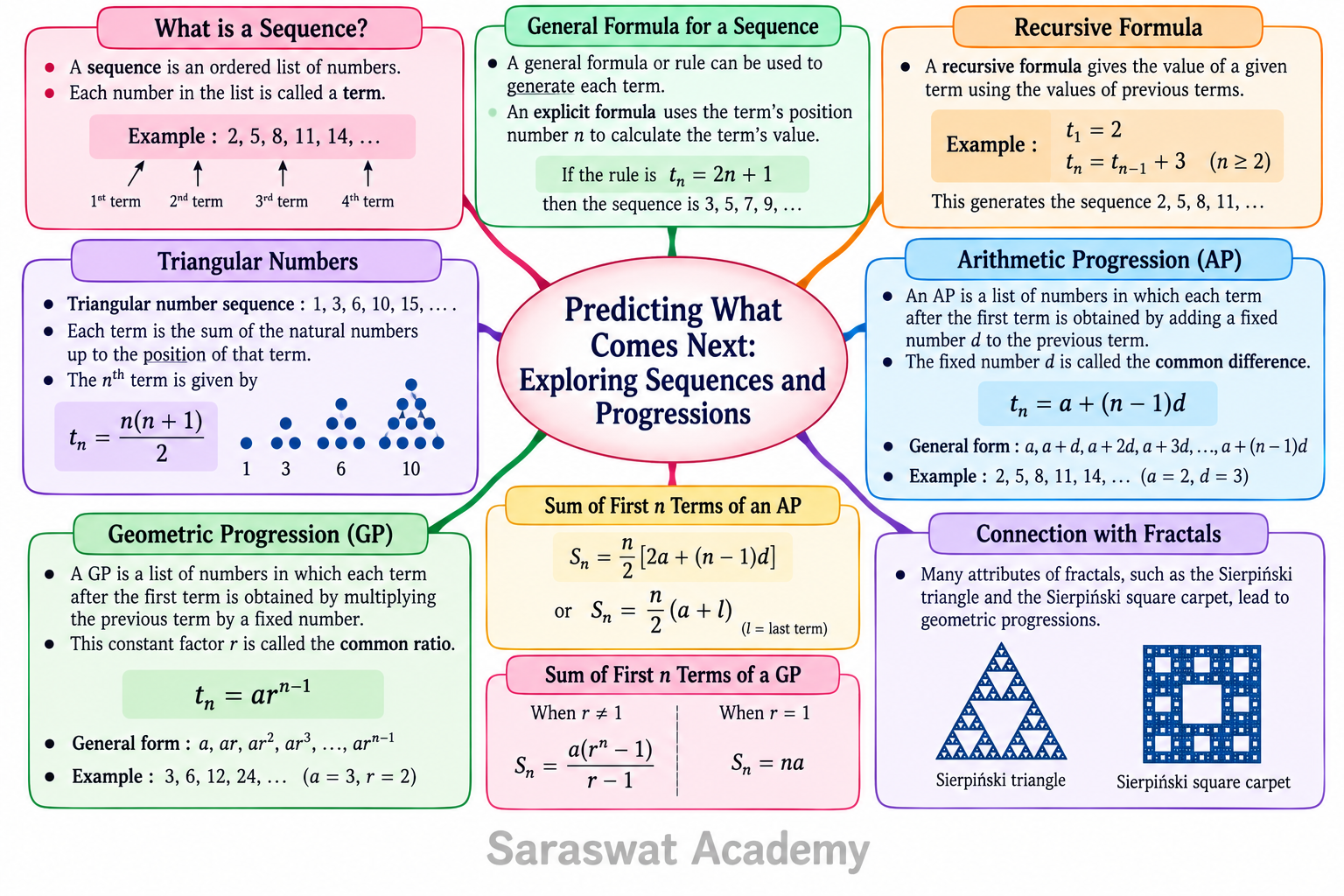
Explore the mind map to revise the main ideas before starting the chapter.
Chapter 8, “Predicting What Comes Next: Exploring Sequences and Progressions”, takes students into one of the most fascinating areas of mathematics—the world of patterns. 🔢✨
Patterns are not limited to textbooks. They can be found everywhere around us—from the arrangement of petals in flowers 🌸 and the rhythm of music 🎵 to population growth 👥, financial planning 💰, architecture 🏛️, and computer programming 💻. This chapter teaches students how these patterns can be represented mathematically using sequences and how mathematical rules can help us predict what comes next.
A sequence is an ordered list of numbers arranged according to a particular rule or pattern. The order of the terms is important because changing the order can change the sequence completely.
| 🔢 Sequence | 📋 First Few Terms | 💡 Pattern |
|---|---|---|
| Natural Numbers | 1, 2, 3, 4, 5, … | Add 1 each time |
| Odd Numbers | 1, 3, 5, 7, 9, … | Add 2 each time |
| Square Numbers | 1, 4, 9, 16, 25, … | 1², 2², 3², 4², … |
| Triangular Numbers | 1, 3, 6, 10, 15, … | Adding consecutive natural numbers |
Sequences may contain positive numbers, negative numbers, fractions, decimals, or other numerical forms. They may also be either finite or infinite.
| 📌 Type | 📖 Meaning | 🔎 Example |
|---|---|---|
| Finite Sequence | A sequence having a fixed number of terms. | 2, 4, 6, 8 |
| Infinite Sequence | A sequence that continues indefinitely. | 2, 4, 6, 8, 10, … |
Every number in a sequence is called a term. Terms are commonly represented using the notation:
t₁, t₂, t₃, …, tₙ
| Symbol | Meaning |
|---|---|
| t₁ | First term |
| t₂ | Second term |
| t₃ | Third term |
| tₙ | nth term |
This notation allows mathematicians to describe very long sequences without having to write every term. For example, instead of writing all the terms up to the 100th term, we can use a mathematical rule to directly find the required term.
An explicit rule, also called an nth-term formula, allows us to calculate a particular term directly using its position number. This is extremely useful when we want to find a distant term such as the 50th, 100th, or even 1000th term.
| 📐 Formula | 🎯 What It Helps Us Find |
|---|---|
| tn = 2n − 1 | Any term of the sequence 1, 3, 5, 7, … |
| tn = 5n − 2 | Any term of the sequence 3, 8, 13, 18, … |
For example, if tn = 2n − 1, then the 10th term can be found directly:
t₁₀ = 2(10) − 1 = 19
There is no need to calculate all nine preceding terms. 🚀
Explicit rules can also help us determine whether a particular number belongs to a sequence and, if it does, identify its position.
A recursive rule generates a new term using one or more previous terms. Instead of directly using the position number, we move through the sequence step by step.
| 🧠 Rule Type | ⚙️ How It Works | 📌 Example |
|---|---|---|
| Explicit Rule | Find a term directly from its position. | tn = 2n − 1 |
| Recursive Rule | Find a term using previous term(s). | tn = tn−1 + 2 |
A famous example is the Virahānka–Fibonacci Sequence, in which each new term is obtained by adding the previous two terms:
1, 1, 2, 3, 5, 8, 13, 21, 34, …
For example:
5 + 8 = 13
8 + 13 = 21
The chapter also introduces students to the historical contribution of the Indian mathematician Virahānka, whose work on such sequences predates the well-known work associated with Fibonacci by several centuries. 🇮🇳📚
One of the most important concepts in this chapter is the Arithmetic Progression (AP).
An arithmetic progression is a sequence in which the difference between every pair of consecutive terms remains constant.
| 🔢 AP | ➕ Common Difference |
|---|---|
| 2, 5, 8, 11, 14, … | 3 |
| 20, 17, 14, 11, 8, … | −3 |
| 1, 1.5, 2, 2.5, 3, … | 0.5 |
Three important quantities are used when studying an AP:
| Symbol | Meaning |
|---|---|
| a | First term |
| d | Common difference |
| n | Number or position of the term |
| tn | nth term |
The nth term of an arithmetic progression is given by:
tn = a + (n − 1)d
This formula allows us to find any term of an AP quickly and efficiently. ⚡
Arithmetic progressions are not just mathematical sequences. They can be used to model situations where a quantity increases or decreases by a constant amount.
| 🌍 Real-Life Situation | 📈 How AP Appears |
|---|---|
| Taxi fare | Fare increases by a fixed amount for each additional unit of distance. |
| Monthly savings | A person increases savings by a fixed amount every month. |
| Seating arrangements | Each row may contain a fixed number of additional seats. |
| Staircase design | Steps may follow a regular numerical pattern. |
| Salary increments | A fixed increase can produce an arithmetic pattern. |
The chapter also connects arithmetic progressions with coordinate geometry. When the terms of an AP are plotted against their positions, the points lie on a straight line. 📊📈
The chapter concludes with another beautiful mathematical idea: finding the sum of the first n natural numbers efficiently.
Instead of adding every number individually, the numbers can be paired from opposite ends:
1 + n
2 + (n − 1)
3 + (n − 2)
…
Each pair has the same sum. This elegant observation leads to the famous formula:
Sn = n(n + 1) / 2
| 📌 Quantity | 🔢 Formula |
|---|---|
| Sum of first n natural numbers | Sn = n(n + 1) / 2 |
| Sum of first 10 natural numbers | 10 × 11 / 2 = 55 |
| Sum of first 100 natural numbers | 100 × 101 / 2 = 5050 |
This result is closely connected with triangular numbers 🔺 and also introduces students to the historical contributions of the Indian mathematician Āryabhaṭa.
| 🎯 Concept | 💡 What You Will Understand |
|---|---|
| 🔢 Sequences | How numbers can be arranged according to mathematical patterns. |
| 🔍 Terms | How individual positions in a sequence are represented. |
| ⚡ Explicit Rules | How to find any term directly using an nth-term formula. |
| 🔄 Recursive Rules | How new terms can be generated from previous terms. |
| 📈 Arithmetic Progression | How sequences with a constant difference are formed. |
| 📐 AP Formula | How to calculate the nth term using tn = a + (n − 1)d. |
| ➕ Sum of Numbers | How to calculate the sum of the first n natural numbers efficiently. |
| 🌍 Applications | How sequences and progressions appear in real-life situations. |
| 🧠 Skill | 📖 How This Chapter Develops It |
|---|---|
| 👀 Observation | Identifying hidden patterns in numbers and figures. |
| 🧩 Logical Reasoning | Discovering the rule that connects different terms. |
| 🔢 Algebraic Thinking | Representing patterns using mathematical formulas. |
| 📊 Analytical Thinking | Comparing sequences and examining their behaviour. |
| 🎯 Problem Solving | Applying sequence and progression formulas to practical problems. |
| 💻 Computational Thinking | Understanding step-by-step rules used in algorithms and programming. |
Sequences and progressions form an important foundation for higher mathematics. The ability to recognise patterns and express them using mathematical rules is useful far beyond the classroom.
| 📚 Future Area | 🔗 Connection with Sequences |
|---|---|
| 📐 Algebra | Generalising numerical patterns using formulas. |
| 📊 Statistics & Data Science | Studying numerical trends and patterns. |
| 💻 Computer Programming | Using repetitive rules and algorithms. |
| 🤖 Artificial Intelligence | Analysing patterns in data and making predictions. |
| 💰 Finance | Understanding regular savings, payments, and growth patterns. |
| 🏗️ Engineering | Using mathematical patterns in design and modelling. |
| 🔬 Scientific Modelling | Representing changing quantities mathematically. |
Chapter 8 transforms simple number patterns into powerful mathematical tools. Students begin by learning what sequences are and how their terms are organised. They then discover how explicit rules and recursive rules can describe and generate sequences.
The study of Arithmetic Progressions introduces the important concepts of the first term, common difference, and nth-term formula. Students also discover how APs can represent real-life situations and how their graphical representation connects algebra with geometry.
Finally, students learn the elegant formula for the sum of the first n natural numbers and explore its connection with triangular numbers and the historical development of mathematics in India. 🇮🇳📚
Overall, this chapter develops pattern recognition, logical reasoning, algebraic thinking, analytical ability, and problem-solving skills. These skills provide a strong foundation for higher mathematical concepts such as geometric progressions, series, calculus, algorithms, data science, cryptography, artificial intelligence, financial mathematics, and scientific modelling. 🚀
🔢 Find the Pattern → 🧠 Discover the Rule → 📐 Build the Formula → 🔮 Predict What Comes Next!
Sequences and arithmetic progressions are used in many real-life situations where values increase, decrease, or follow a regular pattern. Understanding these concepts helps us predict future values, analyse trends, and solve practical problems efficiently.
| Application Area | How Sequences and Progressions are Used |
|---|---|
| Banking and Finance | Monthly savings, recurring deposits, loan repayments, and investment plans often follow arithmetic progressions or predictable numerical patterns. |
| Salary Increments | If an employee receives a fixed annual increment, the salary over the years forms an arithmetic progression. |
| Taxi and Cab Fare | Taxi fares usually consist of a fixed booking charge plus a fixed amount per kilometre, forming an arithmetic progression, as demonstrated in this chapter. |
| Construction and Architecture | Engineers use numerical patterns while designing staircases, seating arrangements, floor tiles, pillars, and structural layouts. |
| Computer Programming | Algorithms use sequences to generate numbers, process loops, search data, encrypt information, and solve computational problems efficiently. |
| Artificial Intelligence (AI) | AI systems analyse sequential data such as speech, text, stock prices, and weather information to make predictions and intelligent decisions. |
| Data Science | Data analysts study numerical sequences to identify trends, forecast future values, and make business predictions. |
| Weather Forecasting | Daily temperature, rainfall, and climate data are analysed as sequences to predict future weather conditions. |
| Population Growth | Governments use population data collected over many years to estimate future population and plan public services. |
| Sports Analytics | Player scores, team performance, and tournament statistics are studied using numerical sequences to evaluate consistency and predict outcomes. |
| Music and Rhythm | Musical beats, rhythmic patterns, and note arrangements often follow repeating or increasing sequences. |
| Nature | The Virahānka–Fibonacci sequence appears in flower petals, pine cones, sunflower seeds, pineapples, shells, and leaf arrangements. |
| Traffic Management | Traffic engineers analyse vehicle counts over time to predict congestion and improve road planning. |
| Business Forecasting | Companies study monthly sales, profits, and customer growth patterns to estimate future demand. |
| Electricity and Water Bills | Regular increases in monthly consumption can be analysed using sequences to estimate future expenses. |
| Education | Schools analyse students' marks over different examinations to monitor academic progress and identify improvement trends. |
| Stock Market | Investors study sequences of share prices to analyse trends and make investment decisions. |
| Manufacturing Industries | Factories use production sequences to plan inventory, schedule manufacturing, and estimate future output. |
| Scientific Research | Scientists analyse experimental observations collected over time to identify patterns and develop mathematical models. |
| Space and Astronomy | Astronomers use mathematical sequences to study planetary motion, satellite orbits, and repeating astronomical events. |
Sequences and progressions help us recognise patterns, predict future values, and solve practical problems efficiently. From taxi fares and salary growth to artificial intelligence, finance, architecture, scientific research, and natural phenomena like the Virahānka–Fibonacci pattern, the concepts learned in this chapter have applications in almost every field of modern life.
| Concept | Memory Trick |
|---|---|
| Sequence | Sequence = Set in Order → Numbers arranged one after another. |
| Term | t = Term → Each number in a sequence is called a term. |
| Finite Sequence | Finite = Finish → Has a fixed number of terms. |
| Infinite Sequence | Infinite = Infinity (∞) → Never ends. |
| Explicit Rule | Explicit = Direct → Find any term using a formula. |
| Recursive Rule | Recursive = Previous Rule → Next term comes from earlier term(s). |
| Arithmetic Progression (AP) | AP = Add Pattern → Add/Subtract the same number every time. |
| Common Difference (d) | d = Difference → Same gap between consecutive terms. |
| First Term (a) | a = (Start) → The first number of the AP. |
| AP Formula | AD Formula → a + (n − 1)d (Start + Extra Difference). |
| Recursive AP | Previous + d → Every next term = Previous term + Common Difference. |
| Virahānka–Fibonacci Sequence | 1 + 2 = 3, 2 + 3 = 5 → Add the previous two terms. |
| Sum of First n Natural Numbers | "Next × Current ÷ 2" → n(n + 1)/2 |
| Triangular Numbers | Triangle = Total → Sum of first n natural numbers. |
| Square Numbers | Squares Grow by Odd Numbers → +3, +5, +7, +9, ... |
| Odd Numbers | 2n − 1 → Always remember this formula. |
| Checking an AP | Equal Difference = AP |
| Finding nth Term | Need Position? → Use the Explicit Formula. |
| Finding Next Term | Need Next? → Use the Recursive Rule. |
| Topic | Quick Revision |
|---|---|
| Sequence | An ordered list of numbers following a particular rule or pattern. |
| Term | Each number in a sequence is called a term. |
| Types of Sequences | Finite (fixed number of terms) and Infinite (continues forever). |
| Notation | t₁, t₂, t₃, …, tₙ represent the first, second, third, … nth term. |
| Explicit Rule | Find any term directly using a formula involving n. |
| Recursive Rule | Find each term using one or more previous terms. |
| Arithmetic Progression (AP) | A sequence in which the difference between consecutive terms is constant. |
| First Term | a = First term of the AP. |
| Common Difference | d = Next Term − Previous Term |
| General Form of AP | a, a + d, a + 2d, a + 3d, … |
| nth Term of AP | tn = a + (n − 1)d |
| Recursive Rule of AP | t₁ = a, tn = tn−1 + d (for n ≥ 2) |
| Virahānka–Fibonacci Sequence | Each term is the sum of the previous two terms. Example: 1, 2, 3, 5, 8, 13, … |
| Odd Numbers Formula | tn = 2n − 1 |
| Triangular Numbers | Each term is the sum of the first n natural numbers. |
| Square Numbers | Successive square numbers increase by odd numbers: +3, +5, +7, +9, … |
| Sum of First n Natural Numbers | Sn = n(n + 1) / 2 |
| How to Identify an AP? | If the difference between consecutive terms is the same, it is an AP. |
| Important Applications | Salary increments, taxi fares, savings, business forecasting, computer algorithms, AI, architecture, and population growth. |
| Exam Tips |
• Check the common difference first. • Use the explicit formula for large term numbers. • Use the recursive rule to generate successive terms. • Memorise tn = a + (n − 1)d and Sn = n(n + 1)/2. |
| Question | Answer |
|---|---|
| 1. What is a sequence? | A sequence is an ordered list of numbers or objects arranged according to a specific rule or pattern. |
| 2. What is a term in a sequence? | Each number in a sequence is called a term. |
| 3. What is the difference between a finite and an infinite sequence? | A finite sequence has a fixed number of terms, whereas an infinite sequence continues endlessly. |
| 4. What is an explicit rule? | An explicit rule is a formula that allows you to find the nth term of a sequence directly without calculating previous terms. |
| 5. What is a recursive rule? | A recursive rule finds each new term using one or more previous terms of the sequence. |
| 6. Why is the explicit formula useful? | It helps find any term, such as the 50th or 100th term, quickly without writing all the previous terms. |
| 7. What is an Arithmetic Progression (AP)? | An Arithmetic Progression is a sequence in which the difference between consecutive terms is always the same. |
| 8. What is the common difference? | The common difference (d) is the constant value added to or subtracted from one term to get the next term. |
| 9. What is the general form of an AP? | a, a + d, a + 2d, a + 3d, ... where a is the first term and d is the common difference. |
| 10. What is the formula for the nth term of an AP? | tn = a + (n − 1)d |
| 11. How do you identify an Arithmetic Progression? | If the difference between every pair of consecutive terms is the same, the sequence is an AP. |
| 12. Can the common difference be negative? | Yes. If each term decreases by the same amount, the common difference is negative. |
| 13. What is the Virahānka–Fibonacci sequence? | It is a sequence in which each term is obtained by adding the previous two terms, beginning with 1 and 2. |
| 14. Why is the Virahānka–Fibonacci sequence important? | It appears in mathematics, computer science, nature, architecture, and many scientific applications. |
| 15. What is the formula for the sum of the first n natural numbers? | Sn = n(n + 1) / 2 |
| 16. What are triangular numbers? | Triangular numbers are obtained by adding the first n natural numbers successively. |
| 17. How are square numbers related to odd numbers? | Each square number is obtained by adding consecutive odd numbers. |
| 18. Where are sequences used in real life? | Sequences are used in finance, banking, computer programming, artificial intelligence, architecture, weather forecasting, business, and scientific research. |
| 19. Why do we study sequences and progressions? | They help us recognise patterns, predict future values, solve mathematical problems, and model real-life situations. |
| 20. Which formulas should be memorised for exams? |
• tn = a + (n − 1)d • tn = 2n − 1 (Odd Numbers) • Sn = n(n + 1)/2 • Recursive AP: tn = tn−1 + d |
Continue learning with other Class 9 Mathematics chapters.
Strengthen your understanding with extra practice materials designed to help you prepare for your exams.
Practise important questions and improve your concepts.
Explore Worksheet →Test your preparation with exam-style question papers.
View Test Paper→Explore more NCERT solutions and other resources with Saraswat Academy.
Get chapter-wise mathematics solutions with clear explanations and step-by-step answers.
Explore Solutions →Study important concepts, exercise solutions and chapter-wise mathematics answers.
Explore Solutions →Understand science concepts with detailed answers to textbook questions.
Explore Solutions →Explore chapter-wise science solutions, explanations and useful study resources.
Explore Solutions →Improve your English skills with detailed answers to textbook questions.
Explore Solutions →Improve your English skills with detailed answers to textbook questions.
Explore Resources →Improve your Hindi skills with detailed answers to textbook questions.
Explore Resources →Improve your Hindi skills with detailed answers to textbook questions.
Explore Resources →Improve your Hindi skills with detailed answers to textbook questions.
Explore Resources →Improve your Social Science skills with detailed answers to textbook questions.
Explore Resources →Improve your Social Science skills with detailed answers to textbook questions.
Explore Resources →Improve your Social Science skills with detailed answers to textbook questions.
Explore Resources →Detailed NCERT solutions for class 9 sanskrit.
Explore Resources →