Class 10
NCERT Solutions for Class 10 Mathematics
Get chapter-wise mathematics solutions with clear explanations and step-by-step answers.
Explore Solutions →Get a quick overview of the important concepts in this chapter.
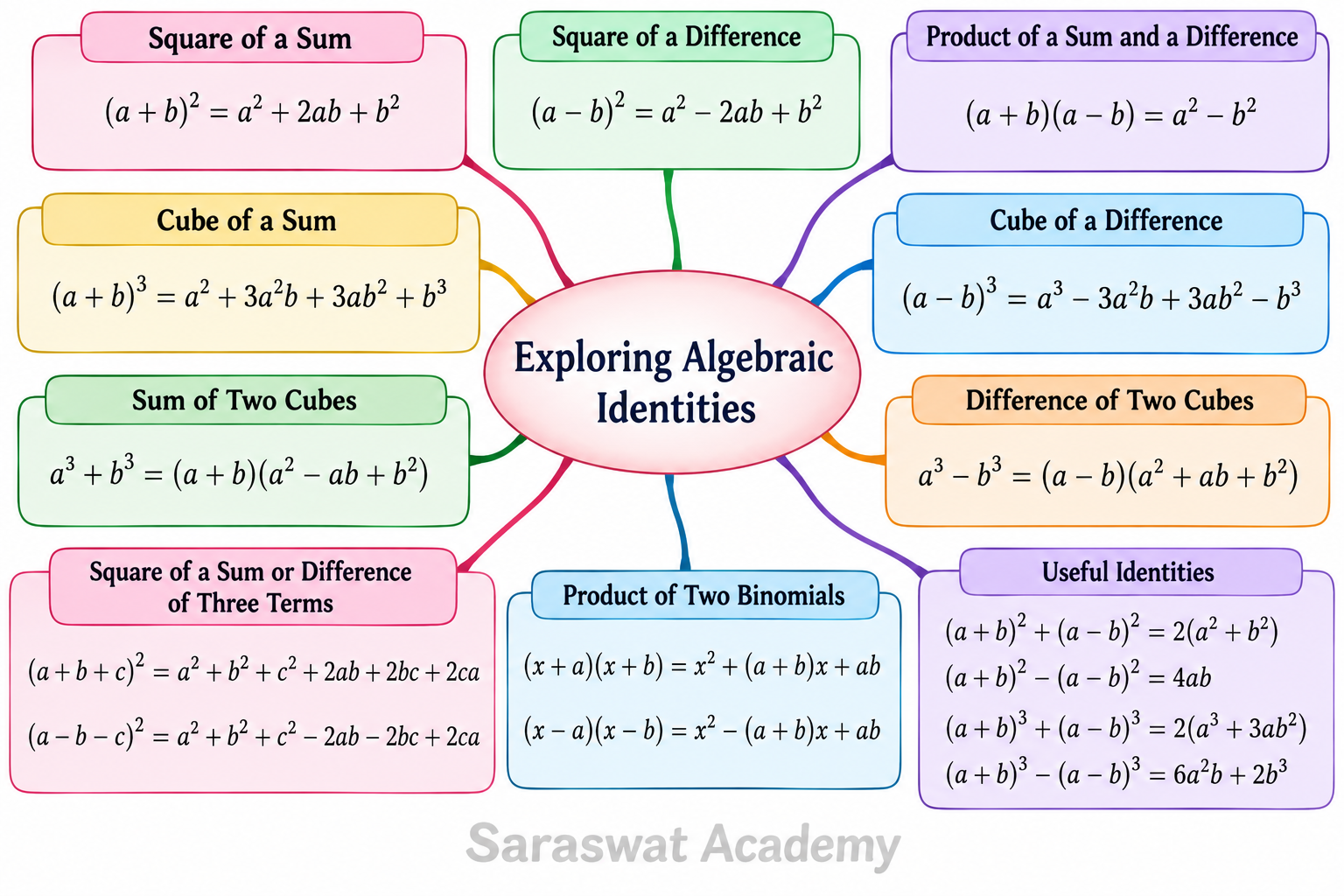
Explore the mind map to revise the main ideas before starting the chapter.
Algebraic identities are mathematical relationships that remain true for all permissible values of their variables. They help simplify expressions, identify patterns and solve problems.
| Concept | Important Point |
|---|---|
| Algebraic Identity | An equality true for all permissible values of variables. |
| Equation vs Identity | An equation may hold for specific values; an identity holds for all permissible values. |
| Consecutive Squares | Patterns involving squares of consecutive numbers can reveal algebraic relationships. |
| Verification | Substitution can check an identity for particular values, but does not prove it generally. |
| Applications | Identities help expand, factorise and simplify algebraic expressions. |
| Identity | Algebraic Formula |
|---|---|
| Square of a Sum | (a + b)² = a² + 2ab + b² |
| Square of a Difference | (a − b)² = a² − 2ab + b² |
| Difference of Squares | a² − b² = (a − b)(a + b) |
| Product of Sum and Difference | (a + b)(a − b) = a² − b² |
| Product of Two Binomials | (x + a)(x + b) = x² + (a + b)x + ab |
| Square of Three Terms | (a + b + c)² = a² + b² + c² + 2ab + 2bc + 2ca |
| Expression | Using Identity | Result |
|---|---|---|
| 21² | (20 + 1)² | 441 |
| 49 × 51 | (50 − 1)(50 + 1) | 2499 |
| (x + 3)² | Square of a sum | x² + 6x + 9 |
| (x − 4)² | Square of a difference | x² − 8x + 16 |
Algebraic identities are not just mathematical formulas—they are powerful tools used to simplify calculations, solve problems quickly, and model real-life situations. Their applications extend to science, engineering, finance, architecture, computer science, and many other fields.
| Application | How Algebraic Identities Are Used |
|---|---|
| Mental Mathematics | Quickly calculating squares of numbers such as 49², 99², or 205² without using a calculator. |
| Architecture & Construction | Finding the area of square and rectangular structures, estimating materials, and simplifying design calculations. |
| Engineering | Simplifying algebraic expressions while designing machines, bridges, electrical circuits, and mechanical systems. |
| Computer Science | Optimising algorithms, simplifying mathematical computations, and improving program efficiency in software development. |
| Physics | Expanding and simplifying equations used in motion, energy, electricity, and mechanics. |
| Business & Finance | Performing quick profit, loss, investment, and budgeting calculations involving algebraic expressions. |
| Data Analysis | Simplifying mathematical models and formulas used to analyse numerical data and trends. |
| Scientific Research | Reducing complex equations into simpler forms for accurate calculations and problem-solving. |
| Competitive Examinations | Saving time by performing faster calculations in aptitude and mathematics-based examinations. |
| Higher Mathematics | Providing the foundation for quadratic equations, polynomial factorisation, coordinate geometry, calculus, and advanced algebra. |
Key Takeaway: Algebraic identities transform lengthy calculations into simple and systematic steps, making mathematical problem-solving faster, more accurate, and widely applicable in everyday life and modern technology.
The following memory tricks will help you remember the important algebraic identities quickly and accurately during examinations.
Formula:
(a + b)2 = a2 + 2ab + b2
Memory Trick: "Plus → Plus → Plus"
Shortcut: Square → Double Product → Square
Formula:
(a − b)2 = a2 − 2ab + b2
Memory Trick: "Only the Middle Changes."
Remember: The sign of the middle term always follows the sign inside the bracket.
Formula:
(a + b)(a − b) = a2 − b2
Memory Trick: "Same Start, Opposite End."
Shortcut: Difference of Squares
Formula:
(a + b + c)2 = a2 + b2 + c2 + 2ab + 2bc + 2ca
Memory Trick: "Three Squares, Three Double Products."
Remember: There are always 3 squares and 3 double products.
| Identity | Memory Trick |
|---|---|
| (a + b)2 | Square – Double Product – Square |
| (a − b)2 | Same as above, only the middle becomes negative |
| (a + b)(a − b) | Difference of Squares (No Middle Term) |
| (a + b + c)2 | 3 Squares + 3 Double Products |
| Code | Meaning |
|---|---|
| SDS | Square → Double Product → Square |
| SMN | Same Formula, Middle Negative |
| DS | Difference of Squares |
| 3S + 3DP | 3 Squares + 3 Double Products |
Remember this one sentence:
"Square the terms, double the products, watch the signs, and never forget the middle term!"
Algebraic identities are equations that are true for every value of the variables. They are used to expand expressions, factorise polynomials, simplify calculations, and solve algebraic problems quickly.
| S. No. | Algebraic Identity |
|---|---|
| 1 | (a + b)2 = a2 + 2ab + b2 |
| 2 | (a − b)2 = a2 − 2ab + b2 |
| 3 | (a + b + c)2 = a2 + b2 + c2 + 2ab + 2bc + 2ca |
| 4 | (a + b)(a − b) = a2 − b2 |
| 5 | (x + a)(x + b) = x2 + (a + b)x + ab |
| 6 | (ax + b)(cx + d) = acx2 + (ad + bc)x + bd |
| 7 | x3 − y3 = (x − y)(x2 + xy + y2) |
| 8 | x3 + y3 = (x + y)(x2 − xy + y2) |
| 9 | (x + y)3 = x3 + 3x2y + 3xy2 + y3 |
| 10 | (x − y)3 = x3 − 3x2y + 3xy2 − y3 |
| 11 | x3 + y3 + z3 − 3xyz = (x + y + z)(x2 + y2 + z2 − xy − xz − yz) |
An algebraic identity is an equation that is true for every value of the variable(s).
An identity is true for all values of the variables, whereas an equation is true only for specific value(s) of the variables.
Algebraic identities help simplify calculations, expand expressions, factorise polynomials, and solve mathematical problems quickly and accurately.
(a + b)2 = a2 + 2ab + b2.
(a − b)2 = a2 − 2ab + b2.
(a + b)(a − b) = a2 − b2. This identity is also called the Difference of Squares.
(a + b + c)2 = a2 + b2 + c2 + 2ab + 2bc + 2ca.
The chapter explains algebraic identities using geometrical models such as squares, rectangles, cubes, and algebra tiles to develop conceptual understanding.
Algebra tiles are geometric models used to represent algebraic expressions, multiplication, expansion, and factorisation visually.
Factorisation is the process of writing an algebraic expression as the product of two or more simpler factors. Algebraic identities make this process easier.
They help calculate squares, cubes, and products of numbers quickly without lengthy multiplication.
x3 − y3 = (x − y)(x2 + xy + y2).
x3 + y3 = (x + y)(x2 − xy + y2).
The chapter introduces:
(x + y)3 = x3 + 3x2y + 3xy2 + y3
(x − y)3 = x3 − 3x2y + 3xy2 − y3.
Rational algebraic expressions are simplified by factorising the numerator and denominator and cancelling the common factors, provided those factors are not equal to zero.
Algebraic identities are used in engineering, architecture, computer science, physics, data analysis, finance, and competitive examinations to simplify calculations and solve mathematical problems efficiently.
Continue learning with other Class 9 Mathematics chapters.
Strengthen your understanding with extra practice materials designed to help you prepare for your exams.
Practise important questions and improve your concepts.
Explore Worksheet →Test your preparation with exam-style question papers.
View Test Paper→Explore more NCERT solutions and other resources with Saraswat Academy.
Get chapter-wise mathematics solutions with clear explanations and step-by-step answers.
Explore Solutions →Study important concepts, exercise solutions and chapter-wise mathematics answers.
Explore Solutions →Understand science concepts with detailed answers to textbook questions.
Explore Solutions →Explore chapter-wise science solutions, explanations and useful study resources.
Explore Solutions →Improve your English skills with detailed answers to textbook questions.
Explore Solutions →Improve your English skills with detailed answers to textbook questions.
Explore Resources →Improve your Hindi skills with detailed answers to textbook questions.
Explore Resources →Improve your Hindi skills with detailed answers to textbook questions.
Explore Resources →Improve your Hindi skills with detailed answers to textbook questions.
Explore Resources →Improve your Social Science skills with detailed answers to textbook questions.
Explore Resources →Improve your Social Science skills with detailed answers to textbook questions.
Explore Resources →Improve your Social Science skills with detailed answers to textbook questions.
Explore Resources →Detailed NCERT solutions for class 9 sanskrit.
Explore Resources →