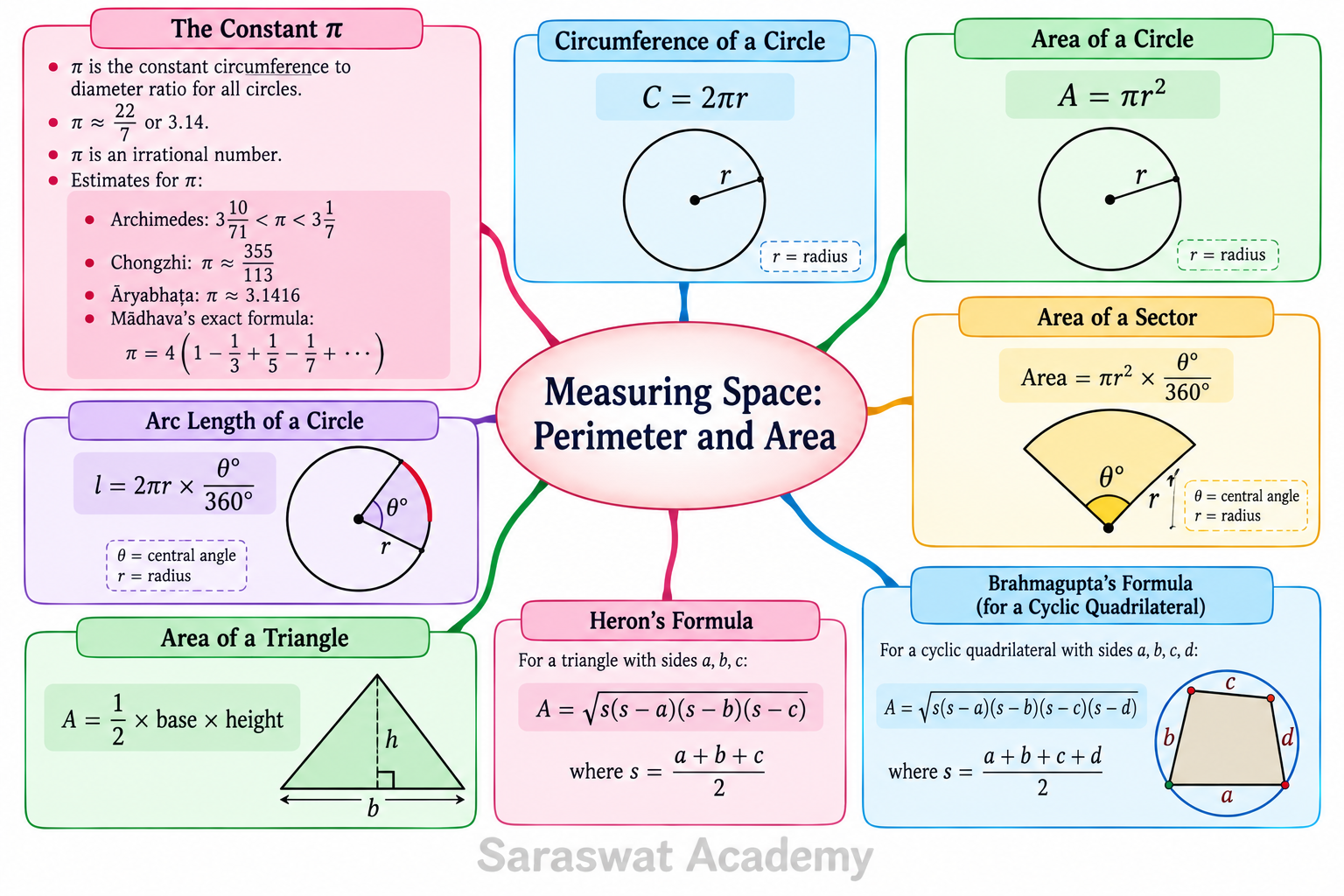
Class 9 Mathematics NCERT Ganita Manjari Chapter 6
Measuring Space: Perimeter and Area

Chapter Overview

๐Ÿ“ Chapter 6 โ€“ Measuring Space: Perimeter and Area

Chapter 6, โ€œMeasuring Space: Perimeter and Areaโ€, explores one of the most useful ideas in geometryโ€”how to measure the boundary and surface of two-dimensional figures. ๐Ÿ“โœจ

Instead of simply presenting formulas, the chapter begins with an interesting real-life situation involving a 400 m athletics track. ๐Ÿƒโ€โ™‚๏ธ๐Ÿƒโ€โ™€๏ธ Students discover why runners in different lanes begin their races from different positions. This practical example naturally leads to the study of the perimeter of circles and the concept of circumference.

Throughout the chapter, students are encouraged to understand why formulas work, rather than merely memorising them. Through geometry, visual reasoning, historical discoveries, activities, and real-life applications, perimeter and area become meaningful mathematical ideas.


๐Ÿƒ 1. The Athletics Track โ€” Why Do Runners Start at Different Places?

Imagine a 400 m running track with several lanes. The inner lane is shorter than the outer lanes because the outer lane follows a larger circular path. If all runners started from exactly the same point, athletes in the outer lanes would have to run farther.

๐Ÿƒ Lane โญ• Size of Curved Path ๐Ÿ“ Distance Covered
Inner Lane Smaller radius Shorter curved distance
Middle Lane Larger radius Longer curved distance
Outer Lane Largest radius Longest curved distance

Therefore, runners in the outer lanes are given a staggered starting position so that every runner covers the same total distance. This simple sporting situation provides a practical reason for studying the circumference of circles. ๐ŸŸ๏ธ๐Ÿ“


๐Ÿ“ 2. What Is Perimeter?

The perimeter of a plane figure is the total distance around its boundary. In everyday language, it is similar to asking: โ€œHow much fencing is needed to go around this shape?โ€ ๐Ÿก

๐Ÿ”ท Figure ๐Ÿ“ Perimeter ๐Ÿ’ก Meaning
Square 4 ร— side Four equal sides
Rectangle 2(length + breadth) Two pairs of equal sides
Equilateral Triangle 3 ร— side Three equal sides
Circle 2ฯ€r Distance around the circle

For a circle, the perimeter has a special name: circumference. โญ•


โญ• 3. Understanding Circumference and ฯ€

When the circumference of a circle is compared with its diameter, something remarkable happens: the ratio is always the same, regardless of the size of the circle.

ฯ€ = Circumference รท Diameter

Therefore:

Circumference = ฯ€ ร— Diameter

Since Diameter = 2r,

โญ• Circumference = 2ฯ€r

๐Ÿ”ค Symbol ๐Ÿ“– Meaning
r Radius of the circle
d Diameter of the circle
ฯ€ Constant ratio of circumference to diameter
C Circumference

๐ŸŒ 4. The Fascinating History of ฯ€

The value of ฯ€ has fascinated mathematicians for thousands of years. Different civilizations developed increasingly accurate ways of estimating it.

๐Ÿ‘จโ€๐Ÿ”ฌ Mathematician / Civilization ๐ŸŒŸ Contribution
๐Ÿบ Ancient Civilizations Developed early approximations for the ratio between circumference and diameter.
Archimedes Used polygons to obtain increasingly accurate bounds for ฯ€.
ฤ€ryabhaแนญa ๐Ÿ‡ฎ๐Ÿ‡ณ Provided a remarkably accurate approximation of ฯ€ in ancient India.
Brahmagupta ๐Ÿ‡ฎ๐Ÿ‡ณ Made important contributions to geometry and mathematical methods.
Zu Chongzhi ๐Ÿ‡จ๐Ÿ‡ณ Obtained a highly accurate rational approximation of ฯ€.
Mฤdhava ๐Ÿ‡ฎ๐Ÿ‡ณ Developed an important infinite series related to ฯ€.
Srinivasa Ramanujan ๐Ÿ‡ฎ๐Ÿ‡ณ Developed remarkable formulas and series involving ฯ€.

The history of ฯ€ demonstrates that mathematical knowledge has developed through the contributions of mathematicians from different cultures and periods. ๐ŸŒ๐Ÿ“š


โ™พ๏ธ 5. Why Is ฯ€ an Irrational Number?

The number ฯ€ cannot be expressed exactly as a ratio of two integers. Therefore, ฯ€ is an irrational number.

ฯ€ = 3.14159265358979323846โ€ฆ

Its decimal expansion continues indefinitely without repeating in a fixed pattern.

๐Ÿ“Œ Property ๐Ÿ” ฯ€
Type of number Irrational number
Decimal expansion Non-terminating
Repeating pattern? Does not repeat periodically
Approximate value 3.14159โ€ฆ

๐ŸŒ™ 6. Length of an Arc

An arc is a part of the circumference of a circle. When a circle is divided into smaller parts, each curved part is called an arc.

โญ• Part of Circle ๐Ÿ“ Central Angle ๐Ÿ“ Arc Length
Full Circle 360ยฐ 2ฯ€r
Semicircle 180ยฐ ฯ€r
Quarter Circle 90ยฐ ฯ€r/2
General Arc ฮธยฐ (ฮธ/360ยฐ) ร— 2ฯ€r

The concept of arc length becomes especially useful when dealing with curved boundaries, sectors, circular tracks, wheels, and composite figures. ๐Ÿ”„


๐ŸŸ๏ธ 7. Applying Arc Length to Athletics Tracks

The idea of arc length explains why staggered starting positions are necessary on curved athletics tracks.

A larger radius produces a larger circumference. Therefore, an athlete running in an outer lane travels a greater distance along the curved portion.

๐Ÿ“Œ Quantity ๐Ÿ” Effect
Radius increases โ†—๏ธ Circumference increases
Radius decreases โ†˜๏ธ Circumference decreases
Outer lane ๐Ÿƒ Longer curved distance
Inner lane ๐Ÿƒ Shorter curved distance

This is a beautiful example of how a mathematical formula directly explains something we observe in real life. ๐Ÿ’ก


๐Ÿงฉ 8. Perimeter of Composite and Curved Figures

Many real-life objects are not simple squares, rectangles, or circles. They may contain a combination of straight and curved boundaries.

๐Ÿ”ท Figure ๐Ÿงฎ What We Need to Add
Semicircular shape Straight diameter + semicircular arc
Sector Two radii + arc length
Composite figure All lengths forming the outer boundary
Curved track Straight sections + curved sections

The key strategy is to identify only the outer boundary when calculating perimeter. ๐Ÿ”๐Ÿ“


๐Ÿง  9. Mathematical Puzzles and Paradoxes

The chapter also contains mathematical puzzles and surprising situations that challenge students to think beyond routine calculations.

These activities encourage students to ask:

๐Ÿค” Question ๐Ÿง  Skill Developed
Why does a formula work? Conceptual reasoning
Can two shapes have the same perimeter but different areas? Geometric thinking
Why does changing a radius affect circumference? Logical analysis
Can a mathematical pattern produce a surprising result? Critical thinking

๐Ÿ“ฆ 10. From Perimeter to Area

After studying the measurement of boundaries, the chapter changes focus to the measurement of the surface enclosed by a figure. This quantity is called area.

A simple way to understand the difference is:

๐Ÿ“ Concept ๐Ÿ’ก Question It Answers ๐Ÿ  Real-Life Example
Perimeter How much distance is around it? Amount of fencing required
Area How much surface does it cover? Amount of flooring required

โ–ญ 11. Area of Rectangles and Squares

The area of a rectangle can be understood by counting the number of equal-sized square units that fit inside it.

๐Ÿ“ Area of Rectangle = Length ร— Breadth

For a square, all sides are equal:

โฌœ Area of Square = Side ร— Side = Sideยฒ

๐Ÿ”ท Figure ๐Ÿ“ Formula
Rectangle l ร— b
Square sยฒ

โ–ฑ 12. Area of a Parallelogram

The area formula for a parallelogram is not simply something to memorise. It can be understood by cutting and rearranging the figure into a rectangle.

๐Ÿ“ Area of Parallelogram = Base ร— Height

The important point is that the height is the perpendicular distance between the parallel sidesโ€”not necessarily the slanting side.

๐Ÿ“Œ Quantity Symbol
Base b
Perpendicular Height h
Area bh

๐Ÿ”บ 13. Area of a Triangle

A triangle can be understood by comparing it with a parallelogram. Two congruent triangles can be combined to form a parallelogram.

๐Ÿ”บ Area of Triangle = ยฝ ร— Base ร— Height

๐Ÿ“Œ Quantity ๐Ÿ”ค Symbol
Base b
Perpendicular Height h
Area ยฝbh

๐Ÿ“ 14. Median of a Triangle and Equal Areas

A fascinating geometric property discussed in the chapter is that a median of a triangle divides the triangle into two triangles having equal areas.

This happens because the two smaller triangles have:

๐Ÿ” Property ๐Ÿ“ Reason
Equal bases The median divides the opposite side into two equal parts.
Same altitude Both triangles share the same perpendicular height.
Equal areas Area = ยฝ ร— base ร— height.

This is a beautiful example of how a geometric property follows naturally from an area formula. ๐Ÿง โœจ


๐Ÿ“ 15. Heron's Formula

What if we know the three sides of a triangle but do not know its height? Heron's Formula provides an elegant solution.

For a triangle with sides a, b, c, first calculate the semiperimeter:

s = (a + b + c) / 2

Then the area is:

๐Ÿ”บ Area = โˆš[s(s โˆ’ a)(s โˆ’ b)(s โˆ’ c)]

๐Ÿ”ค Symbol ๐Ÿ“– Meaning
a, b, c Three sides of the triangle
s Semiperimeter
Area Area calculated using the three sides

Heron's Formula is especially useful when the height of a triangle is difficult or inconvenient to determine. ๐Ÿ”บ๐Ÿ“


โฌ› 16. Brahmagupta's Formula

The chapter extends the study of area to quadrilaterals and introduces Brahmagupta's Formula for a cyclic quadrilateralโ€”a quadrilateral whose four vertices lie on a common circle.

If the sides are a, b, c, d, then its semiperimeter is:

s = (a + b + c + d) / 2

For a cyclic quadrilateral:

โฌ› Area = โˆš[(s โˆ’ a)(s โˆ’ b)(s โˆ’ c)(s โˆ’ d)]

This formula demonstrates how mathematical ideas can be extended from triangles to more general geometric figures.


๐Ÿ”— 17. Special Cases and Generalisation

One of the deeper mathematical ideas in this chapter is generalisation. A powerful mathematical formula may apply to a broad class of figures, while familiar formulas can appear as special cases.

๐Ÿง  Idea ๐Ÿ“– Meaning
Special Case A particular situation obtained from a more general mathematical idea.
Generalisation Extending a mathematical relationship so that it applies to a wider range of situations.
Why Important? It helps students see mathematics as a connected system rather than isolated formulas.

โญ• 18. Area of a Circle

The area of a circle can be developed through elegant geometric reasoning. One way to understand the result is to imagine dividing a circle into many thin sectors and rearranging them.

As the number of sectors becomes larger, the rearranged figure increasingly resembles a rectangle.

โญ• Area of Circle = ฯ€rยฒ

๐Ÿ”ค Symbol ๐Ÿ“– Meaning
ฯ€ Constant approximately equal to 3.14159โ€ฆ
r Radius of the circle
ฯ€rยฒ Area enclosed by the circle

๐Ÿฅง 19. Area of a Sector

A sector is the region enclosed by two radii and the corresponding arc of a circle. It resembles a slice of a circular pie. ๐Ÿฅง

If the central angle is ฮธยฐ, then:

Area of Sector = (ฮธ/360ยฐ) ร— ฯ€rยฒ

๐Ÿฅง Sector ๐Ÿ“ Central Angle ๐Ÿ“Š Fraction of Circle
Full circle 360ยฐ 1
Semicircle 180ยฐ 1/2
Quarter circle 90ยฐ 1/4

๐Ÿง  20. Perimeter vs Area โ€” Never Confuse Them!

๐Ÿ“Œ Feature ๐Ÿ“ Perimeter ๐Ÿ“ฆ Area
Measures Boundary Enclosed surface
Dimension One-dimensional measure Two-dimensional measure
Typical unit cm, m, km cmยฒ, mยฒ, kmยฒ
Example Fencing a garden Covering a garden with grass
Circle 2ฯ€r ฯ€rยฒ

๐ŸŒ 21. Perimeter and Area in Real Life

The concepts in this chapter have countless practical applications.

๐ŸŒŸ Field ๐Ÿ“ Application
๐Ÿ  Architecture Calculating floor areas, wall surfaces, boundaries, and designs.
๐Ÿ—๏ธ Engineering Designing structures and calculating material requirements.
๐ŸŸ๏ธ Sports Designing running tracks, playing fields, and stadium spaces.
๐ŸŒพ Agriculture Calculating field boundaries and cultivated areas.
๐Ÿก Landscaping Planning lawns, gardens, pathways, and fencing.
๐Ÿ›ฃ๏ธ Construction Estimating material and surface requirements.
๐ŸŽจ Design Creating patterns, floor plans, artwork, and layouts.

๐ŸŽฏ 22. What Will You Learn in This Chapter?

๐Ÿ“š Concept ๐Ÿ’ก What You Will Understand
๐Ÿ“ Perimeter How to measure the boundary of plane figures.
โญ• Circumference How to calculate the perimeter of a circle.
ฯ€ Why the ratio of circumference to diameter is constant.
๐ŸŒ™ Arc Length How to calculate the length of a part of a circular boundary.
๐Ÿ“ฆ Area How to measure the surface enclosed by a figure.
โ–ฑ Parallelogram How its area can be derived using geometric transformations.
๐Ÿ”บ Triangle How the formula ยฝ ร— base ร— height is developed.
๐Ÿ“ Heron's Formula How to find triangle area using its three sides.
โฌ› Brahmagupta's Formula How to find the area of a cyclic quadrilateral.
โญ• Circle How the formula ฯ€rยฒ is developed.
๐Ÿฅง Sector How to calculate the area of a sector.

๐Ÿง  23. Skills You Will Develop

๐ŸŒŸ Skill ๐Ÿ“– How This Chapter Develops It
๐Ÿ‘€ Observation Identifying geometric patterns and relationships.
๐Ÿงฉ Logical Reasoning Understanding why geometric formulas work.
๐Ÿ“ Spatial Thinking Visualising shapes, transformations, boundaries, and regions.
๐Ÿ”ข Mathematical Reasoning Deriving formulas rather than simply memorising them.
๐ŸŽฏ Problem Solving Applying formulas to practical and composite figures.
๐Ÿ”ฌ Generalisation Recognising connections between different geometric formulas.

๐Ÿš€ 24. From Geometry to Higher Mathematics

The concepts developed in this chapter provide an important foundation for several advanced subjects.

๐Ÿ“š Future Subject ๐Ÿ”— Connection
๐Ÿ“ Geometry Understanding shapes, dimensions, transformations, and spatial relationships.
๐Ÿ“Š Trigonometry Using angles, lengths, and geometric relationships.
๐Ÿ—๏ธ Engineering Measuring and designing physical structures.
๐Ÿ›๏ธ Architecture Planning areas, boundaries, curves, and spatial designs.
โš›๏ธ Physics Applying geometric measurements to physical systems.
๐Ÿ“ Coordinate Geometry Representing geometric figures mathematically.
โˆซ Calculus Extending the idea of area and measurement to more complex regions.

โœจ Chapter at a Glance

Chapter 6 transforms the simple ideas of โ€œaround a shapeโ€ and โ€œinside a shapeโ€ into powerful mathematical concepts. Students begin with the practical problem of an athletics track and gradually develop an understanding of perimeter, circumference, ฯ€, and arc length. ๐Ÿƒโ€โ™‚๏ธโญ•

The chapter then moves from boundary measurement to surface measurement and develops the concepts of area of parallelograms, triangles, circles, and sectors. Students encounter important results such as the equal-area property of a triangle's median, Heron's Formula, and Brahmagupta's Formula.

What makes this chapter particularly valuable is its emphasis on derivation, visual reasoning, mathematical history, and generalisation. Students learn not only what a formula is, but also why it works and how it is connected to other mathematical ideas. ๐Ÿง โœจ

By the end of the chapter, learners develop a strong conceptual foundation in perimeter, circumference, arc length, area, sectors, ฯ€, Heron's Formula, and Brahmagupta's Formula. These ideas become essential building blocks for higher geometry, trigonometry, engineering, architecture, physics, and advanced mathematics. ๐Ÿš€

๐Ÿ“ Measure the Boundary โ†’ ๐Ÿ“ฆ Measure the Surface โ†’ ๐Ÿง  Understand the Formula โ†’ ๐Ÿš€ Apply Mathematics in the Real World!

Real-Life Applications of Measuring Space: Perimeter and Area

The concepts of perimeter and area are widely used in our daily lives. They help us measure boundaries, estimate materials, design structures, and solve practical problems in engineering, architecture, construction, and many other fields.

Concept Real-Life Application How It Is Used
Perimeter of Shapes Fencing Agricultural Fields Farmers calculate the perimeter of fields to determine the length of fencing wire or boundary walls required.
Perimeter Boundary Walls Around Houses Builders use the perimeter to estimate the amount of bricks, cement, and iron needed for compound walls.
Perimeter Running Tracks and Stadiums The length of athletics tracks is determined using perimeter and curved boundaries to ensure fair race distances.
Circumference of a Circle Designing Wheels and Tyres Automobile engineers calculate the circumference of tyres to determine the distance travelled in one complete revolution.
Circumference Clock and Gear Manufacturing Circular gears, pulleys, and clocks are designed using circumference calculations for accurate movement.
Circumference Water Tanks and Pipelines Engineers calculate the circumference of circular tanks and pipes while designing water supply systems.
Arc Length Road and Railway Curves Civil engineers use arc length to design safe curved roads, highways, railway tracks, and flyovers.
Arc Length Athletics Track Design The staggered starting positions in 200 m and 400 m races are calculated using arc length so that every athlete runs the same distance.
Area of Rectangle Flooring and Tiling Workers calculate the floor area to estimate the number of tiles, marble slabs, or wooden panels required.
Area of Rectangle Painting Walls Painters calculate wall areas to estimate the quantity of paint needed and the total painting cost.
Area of Parallelogram Roof Construction Architects use the area of parallelograms while designing sloping roofs, ramps, and bridge structures.
Area of Triangle Architecture and Construction Triangular roof trusses, towers, and bridges are designed using triangular area calculations.
Heron's Formula Land Surveying Surveyors calculate the area of triangular plots when only the lengths of the three sides are known.
Area of Circle Parks and Gardens Landscape designers calculate the area of circular lawns, fountains, and flower beds for planning and maintenance.
Area of Circle Storage Tanks Engineers estimate the material required for circular tanks, domes, and reservoirs using the area formula.
Area of Sector Pizza and Cake Slices Restaurants divide pizzas and cakes into equal sectors to ensure each slice has the same area.
Area of Sector Mechanical Engineering Sector areas are used in designing fan blades, turbine components, and rotating machine parts.
ฯ€ (Pi) Engineering and Technology ฯ€ is used in mechanical engineering, robotics, aerospace engineering, satellite technology, and computer graphics.
Geometry of Circles GPS and Navigation Circular geometry helps in satellite communication, radar systems, GPS positioning, and wireless network coverage.
Measurement of Area and Perimeter Construction Cost Estimation Architects estimate the quantity of cement, bricks, paint, flooring, and labour required for buildings using area and perimeter calculations.

Key Takeaway: The concepts of perimeter, circumference, arc length, area, sectors, and ฯ€ are essential in everyday life. They are widely used in construction, architecture, engineering, agriculture, transportation, manufacturing, sports, and modern technology to measure distances, estimate materials, design structures, and solve practical problems efficiently.

Memory Tricks for Measuring Space: Perimeter and Area

The following memory tricks will help you remember the important formulas and concepts of this chapter quickly during examinations.

Concept Memory Trick What to Remember
Perimeter "Perimeter Protects the Boundary." Perimeter means the total distance around a closed figure.
Area "Area Fills the Space." Area measures the surface enclosed inside a figure.
Square "4 Sides Outside, 2 Sides Inside." Perimeter = 4a   |   Area = a2
Rectangle "Twice Around, Length ร— Breadth Within." Perimeter = 2(l + b)   |   Area = l ร— b
Parallelogram "Base Supports the Height." Area = Base ร— Height (NOT side ร— side).
Triangle "Half of a Rectangle." Area = ยฝ ร— Base ร— Height.
Heron's Formula "Half Perimeter First." Find s = (a + b + c)/2 before applying the formula.
Heron's Area "SSSS under Root." Area = โˆš[s(s โˆ’ a)(s โˆ’ b)(s โˆ’ c)]
Circle "Circle Loves Pi." Every circle formula contains ฯ€.
Circumference "Round = 2ฯ€r." Circumference = 2ฯ€r.
Area of Circle "Pi and Radius Square." Area = ฯ€r2.
Arc Length "Angle Decides the Arc." Arc Length = (ฮธ/360) ร— 2ฯ€r.
Sector Area "Angle Decides the Area." Sector Area = (ฮธ/360) ร— ฯ€r2.
Semicircle "Half Circle = Half Formula." Area = ยฝฯ€r2.
Quarter Circle "Quarter Means Divide by 4." Area = ยผฯ€r2.
ฯ€ (Pi) "Pi Never Ends." ฯ€ โ‰ˆ 22/7 or 3.14 and is an irrational number.
Sector "Sector = Pizza Slice." A sector is the region enclosed by two radii and an arc.
Segment "Segment = Chord + Arc." A segment is enclosed by a chord and its corresponding arc.


Quick Formula Code

Code Meaning
PB Perimeter = Boundary
AS Area = Space Inside
BH Base ร— Height
ยฝBH Triangle Area
SSSS Heron's Formula: โˆš[s(s โˆ’ a)(s โˆ’ b)(s โˆ’ c)]
2ฯ€r Circumference of Circle
ฯ€rยฒ Area of Circle
ฮธ/360 Use for Arc Length and Sector Area

One Minute Revision

Chapter 6 โ€“ Measuring Space: Perimeter and Area teaches how to calculate the boundary and enclosed region of different plane figures using logical reasoning, geometry, and mathematical formulas.


Quick Formula Revision

Concept Formula / Key Point
Perimeter of Square 4a
Perimeter of Rectangle 2(l + b)
Perimeter of Equilateral Triangle 3a
Circumference of Circle 2ฯ€r
Arc Length (ฮธ/360) ร— 2ฯ€r
Area of Rectangle l ร— b
Area of Square a2
Area of Parallelogram Base ร— Height
Area of Triangle ยฝ ร— Base ร— Height
Heron's Formula Area = โˆš[s(s โˆ’ a)(s โˆ’ b)(s โˆ’ c)]
s = (a + b + c)/2
Area of Circle ฯ€r2
Area of Sector (ฮธ/360) ร— ฯ€r2
Brahmagupta's Formula Area = โˆš[(s โˆ’ a)(s โˆ’ b)(s โˆ’ c)(s โˆ’ d)]
s = (a + b + c + d)/2
Value of ฯ€ ฯ€ โ‰ˆ 22/7 โ‰ˆ 3.14 (ฯ€ is an irrational number)