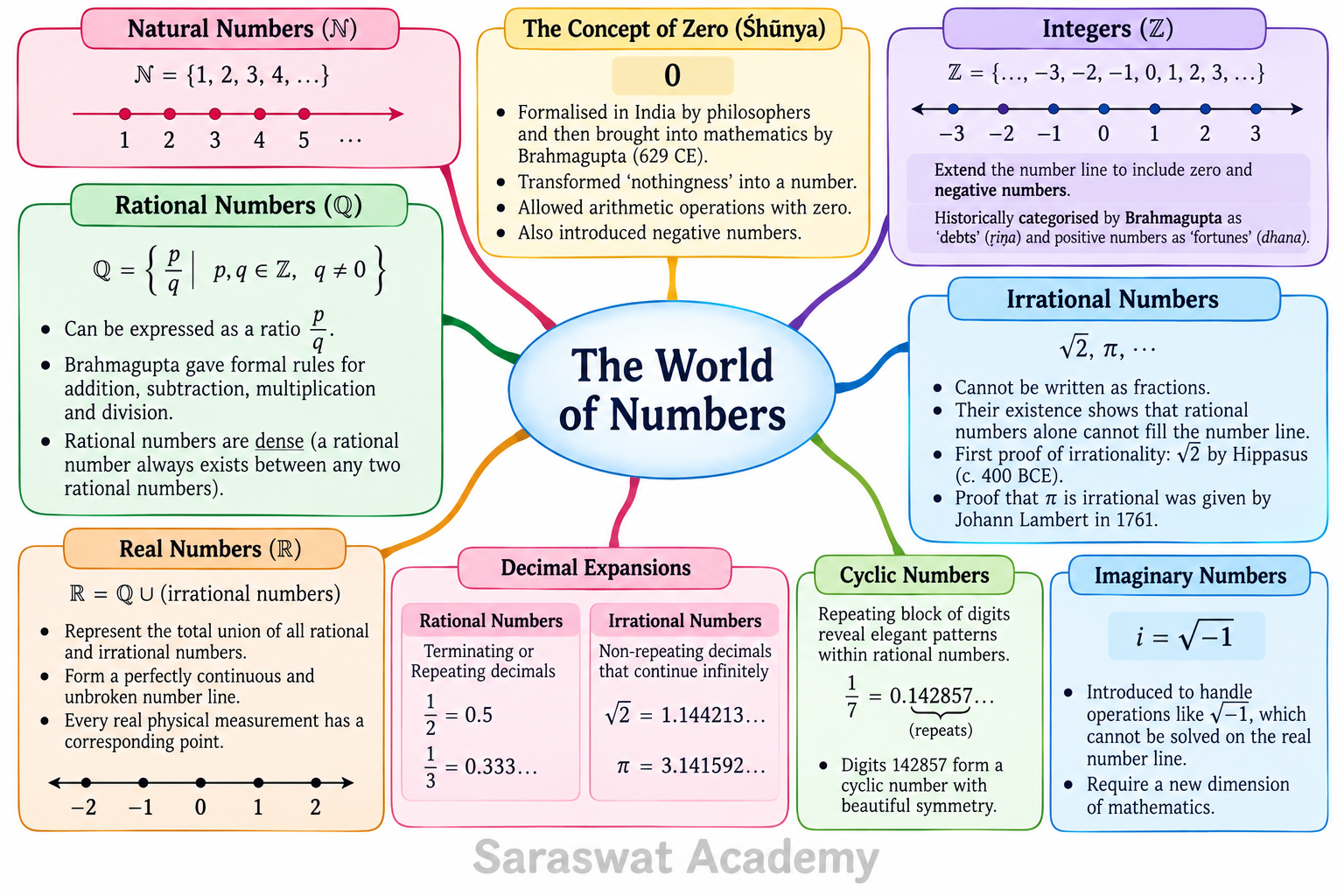
Class 9 Mathematics NCERT Ganita Manjari Chapter 3
The World of Numbers

๐Ÿ”ข The World of Numbers โ€” From Counting to Modern Mathematics

The chapter โ€œThe World of Numbersโ€ takes students on a fascinating journey through the history, development, and structure of numbers. Numbers may seem like simple symbols that we use every day, but behind them lies thousands of years of human discovery, logical thinking, and mathematical innovation. ๐ŸŒ๐Ÿง 

From early humans counting objects using stones and tally marks to the sophisticated decimal place-value system used around the world today, this chapter shows how the number system gradually evolved. It also introduces one of humanity's greatest mathematical discoveriesโ€”zeroโ€”and develops students' understanding of integers, fractions, rational numbers, number lines, absolute value, and the remarkable density of rational numbers.


๐Ÿชจ 1. How Did Numbers Begin?

Long before written numbers existed, humans needed ways to keep track of things. They counted animals, people, food, tools, and other objects using simple methods such as one-to-one correspondence, tally marks, fingers, stones, and other natural objects.

๐Ÿงฎ Early Method ๐Ÿ’ก How It Worked ๐ŸŒ Purpose
โ˜๏ธ Fingers Using fingers to represent quantities. Simple counting
๐Ÿชจ Stones One stone could represent one object. Counting animals or goods
๐Ÿฆด Tally Marks Making marks to keep track of quantities. Recording repeated counts
๐Ÿงฉ One-to-One Correspondence Matching one object with one mark or object. Keeping an accurate count

These early methods may look simple today, but they represent an important milestone: humans began to understand that a quantity could be represented independently of the objects being counted. ๐Ÿ”ขโœจ


๐Ÿบ 2. Ancient Evidence of Counting

Archaeological discoveries provide evidence that humans were thinking about quantities thousands of years ago. Two famous examples are the Lebombo Bone and the Ishango Bone.

๐Ÿบ Historical Object ๐Ÿ” Importance
Lebombo Bone Contains deliberate markings that provide evidence of very early counting or record-keeping practices.
Ishango Bone Contains groups of markings that suggest sophisticated numerical thinking in prehistoric times.

These discoveries remind us that the human need to count, compare, record, and organise quantities is extremely ancient. ๐Ÿง โณ


๐Ÿ‡ฎ๐Ÿ‡ณ 3. India's Remarkable Contribution to Numbers

Ancient Indian mathematicians made extraordinary contributions to the development of the number system. One of the most important achievements was the development and refinement of the decimal place-value system.

In a place-value system, the value of a digit depends on its position.

๐Ÿ”ข Number ๐Ÿ“ Position ๐Ÿ’ก Value
5,432 5 5 ร— 1000 = 5000
5,432 4 4 ร— 100 = 400
5,432 3 3 ร— 10 = 30
5,432 2 2 ร— 1 = 2

๐Ÿ”Ÿ 10โฐ = 1    |    10ยน = 10    |    10ยฒ = 100    |    10ยณ = 1000

This system made it possible to represent extremely large and small quantities efficiently and became the foundation of the modern numerical system used around the world. ๐ŸŒŽ


โญ• 4. ลšhลซnya โ€” The Discovery of Zero

One of the greatest highlights of the chapter is the story of ลšhลซnya (Zero). Zero is far more than simply a symbol meaning โ€œnothingโ€. It plays a fundamental role in place value, arithmetic, algebra, and the entire decimal number system.

The mathematical idea of zero developed gradually. Indian mathematical traditions made major contributions to treating zero as a genuine number and to developing rules for arithmetic involving it.

๐Ÿ“œ Historical Development ๐ŸŒŸ Significance
Bakhshali Manuscript Contains early evidence of the use of a symbol representing zero as a placeholder.
Brahmagupta Gave important rules for arithmetic involving zero and negative numbers.
Indian Decimal System Integrated zero into the place-value system.

For example:

105 โ‰  15

The zero in 105 indicates that there are no tens, but it preserves the position of the digits. Without such a place-value role, representing numbers efficiently would be extremely difficult.


๐Ÿงฎ 5. Important Properties of Zero

โž• Operation ๐Ÿ“ Rule ๐Ÿ’ก Example
Addition a + 0 = a 7 + 0 = 7
Subtraction a โˆ’ 0 = a 7 โˆ’ 0 = 7
Multiplication a ร— 0 = 0 7 ร— 0 = 0
Division 0 รท a = 0, for a โ‰  0 0 รท 7 = 0

However, division by zero is not defined:

โŒ a รท 0 is undefined

Understanding why these rules work is an important part of developing mathematical reasoning. ๐Ÿง 


โž• 6. Enter the World of Integers

The number system becomes more powerful when we introduce negative numbers. Together, positive and negative whole numbers, along with zero, form the set of integers.

โ„ค = {โ€ฆ, โˆ’3, โˆ’2, โˆ’1, 0, 1, 2, 3, โ€ฆ}

๐Ÿ”ข Type ๐Ÿ“Œ Examples ๐ŸŒ Real-Life Meaning
Positive Integers 1, 2, 3, 4, โ€ฆ Profit, gain, increase
Zero 0 No gain or loss / reference point
Negative Integers โˆ’1, โˆ’2, โˆ’3, โ€ฆ Debt, loss, decrease

Negative numbers are useful whenever quantities can move in opposite directions from a reference point.

๐ŸŒ Situation โž• Positive โž– Negative
๐ŸŒก๏ธ Temperature Above 0ยฐC Below 0ยฐC
๐Ÿ’ฐ Money Profit / money received Loss / debt
๐Ÿข Floors Floors above ground Basement levels
๐ŸŒŠ Sea Level Above sea level Below sea level

โž•โž– 7. Operations with Integers

The chapter develops the rules for addition, subtraction, multiplication, and division of integers. Instead of merely memorising sign rules, students learn to understand them through mathematical reasoning and real-life situations.

๐Ÿงฎ Operation ๐Ÿ“Œ Important Rule ๐Ÿ”ข Example
Add same signs Add magnitudes and keep the sign. (โˆ’5) + (โˆ’3) = โˆ’8
Add different signs Subtract magnitudes and keep the sign of the larger magnitude. 7 + (โˆ’3) = 4
Multiply same signs Result is positive. (โˆ’4)(โˆ’2) = 8
Multiply different signs Result is negative. (โˆ’4)(2) = โˆ’8

โž• ร— โž• = โž•    |    โž– ร— โž– = โž•    |    โž• ร— โž– = โž–    |    โž– ร— โž• = โž–


๐Ÿ• 8. Fractions and Rational Numbers

Many quantities cannot be represented using whole numbers. For example, half a pizza ๐Ÿ•, three-quarters of a litre, or โ‚น2.50 all require numbers beyond integers.

This leads us to rational numbers.

โ„š = {p/q : p, q โˆˆ โ„ค and q โ‰  0}

A rational number is any number that can be expressed in the form:

p/q

where p and q are integers and q โ‰  0.

๐Ÿ”ข Number ๐Ÿ“ Rational Form
5 5/1
โˆ’3 โˆ’3/1
1/2 1/2
0.75 3/4
โˆ’2.5 โˆ’5/2

Thus, every integer is also a rational number because it can be written with denominator 1.


๐Ÿชœ 9. The Number System โ€” A Mathematical Family

The different types of numbers are connected to one another. Understanding these relationships helps students see the number system as a structured mathematical system.

๐Ÿ”ข Number System ๐Ÿ“‹ Examples ๐Ÿ’ก Description
Natural Numbers 1, 2, 3, โ€ฆ Counting numbers
Whole Numbers 0, 1, 2, 3, โ€ฆ Natural numbers including zero
Integers โ€ฆ, โˆ’2, โˆ’1, 0, 1, 2, โ€ฆ Positive and negative whole numbers
Rational Numbers 1/2, โˆ’3/4, 5, 2.5 Numbers expressible as p/q, q โ‰  0

Natural Numbers โŠ‚ Whole Numbers โŠ‚ Integers โŠ‚ Rational Numbers


โš™๏ธ 10. Properties of Rational Numbers

Rational numbers follow several important mathematical properties. These properties help us understand why arithmetic operations behave consistently.

๐Ÿ“ Property ๐Ÿง  Meaning ๐Ÿ”ข Example
Closure Performing certain operations on rational numbers produces another rational number. 1/2 + 1/3 = 5/6
Commutative Order does not affect addition or multiplication. a + b = b + a
Associative Grouping does not affect addition or multiplication. (a + b) + c = a + (b + c)
Distributive Multiplication distributes over addition or subtraction. a(b + c) = ab + ac

These properties form the foundation of algebraic manipulation in higher mathematics. ๐Ÿ“š


๐Ÿ“ 11. Rational Numbers on the Number Line

The number line provides a visual way to understand numbers. Positive numbers are located to the right of zero, while negative numbers are located to the left.

โ† Negative Numbers | 0 | Positive Numbers โ†’

Fractions can also be placed accurately on the number line by dividing intervals into equal parts.

๐Ÿ”ข Number ๐Ÿ“ Location
1/2 Halfway between 0 and 1
3/4 Three-fourths of the distance from 0 to 1
โˆ’1/2 Halfway between โˆ’1 and 0
5/2 Between 2 and 3

๐Ÿ“ 12. Absolute Value โ€” Distance from Zero

The absolute value of a number represents its distance from zero on the number line. Since distance cannot be negative, absolute value is always non-negative.

๐Ÿ”ข Number ๐Ÿ“ Absolute Value
5 |5| = 5
โˆ’5 |โˆ’5| = 5
0 |0| = 0

|a| = Distance of a from 0

For example, both 4 and โˆ’4 are four units away from zero:

|4| = |โˆ’4| = 4


โ†”๏ธ 13. Distance Between Two Rational Numbers

The number line also helps us calculate the distance between two numbers.

Distance between a and b = |a โˆ’ b|

For example, the distance between โˆ’2 and 5 is:

|5 โˆ’ (โˆ’2)| = |7| = 7

This provides a powerful connection between arithmetic and geometry: numerical subtraction can represent physical distance on a number line. ๐Ÿ“๐Ÿ”ข


โ™พ๏ธ 14. The Amazing Density of Rational Numbers

One of the most fascinating ideas in the chapter is the density of rational numbers.

Between any two distinct rational numbers, there are infinitely many rational numbers.

For example, between 1 and 2:

1 < 3/2 < 2

But we can find many more:

1 < 5/4 < 3/2 < 7/4 < 2

And we can continue finding more rational numbers forever. โ™พ๏ธ

โ“ Question โœ… Answer
Are there rational numbers between 1 and 2? Yes.
Can we find another rational number between them? Yes.
Can this process continue indefinitely? Yes.
How many rational numbers are between two distinct rational numbers? Infinitely many.

This remarkable property prepares students for the later study of irrational numbers and real numbers. ๐ŸŒŸ


๐ŸŒ 15. Numbers in Everyday Life

Numbers are not limited to mathematics classrooms. Almost every part of modern life depends on them.

๐ŸŒ Area ๐Ÿ”ข Use of Numbers
๐Ÿ’ฐ Banking Balances, transactions, interest, profits, and losses.
๐ŸŒก๏ธ Weather Temperature, rainfall, pressure, and forecasts.
๐Ÿ›’ Shopping Prices, discounts, quantities, and bills.
๐Ÿ“Š Statistics Collecting, comparing, and analysing data.
๐Ÿ’ป Computers Representing and processing information numerically.
๐Ÿ—๏ธ Engineering Measurements, calculations, dimensions, and design.
๐Ÿ”ฌ Science Measuring physical quantities and analysing experiments.
๐Ÿ“ฑ Technology Digital systems, algorithms, coding, and data processing.

๐ŸŽฏ 16. What Will You Learn in This Chapter?

๐Ÿ“š Concept ๐Ÿ’ก What You Will Understand
๐Ÿชจ History of Numbers How humans developed methods for counting and representing quantities.
๐Ÿ‡ฎ๐Ÿ‡ณ Decimal System How India's place-value system transformed mathematics.
โญ• Zero Why zero is a fundamental number and placeholder.
โž•โž– Integers How positive and negative numbers represent quantities in opposite directions.
๐Ÿ• Fractions How quantities smaller than one can be represented.
โ„š Rational Numbers How numbers can be expressed in the form p/q.
๐Ÿ“ Number Line How numbers can be represented visually.
๐Ÿ“ Absolute Value How distance from zero can be measured.
โ™พ๏ธ Density Why infinitely many rational numbers exist between any two rational numbers.

๐Ÿง  17. Skills You Will Develop

๐ŸŒŸ Skill ๐Ÿ“– How This Chapter Develops It
๐Ÿ” Logical Thinking Understanding why number operations follow particular rules.
๐Ÿงฎ Computational Skill Performing operations confidently with integers and rational numbers.
๐Ÿ“ Visualisation Representing numbers and distances on the number line.
๐Ÿงฉ Problem Solving Applying number concepts to practical situations.
๐Ÿ“š Historical Thinking Understanding how mathematical ideas developed over time.
๐Ÿง  Abstract Thinking Understanding concepts such as zero, negative numbers, and density.

๐Ÿš€ 18. From Numbers to Higher Mathematics

The number system developed in this chapter provides the foundation for almost every branch of mathematics and many areas of computer science.

๐Ÿ“š Future Area ๐Ÿ”— Connection with This Chapter
๐Ÿ“ Algebra Uses rational numbers, integers, variables, and operations.
๐Ÿ“ Coordinate Geometry Uses the number line and ordered numerical positions.
๐Ÿ“ Mensuration Uses numerical measurements and calculations.
๐Ÿ“Š Statistics Uses numbers to collect and analyse data.
๐Ÿ“ˆ Calculus Builds upon the real number system.
๐Ÿ’ป Computer Science Uses numerical representation, algorithms, and computation.
๐Ÿค– Artificial Intelligence Relies heavily on numerical data and mathematical computation.

โœจ Chapter at a Glance

โ€œThe World of Numbersโ€ takes students on a remarkable journey from the earliest methods of counting to the sophisticated number system used in modern mathematics. ๐Ÿ”ข๐ŸŒ

Students discover how humans began counting using one-to-one correspondence, tally marks, stones, and natural objects, and how archaeological evidence such as the Lebombo Bone and Ishango Bone reveals the ancient history of numerical thinking.

The chapter then explores India's extraordinary contribution to mathematics, particularly the decimal place-value system and ลšhลซnya (zero). The work associated with the Bakhshali Manuscript and Brahmagupta demonstrates the profound development of zero as a mathematical concept. ๐Ÿ‡ฎ๐Ÿ‡ณโœจ

Students then enter the world of integers and rational numbers, learning how positive and negative quantities can represent real-life situations such as profit, loss, temperature, debt, and elevation. They develop fluency with arithmetic operations and understand important properties such as closure, commutativity, associativity, and distributivity.

The number line provides a powerful visual tool for representing rational numbers, comparing values, and understanding absolute value and distance. Finally, students encounter one of the most fascinating properties of rational numbers: there are infinitely many rational numbers between any two distinct rational numbers. โ™พ๏ธ

Overall, this chapter demonstrates that numbers are not merely symbols used for calculation. They are a carefully developed mathematical language that allows us to count, measure, compare, represent, analyse, and understand the world around us.

๐Ÿชจ Count โ†’ ๐Ÿ”ข Represent โ†’ โญ• Discover Zero โ†’ โž•โž– Extend to Integers โ†’ ๐Ÿ• Explore Rational Numbers โ†’ โ™พ๏ธ Discover Infinite Possibilities!

Real-Life Applications of This Chapter

The concepts learned in this chapter are used in almost every part of our daily lives. From counting objects to managing money, numbers help us make accurate decisions and solve practical problems.

Concept Real-Life Application
Natural Numbers Counting students, books, vehicles, products, attendance and inventory.
Zero Banking, mobile numbers, digital clocks, computer programming and place-value system.
Integers Profits and losses, temperatures, sea level, lifts, sports scores and financial transactions.
Rational Numbers Cooking, shopping discounts, measurements, engineering, medicine and construction.

Where You Use These Concepts Every Day

  • Shopping: Calculating discounts, bills and change.
  • Banking: Deposits, withdrawals, balances and loans.
  • Cooking: Measuring ingredients using fractions.
  • Weather Forecast: Reading temperatures above and below zero.
  • Construction: Measuring lengths and dimensions accurately.
  • Computer Science: Binary numbers, algorithms and digital systems depend on zero and numbers.
  • Business: Managing profits, losses, stock and financial records.

Why This Chapter Is Important

  • Builds the foundation of the entire number system.
  • Develops logical and analytical thinking.
  • Prepares students for Algebra, Coordinate Geometry and higher Mathematics.
  • Strengthens problem-solving skills used in competitive examinations and everyday life.

The following memory tricks will help you quickly remember the important terms and concepts of this chapter. These tricks are designed to make revision easier before class tests and board examinations.

Term Memory Trick Remember This
Natural Numbers (โ„•) "Nature Starts from 1" Natural numbers are counting numbers: 1, 2, 3, 4, ...
Zero (0) "Zero Means Nothing, But Changes Everything" Zero represents nothing, yet it makes the place-value system possible.
Integers (โ„ค) "Left is Loss, Right is Rich" Negative numbers lie on the left of zero, positive numbers on the right.
Rational Numbers (โ„š) "Q for Quotient" Every rational number can be written as p/q, where q โ‰  0.
Absolute Value "Always Count Distance, Never Direction" Absolute value is the distance from zero, so it is always non-negative.
Equivalent Fractions "Different Faces, Same Value" Fractions like 1/2, 2/4 and 5/10 represent the same quantity.
Density of Rational Numbers "Between Two... There Are Infinite More" There are infinitely many rational numbers between any two rational numbers.
Co-prime Numbers "Only One Common Friend" Their only common factor is 1.

Easy Tricks to Remember Mathematical Symbols

  • โ„• โ†’ N = Nature = Natural Numbers
  • โ„ค โ†’ Z = Zero Family (Integers include Zero)
  • โ„š โ†’ Q = Quotient = Rational Numbers
  • |x| โ†’ Two Walls Protect the Number
    Think of | | as two walls. They only care about how far the number is from zero, not whether it is positive or negative.

Remember Brahmagupta's Rules with One Sentence

"Add Zero โ†’ Same, Subtract Zero โ†’ Same, Multiply by Zero โ†’ Zero."

  • 7 + 0 = 7
  • 7 โˆ’ 0 = 7
  • 7 ร— 0 = 0

Sign Rules Memory Trick

Operation Memory Trick
+ ร— + Friends Stay Friends ๐Ÿ˜Š โ†’ Positive
โˆ’ ร— โˆ’ Two Negatives Become Friends โ†’ Positive
+ ร— โˆ’ Different Signs Fight โšก โ†’ Negative
โˆ’ ร— + Different Signs Fight โšก โ†’ Negative

One-Line Chapter Formula

Count โ†’ Zero โ†’ Integers โ†’ Fractions โ†’ Rational Numbers โ†’ Number Line

This single sequence helps you remember the complete flow of the chapter from the beginning to the end.

One-Minute Revision

Need a quick recap before your exam? Read these points once to revise the entire chapter in just one minute.

Topic Quick Revision
Natural Numbers (โ„•) Counting numbers: 1, 2, 3, 4, .... They are used for counting objects and are closed under addition and multiplication, but not under subtraction.
Zero (0) India introduced the concept of ลšhลซnya (Zero). It is the foundation of the place-value system.
Brahmagupta's Rules
  • a + 0 = a
  • a โˆ’ 0 = a
  • a ร— 0 = 0
Integers (โ„ค) Include negative numbers, zero, and positive numbers. Used to represent profits, losses, temperatures and elevations.
Sign Rules
  • (+) ร— (+) = (+)
  • (โˆ’) ร— (โˆ’) = (+)
  • (+) ร— (โˆ’) = (โˆ’)
  • (โˆ’) ร— (+) = (โˆ’)
Rational Numbers (โ„š) Every rational number can be written as p/q, where p and q are integers and q โ‰  0.
Equivalent Fractions Different fractions can represent the same value, such as 1/2 = 2/4 = 5/10.
Arithmetic of Rational Numbers Addition, subtraction, multiplication and division follow the standard fraction rules. Division by zero is not defined.
Number Line Positive numbers lie to the right of zero, while negative numbers lie to the left. Rational numbers are located by dividing intervals into equal parts.
Absolute Value |x| represents the distance from zero, so it is always non-negative.
Density of Rational Numbers Between any two rational numbers, there are infinitely many rational numbers.

Important Facts to Remember

  • Natural Numbers: โ„• = {1, 2, 3, ...}
  • Integers: โ„ค = {..., โˆ’3, โˆ’2, โˆ’1, 0, 1, 2, 3, ...}
  • Rational Numbers: โ„š = p/q, where q โ‰  0.
  • Zero is neither positive nor negative.
  • Absolute value is always greater than or equal to zero.
  • Division by zero is never possible.
  • Every integer is a rational number, but every rational number is not an integer.
  • Every natural number is an integer and a rational number.

Chapter Flow in One Line

Counting โ†’ Natural Numbers โ†’ Zero โ†’ Integers โ†’ Fractions โ†’ Rational Numbers โ†’ Number Line โ†’ Absolute Value โ†’ Density of Rational Numbers

Exam Booster

  • โœ” Remember the definitions of Natural Numbers, Integers and Rational Numbers.
  • โœ” Learn Brahmagupta's rules for Zero.
  • โœ” Practice sign rules of integers.
  • โœ” Revise operations on rational numbers.
  • โœ” Know how to represent rational numbers on the number line.
  • โœ” Remember that infinitely many rational numbers exist between any two rational numbers.

Revision Mantra: Understand the evolution of numbers, master the properties of integers and rational numbers, and practice number line representation to build a strong foundation for higher mathematics.

Frequently Asked Questions (FAQs)

The following frequently asked questions will help you revise the important concepts of this chapter quickly and strengthen your conceptual understanding.

  1. 1. Why are natural numbers called counting numbers?

    Natural numbers are called counting numbers because they are used to count objects such as books, students, fruits, and other everyday items. They begin with 1 and continue infinitely.

  2. 2. What is the importance of zero in mathematics?

    Zero is one of the greatest mathematical discoveries. It represents the absence of quantity and is an essential part of the decimal place-value system. It also makes modern arithmetic and computing possible.

  3. 3. Who introduced the mathematical rules for zero?

    Indian mathematician Brahmagupta was the first to define zero as a number and establish rules for performing arithmetic operations involving zero.

  4. 4. What are integers?

    Integers are numbers that include negative numbers, zero, and positive numbers. They are represented by the symbol โ„ค.

  5. 5. Why do we use negative numbers in real life?

    Negative numbers are used to represent quantities below a reference point, such as temperatures below 0ยฐC, financial losses, debts, elevations below sea level, and downward movements.

  6. 6. What is a rational number?

    A rational number is any number that can be written in the form p/q, where p and q are integers and q โ‰  0.

  7. 7. Why can't the denominator of a rational number be zero?

    Division by zero is not defined in mathematics. Therefore, the denominator of a rational number can never be zero.

  8. 8. What are equivalent rational numbers?

    Equivalent rational numbers are different fractions that represent the same value, such as 1/2, 2/4, 3/6, and 5/10.

  9. 9. What is the absolute value of a number?

    The absolute value of a number is its distance from zero on the number line. Since distance is always positive or zero, the absolute value is never negative.

  10. 10. What is meant by the density of rational numbers?

    The density property states that between any two rational numbers, there are infinitely many other rational numbers.

  11. 11. How are rational numbers represented on a number line?

    To represent a rational number, divide the interval between two consecutive integers into equal parts according to the denominator and locate the required numerator on the number line.

  12. 12. Which mathematical properties do rational numbers satisfy?

    Rational numbers satisfy the closure, commutative, associative, and distributive properties for the appropriate arithmetic operations. Division is possible only when the divisor is not zero.

  13. 13. Why is this chapter important for higher mathematics?

    This chapter builds the foundation for algebra, coordinate geometry, linear equations, statistics, probability, and many advanced mathematical concepts studied in higher classes.

  14. 14. Where are the concepts of this chapter used in daily life?

    The concepts are used in banking, shopping, accounting, cooking, engineering, computer science, scientific measurements, weather forecasting, navigation, and many other real-life situations.

  15. 15. What is the biggest learning outcome of this chapter?

    This chapter helps students understand how the number system evolved, how different types of numbers are related, and how they are used to solve practical and mathematical problems accurately.

Quick Exam Questions

  • Who introduced the arithmetic rules for zero?
  • What is the difference between natural numbers and integers?
  • Why is zero called a revolutionary discovery?
  • Can every integer be written as a rational number? Explain.
  • What is the formula for a rational number?
  • Why is division by zero not possible?
  • What does the absolute value of a number represent?
  • What is meant by equivalent fractions?
  • What is the density property of rational numbers?
  • How do rational numbers differ from integers?