Class 10
NCERT Solutions for Class 10 Mathematics
Get chapter-wise mathematics solutions with clear explanations and step-by-step answers.
Explore Solutions →Get a quick overview of the important concepts in this chapter.
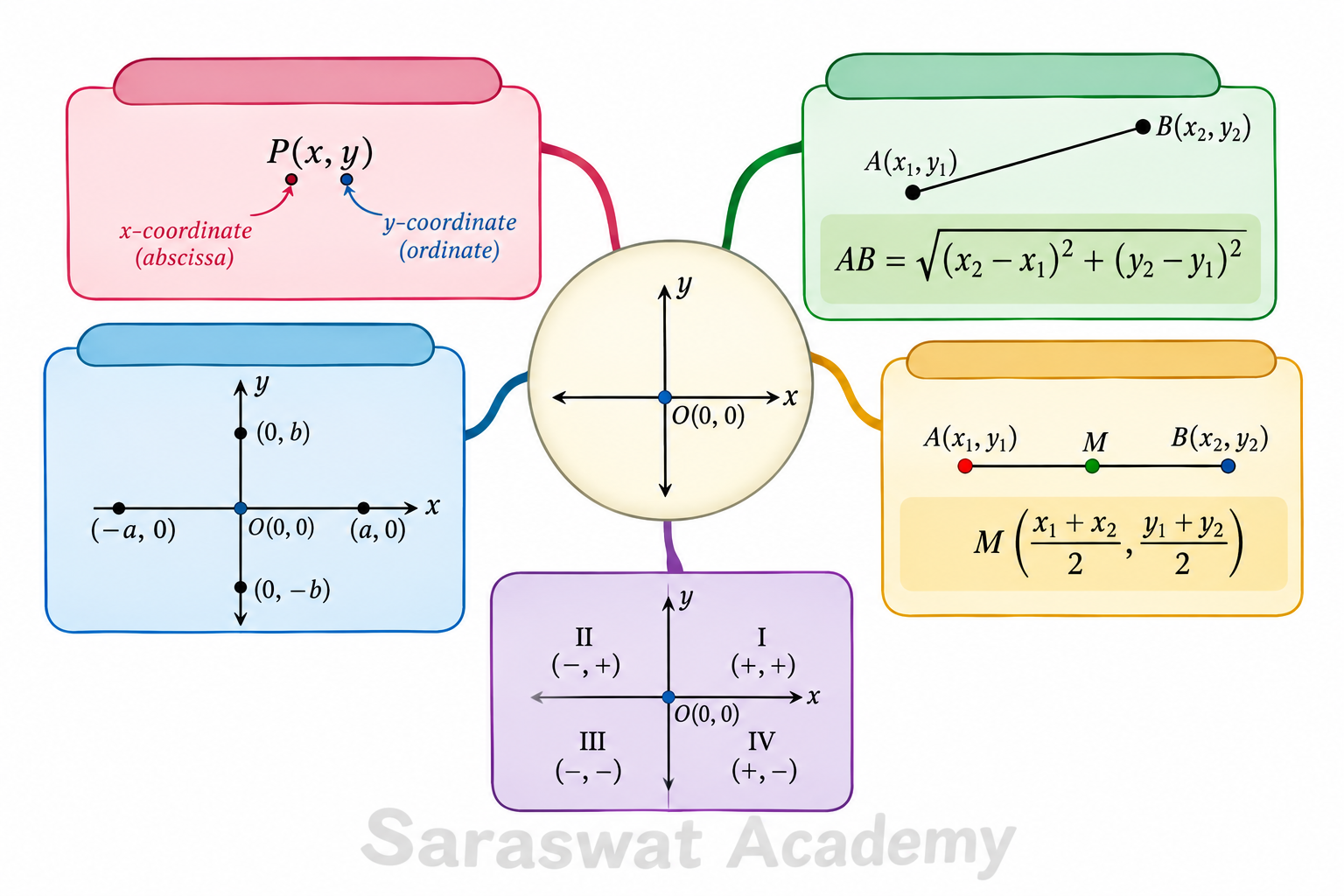
Explore the mind map to revise the main ideas before starting the chapter.
The Cartesian plane is formed by two perpendicular number lines called the X-axis and the Y-axis. Their point of intersection is called the Origin (0,0). Every point on the plane is represented by an ordered pair (x, y), where the first value indicates horizontal movement and the second indicates vertical movement.
The shortest distance between two points is obtained using the Distance Formula:
√[(x₂ − x₁)² + (y₂ − y₁)²]
| Term | Definition |
|---|---|
| Coordinate Plane | A flat surface formed by the X-axis and Y-axis, used to locate points using coordinates. |
| Ordered Pair | A pair of numbers written as (x, y) that represents the position of a point on the coordinate plane. |
| Origin | The point (0, 0) where the X-axis and Y-axis intersect. |
| X-axis | The horizontal number line on the coordinate plane. |
| Y-axis | The vertical number line on the coordinate plane. |
| Quadrants | The four regions into which the X-axis and Y-axis divide the coordinate plane. |
| Distance Formula | A formula used to find the distance between two points on the coordinate plane. |
| Symmetry | The property in which a figure or point is reflected equally about an axis or the origin. |
| Field | Application of Coordinate Geometry |
|---|---|
| GPS & Navigation | Finding exact locations and shortest routes. |
| Digital Maps | Representing locations using coordinates. |
| Architecture | Designing buildings and construction plans. |
| Computer Graphics | Creating images, animations, and video games. |
| Robotics | Controlling robot movement and positioning. |
| Astronomy | Locating stars and planets in space. |
| Engineering | Designing machines, roads, and structures. |
| Surveying | Measuring land and property boundaries. |
| Aviation & Marine | Navigation of aircraft and ships. |
| Sports | Tracking player and ball movements. |
| Medical Science | Creating accurate body images using scans. |
| Urban Planning | Planning cities and public infrastructure. |
Did You Know?
Whenever you use Google Maps, play a video game, book a cab, or view your location on a smartphone, coordinate geometry is working behind the scenes to determine positions and calculate distances accurately.
XYOQDR
Exam Mantra: Write (x, y), move X first then Y, remember quadrant signs, and apply the correct reflection rule.
Coordinate Geometry is a branch of Mathematics that uses coordinates to locate points and study geometric figures on a coordinate plane.
A coordinate plane is a flat surface formed by the X-axis and Y-axis. It is used to locate and represent points using ordered pairs.
An ordered pair is a pair of numbers written as (x, y), where x represents the horizontal position and y represents the vertical position of a point.
The origin is the point (0, 0) where the X-axis and Y-axis intersect.
The X-axis is the horizontal number line on the coordinate plane.
The Y-axis is the vertical number line on the coordinate plane.
There are four quadrants. They are numbered I, II, III, and IV in the anticlockwise direction.
Quadrant I: (+, +)
Quadrant II: (−, +)
Quadrant III: (−, −)
Quadrant IV: (+, −)
The distance between two points is found using the distance formula:
d = √[(x₂ − x₁)² + (y₂ − y₁)²]
Symmetry means reflecting a point or figure about the X-axis, Y-axis, or the origin while maintaining equal distance from the line of reflection.
Only the y-coordinate changes its sign.
Example: (4, 3) → (4, −3)
Only the x-coordinate changes its sign.
Example: (4, 3) → (−4, 3)
Yes. A point with y = 0 lies on the X-axis, and a point with x = 0 lies on the Y-axis.
The order is important because (x, y) and (y, x) represent different points on the coordinate plane.
Coordinate geometry is used in GPS navigation, Google Maps, computer graphics, architecture, engineering, robotics, astronomy, surveying, medical imaging, and video game development.
Continue learning with other Class 9 Mathematics chapters.
Strengthen your understanding with extra practice materials designed to help you prepare for your exams.
Explore more NCERT solutions and other resources with Saraswat Academy.
Get chapter-wise mathematics solutions with clear explanations and step-by-step answers.
Explore Solutions →Study important concepts, exercise solutions and chapter-wise mathematics answers.
Explore Solutions →Understand science concepts with detailed answers to textbook questions.
Explore Solutions →Explore chapter-wise science solutions, explanations and useful study resources.
Explore Solutions →Improve your English skills with detailed answers to textbook questions.
Explore Solutions →Improve your English skills with detailed answers to textbook questions.
Explore Resources →Improve your Hindi skills with detailed answers to textbook questions.
Explore Resources →Improve your Hindi skills with detailed answers to textbook questions.
Explore Resources →Improve your Hindi skills with detailed answers to textbook questions.
Explore Resources →Improve your Social Science skills with detailed answers to textbook questions.
Explore Resources →Improve your Social Science skills with detailed answers to textbook questions.
Explore Resources →Improve your Social Science skills with detailed answers to textbook questions.
Explore Resources →Detailed NCERT solutions for class 9 sanskrit.
Explore Resources →Explore more NCERT solutions and other resources with Saraswat Academy.
Get chapter-wise mathematics solutions with clear explanations and step-by-step answers.
Explore Solutions →Study important concepts, exercise solutions and chapter-wise mathematics answers.
Explore Solutions →Understand science concepts with detailed answers to textbook questions.
Explore Solutions →Explore chapter-wise science solutions, explanations and useful study resources.
Explore Solutions →Improve your English skills with detailed answers to textbook questions.
Explore Solutions →Improve your English skills with detailed answers to textbook questions.
Explore Resources →Improve your Hindi skills with detailed answers to textbook questions.
Explore Resources →Improve your Hindi skills with detailed answers to textbook questions.
Explore Resources →Improve your Hindi skills with detailed answers to textbook questions.
Explore Resources →Improve your Social Science skills with detailed answers to textbook questions.
Explore Resources →Improve your Social Science skills with detailed answers to textbook questions.
Explore Resources →Improve your Social Science skills with detailed answers to textbook questions.
Explore Resources →Detailed NCERT solutions for class 9 sanskrit.
Explore Resources →