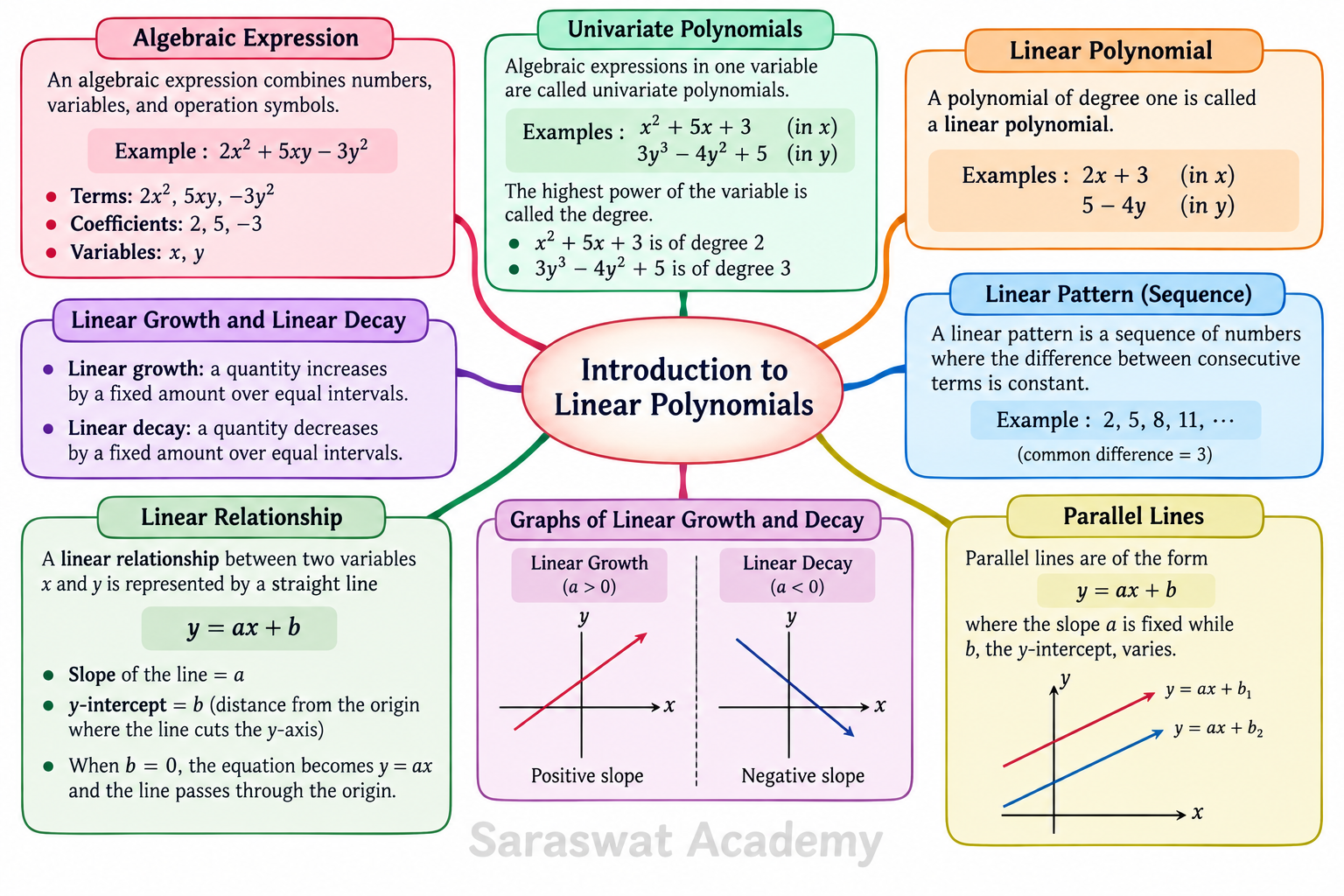
Class 9 Mathematics NCERT Ganita Manjari Chapter 2
Introduction to Linear Polynomials

๐Ÿ“˜ Introduction to Linear Polynomials โ€” Understanding Change Through Algebra

Welcome to the fascinating world of Linear Polynomials! ๐Ÿ”ขโœจ This chapter builds a strong foundation in algebra by showing how simple mathematical expressions can be used to represent and solve problems from everyday life.

Shopping expenses ๐Ÿ›’, taxi fares ๐Ÿš•, bank savings ๐Ÿ’ฐ, mobile recharge plans ๐Ÿ“ฑ, population changes ๐Ÿ‘ฅ, water-level changes ๐Ÿ’ง, and geometric measurements ๐Ÿ“ can all be described using algebraic expressions. The central idea of this chapter is to understand how linear polynomials represent quantities that change in a simple and predictable way.


๐Ÿงฎ 1. What Is an Algebraic Expression?

Before studying linear polynomials, students revisit the basic building blocks of algebra: variables, constants, coefficients, and terms.

๐Ÿ”ค Algebraic Part ๐Ÿ“– Meaning ๐Ÿ”ข Example
Variable A symbol representing a value that can change. x, y, a
Constant A fixed numerical value. 5, โˆ’3, 10
Coefficient A number multiplied by a variable. 7 in 7x
Term A number, variable, or product separated by + or โˆ’ signs. 3x, โˆ’5, 2y

For example, consider:

4x + 7

Part Value
Coefficient of x 4
Variable x
Constant 7
Terms 4x and 7

๐Ÿ“Š 2. What Is a Polynomial?

A polynomial is an algebraic expression made up of variables, coefficients, and non-negative integer powers of variables, combined using addition or subtraction.

๐Ÿ“ Polynomial Type ๐Ÿ”ข Example ๐ŸŽฏ Degree
Constant 7 0
Linear 3x + 5 1
Quadratic xยฒ + 4x + 3 2
Cubic xยณ โˆ’ 2x + 1 3

The degree of a polynomial is the highest power of the variable with a non-zero coefficient.

๐Ÿ”ข Highest Power of Variable = Degree of Polynomial


๐Ÿ“ 3. Understanding Linear Polynomials

A linear polynomial in one variable is a polynomial whose degree is exactly 1.

p(x) = ax + b

where a and b are constants and a โ‰  0.

๐Ÿ”ค Symbol ๐Ÿ“– Meaning
x Variable
a Coefficient of x
b Constant term
p(x) Value of the polynomial for a particular x

Examples of linear polynomials include:

2x + 5    |    7x โˆ’ 3    |    โˆ’4x + 9    |    x โˆ’ 8


๐ŸŒ 4. Linear Polynomials in Everyday Life

Linear expressions are particularly useful when a quantity changes by a constant amount.

๐ŸŒ Real-Life Situation ๐Ÿงฎ Possible Linear Model ๐Ÿ’ก Meaning
๐Ÿš• Taxi Fare y = 50 + 15x โ‚น50 fixed charge + โ‚น15 per kilometre
๐Ÿ’ฐ Savings y = 1000 + 500x โ‚น1,000 starting amount + โ‚น500 per month
๐Ÿ“ฑ Mobile Recharge y = 199 + 20x Base plan + additional fixed charges
๐Ÿ’ง Water Level y = 100 โˆ’ 5x Water level decreases by 5 units per hour
๐Ÿ›’ Shopping y = 200 + 50x โ‚น200 fixed cost + โ‚น50 for each additional item

The important idea is:

๐Ÿ“ˆ Constant Increase โ†’ Linear Growth
๐Ÿ“‰ Constant Decrease โ†’ Linear Decay


๐Ÿ” 5. Degree of a Polynomial

The degree helps us classify polynomials according to the highest power of their variable.

Polynomial Highest Power Type
8 0 Constant
5x + 2 1 Linear
3xยฒ + 2x + 1 2 Quadratic
xยณ + 4xยฒ โˆ’ x + 2 3 Cubic

This classification becomes increasingly important as students move towards higher algebra, equations, functions, and graphs.


๐ŸŽฏ 6. Evaluating a Linear Polynomial

Evaluating a polynomial means finding its value when a particular value is assigned to the variable.

Consider:

p(x) = 3x + 5

If x = 4:

p(4) = 3(4) + 5 = 12 + 5 = 17

Step Process
1๏ธโƒฃ Write the polynomial: p(x) = 3x + 5
2๏ธโƒฃ Substitute x = 4.
3๏ธโƒฃ p(4) = 3(4) + 5
4๏ธโƒฃ p(4) = 17

You can think of a polynomial as an input-output machine โš™๏ธ: put in a value of x, perform the required operations, and obtain the output.


โš™๏ธ 7. Polynomial as an Input-Output Machine

Input x โ†’ ๐Ÿงฎ Apply Rule โ†’ Output p(x)

Input x Rule: p(x) = 2x + 3 Output p(x)
1 2(1) + 3 5
2 2(2) + 3 7
3 2(3) + 3 9
4 2(4) + 3 11

The outputs form the sequence:

5, 7, 9, 11, โ€ฆ

This provides a natural connection between polynomials and patterns. ๐Ÿ”ข


๐Ÿ“ 8. From Linear Polynomial to Linear Equation

When a linear polynomial is equated to a constant, we obtain a linear equation.

๐Ÿ”ข Expression โžก๏ธ Equation
3x + 5 3x + 5 = 20
7x โˆ’ 2 7x โˆ’ 2 = 19
5x + 10 5x + 10 = 35

For example:

3x + 5 = 20
3x = 15
x = 5

Thus, linear polynomials provide an important foundation for solving linear equations and real-life word problems.


๐Ÿ”ข 9. Linear Patterns

A linear pattern is a pattern in which the quantity changes by a constant amount from one step to the next.

๐Ÿ”ข Step ๐Ÿ“ˆ Number of Objects โž• Change
1 4 โ€”
2 7 +3
3 10 +3
4 13 +3
5 16 +3

Since the pattern increases by 3 each time, it follows a linear relationship.

4, 7, 10, 13, 16, โ€ฆ

Students can use algebra to describe such patterns and predict future values. ๐Ÿ”ฎ


๐Ÿงฉ 10. Growing Tile Patterns

Visual patterns made from tiles, matchsticks, dots, or shapes provide an excellent way to understand linear growth.

๐Ÿงฑ Figure Number ๐Ÿ”ข Number of Tiles ๐Ÿ“ˆ Increase
Figure 1 5 โ€”
Figure 2 8 +3
Figure 3 11 +3
Figure 4 14 +3

The fixed increase allows us to predict the number of tiles required for much larger figures without drawing every intermediate figure.

๐Ÿ” Observe โ†’ ๐Ÿง  Find the Rule โ†’ ๐Ÿ“ Write the Expression โ†’ ๐Ÿ”ฎ Predict!


๐Ÿ“ˆ 11. Linear Growth

When a quantity increases by a constant amount over equal intervals of time, it can often be represented using a linear growth model.

y = ax + b

Symbol Meaning
x Input or time
y Output or quantity
a Rate of change
b Initial value

For example, if a plant grows 2 cm every week and is initially 10 cm tall:

Height = 2x + 10

After 5 weeks:

Height = 2(5) + 10 = 20 cm ๐ŸŒฑ


๐Ÿ“‰ 12. Linear Decay

Linear relationships can also describe situations where a quantity decreases by a constant amount.

๐ŸŒ Situation ๐Ÿ“‰ Example of Constant Decrease
๐Ÿ’ง Water Level Decreases by 5 cm every hour
๐Ÿ“ฑ Depreciation Value decreases by a fixed amount per year in a simplified model
๐Ÿ›ข๏ธ Fuel Amount decreases by a fixed quantity over equal intervals
๐Ÿ“ฆ Stock Inventory decreases by a fixed number of items each day

A linear decay model may have the form:

y = b โˆ’ ax

where a represents the constant rate of decrease.


๐Ÿ”— 13. Linear Relationships Between Two Variables

One of the most important ideas in the chapter is the relationship between two variables.

y = ax + b

Here, the value of y changes in a predictable way when x changes.

๐Ÿ“Œ Part ๐Ÿ’ก Interpretation
x Independent variable
y Dependent variable
a Rate of change / slope
b Initial value / y-intercept

For example:

y = 4x + 2

Every time x increases by 1, y increases by 4.


๐Ÿ“Š 14. Linear Relationships and Graphs

The equation y = ax + b is also the foundation of graphing linear relationships. When suitable values of x and y are plotted on a coordinate plane, they form a straight line.

๐Ÿ”ข x ๐Ÿ“ y = 2x + 1
0 1
1 3
2 5
3 7

(0,1), (1,3), (2,5), (3,7)

These points lie on a straight line. This creates an important connection between algebra, patterns, tables, and coordinate geometry. ๐Ÿ“Š๐Ÿ“


๐Ÿ›’ 15. Linear Polynomials in Real-Life Problems

๐ŸŒ Situation ๐Ÿงฎ Linear Model ๐Ÿ’ก What It Represents
๐Ÿš• Taxi Fare y = ax + b Distance-based fare + fixed charge
๐Ÿ’ฐ Savings y = ax + b Regular savings + initial amount
๐Ÿ“ฑ Recharge y = ax + b Base cost + additional usage
๐ŸŒฑ Plant Growth y = ax + b Initial height + regular growth
๐Ÿ’ง Water Level y = b โˆ’ ax Initial level โˆ’ regular decrease
๐Ÿ“ฆ Inventory y = b โˆ’ ax Initial stock โˆ’ regular sales

๐Ÿง  16. What Will You Learn in This Chapter?

๐Ÿ“š Concept ๐Ÿ’ก What You Will Understand
๐Ÿ”ค Algebraic Expressions Variables, constants, coefficients, and terms.
๐Ÿ“Š Polynomials How algebraic expressions are classified.
๐Ÿ“ Degree How the highest power determines the degree of a polynomial.
๐Ÿ“ Linear Polynomials Polynomials of degree one.
๐ŸŽฏ Evaluation How to find the value of a polynomial for a given input.
๐Ÿ“ Linear Equations How expressions become equations and can be solved.
๐Ÿ”ข Linear Patterns How constant changes create predictable patterns.
๐Ÿ“ˆ Linear Growth How quantities can increase at a constant rate.
๐Ÿ“‰ Linear Decay How quantities can decrease at a constant rate.
๐Ÿ“Š Linear Relationships How two variables can be related using y = ax + b.

๐ŸŒŸ 17. Skills You Will Develop

๐Ÿง  Skill ๐Ÿ“– How This Chapter Develops It
๐Ÿ” Pattern Recognition Identifying constant changes and predicting future values.
๐Ÿงฎ Algebraic Thinking Representing real situations using variables and expressions.
๐ŸŽฏ Problem Solving Converting word problems into mathematical equations.
๐Ÿ“Š Data Interpretation Understanding relationships between input and output values.
๐Ÿ“ Mathematical Modelling Representing real-world situations using linear expressions.
๐Ÿ“ˆ Graphical Thinking Connecting equations with tables and straight-line graphs.

๐Ÿš€ 18. From Linear Polynomials to Higher Mathematics

The ideas introduced in this chapter form an important bridge between elementary arithmetic and higher-level algebra.

๐Ÿ“š Future Area ๐Ÿ”— Connection
๐Ÿ“ Algebra Linear polynomials provide the foundation for equations and expressions.
๐Ÿ“Š Coordinate Geometry Linear relationships are represented using straight-line graphs.
๐Ÿ“ˆ Functions Expressions such as y = ax + b describe input-output relationships.
๐Ÿ“ Trigonometry Algebraic relationships are used extensively with geometric quantities.
๐Ÿ“Š Statistics Linear models can describe trends in data.
๐Ÿ’ฐ Economics Linear models can represent costs, revenue, and other relationships.
โš™๏ธ Engineering Linear relationships are used to model physical quantities.
๐Ÿ’ป Computer Science Algebraic expressions and functions are fundamental to programming and algorithms.

โœจ Chapter at a Glance

The chapter โ€œIntroduction to Linear Polynomialsโ€ builds a strong conceptual bridge between basic arithmetic and algebra. Students begin by revising the fundamental components of algebraic expressionsโ€”variables, constants, coefficients, terms, and degree.

They then focus on linear polynomials, learning how expressions such as ax + b can represent quantities that change at a constant rate. Through substitution and evaluation, students learn to treat algebraic expressions like mathematical input-output machines. โš™๏ธ

The chapter then connects linear polynomials with linear equations and patterns. Growing tile arrangements, shopping expenses, savings, taxi fares, plant growth, and water-level changes demonstrate how mathematics can describe real-world situations.

Finally, students explore linear growth, linear decay, and relationships between two variables through the general form:

y = ax + b

This creates an important connection between algebra, patterns, tables, and straight-line graphs, preparing students for functions, coordinate geometry, advanced algebra, statistics, economics, science, engineering, and computer science.

๐Ÿ”ค Expression โ†’ ๐Ÿ“ Polynomial โ†’ ๐ŸŽฏ Linear Rule โ†’ ๐Ÿงฉ Pattern โ†’ ๐Ÿ“Š Relationship โ†’ ๐Ÿš€ Real-World Model!

Real-Life Applications of Linear Polynomials

Linear polynomials are used to represent situations where a quantity changes at a constant rate. They help us make predictions, calculate costs, and solve everyday problems quickly and accurately. Some important real-life applications are given below.

  • Shopping: Calculating the total cost of items based on quantity purchased.
  • Taxi and Cab Fares: Finding the total fare using a fixed charge and a cost per kilometre.
  • Banking: Estimating savings or expenses that increase or decrease regularly.
  • Mobile and Internet Plans: Calculating monthly bills based on data usage or call duration.
  • Business: Computing profit, production cost, and revenue when values change uniformly.
  • Construction: Determining the cost of fencing, painting, or flooring based on dimensions.
  • Science: Representing steady growth or decay, such as plant growth or water level changes.
  • Transportation: Estimating travel distance, fuel cost, and journey expenses.
  • Population Studies: Predicting population increase or decrease over time.
  • Computer Science: Modelling simple input-output relationships in algorithms and programming.

Key Idea: Whenever a quantity increases or decreases by the same amount over equal intervals, linear polynomials provide a simple mathematical model to describe and predict the situation.

Memory Tricks for Linear Polynomials

These simple memory tricks will help you remember the important concepts of the chapter "Introduction to Linear Polynomials" quickly and accurately.


1. Remember a Linear Polynomial

Memory Trick: "One Power, One Line."

  • A linear polynomial always has the highest power of the variable equal to 1.
  • Example: 2x + 5, 7y โ€“ 3, x โ€“ 10


2. Remember Degree of a Polynomial

Memory Trick: "Highest Power = Degree."

Polynomial Degree
5 0
4x + 2 1
xยฒ + 3x + 1 2
xยณ โ€“ x + 7 3


3. Remember Parts of a Polynomial

Memory Trick: "TVCC"

  • T โ†’ Terms
  • V โ†’ Variable
  • C โ†’ Coefficient
  • C โ†’ Constant

Example: 4x + 7

  • Term โ†’ 4x, 7
  • Variable โ†’ x
  • Coefficient โ†’ 4
  • Constant โ†’ 7


4. Remember Polynomial Types

Memory Trick: "CLQC"

Degree Name
0 Constant
1 Linear
2 Quadratic
3 Cubic

Memory Sentence: "Constant Lions Quit Carefully."


5. Remember Linear Equation

Memory Trick: "Polynomial + Equal Sign = Equation."

Example:

  • 2x + 5 โ†’ Linear Polynomial
  • 2x + 5 = 11 โ†’ Linear Equation


6. Remember Input-Output Machine

Memory Trick: "Input Goes In, Answer Comes Out."

Put the value of x into the polynomial to get the output.

Example:

If y = 3x + 2 and x = 4, then y = 14.


7. Remember Linear Pattern

Memory Trick: "Same Difference Means Linear."

If the difference between consecutive terms is constant, the pattern is linear.

Example:

5, 8, 11, 14, 17...

Difference = +3 every time.


8. Remember Linear Growth

Memory Trick: "Grow = Go Up."

  • Plant height
  • Population
  • Savings
  • Salary

All increase by a fixed amount.


9. Remember Linear Decay

Memory Trick: "Decay = Drop Down."

  • Water level
  • Battery charge
  • Mobile value
  • Money spent

All decrease by a fixed amount.


10. Remember Linear Relationship

Memory Trick: "Y Depends on X."

Every linear relationship is written as:

y = ax + b

  • a โ†’ Rate of change
  • b โ†’ Initial value


11. Remember Evaluation

Memory Trick: "Replace and Calculate."

Substitute the value of the variable and simplify.

Example:

5x โ€“ 4 at x = 3 โ†’ 15 โ€“ 4 = 11


12. Golden Exam Formula

Concept Memory Trick
Degree Highest Power = Degree
Linear Polynomial One Power, One Line
Polynomial Parts TVCC
Polynomial Types Constant โ†’ Linear โ†’ Quadratic โ†’ Cubic
Linear Equation Polynomial + Equal Sign
Evaluation Replace and Calculate
Linear Pattern Same Difference Means Linear
Linear Growth Grow = Go Up
Linear Decay Decay = Drop Down
Linear Relationship Y Depends on X


Exam Mantra

Remember these five golden rules:

  1. Find the highest power to identify the degree.
  2. If the degree is 1, it is a linear polynomial.
  3. To evaluate a polynomial, substitute the value of the variable.
  4. If the difference between consecutive values is constant, the pattern is linear.
  5. For every linear relationship, think of the form y = ax + b.
  • Polynomial: An algebraic expression made of variables, coefficients, and non-negative integer powers.
  • Linear Polynomial: A polynomial whose highest power (degree) is 1. Example: 3x + 5.
  • Degree: The highest power of the variable in a polynomial.
  • Parts of a Polynomial: Variable, coefficient, constant, and terms.
  • Evaluation: Replace the variable with a given value and simplify.
  • Linear Equation: A linear polynomial with an equal sign (=). Example: 2x + 3 = 11.
  • Linear Pattern: A sequence where the difference between consecutive terms is constant.
  • Linear Growth: A quantity increases by the same amount over equal intervals.
  • Linear Decay: A quantity decreases by the same amount over equal intervals.
  • Linear Relationship: Two variables connected by the equation y = ax + b.


Quick Formula Box

  • Degree of Linear Polynomial = 1
  • General Form: ax + b (a โ‰  0)
  • Linear Relationship: y = ax + b
  • Evaluate โ†’ Substitute โ†’ Simplify


Exam Mantra: Identify the highest power, find the degree, substitute values carefully, look for a constant difference in patterns, and remember that every linear polynomial has degree 1.

Frequently Asked Questions (FAQs)

1. What is a linear polynomial?

A linear polynomial is a polynomial whose highest power (degree) of the variable is 1. Examples: 2x + 5, 7y โ€“ 3.


2. What is the degree of a linear polynomial?

The degree of a linear polynomial is always 1.


3. What is a polynomial?

A polynomial is an algebraic expression made up of variables, coefficients, constants, and non-negative integer powers of variables.


4. What is the degree of a polynomial?

The degree of a polynomial is the highest power of its variable.


5. What are the parts of a polynomial?

A polynomial consists of terms, variables, coefficients, and constant terms.


6. How do you evaluate a linear polynomial?

Substitute the given value of the variable into the polynomial and simplify the expression.


7. What is a linear equation?

A linear equation is formed by equating a linear polynomial to another expression or number. It can also be written in the form y = ax + b. :contentReference[oaicite:0]{index=0}


8. What is a linear pattern?

A linear pattern is a sequence in which the difference between consecutive terms is constant. :contentReference[oaicite:1]{index=1}


9. What is linear growth?

Linear growth is a pattern in which a quantity increases by a fixed amount over equal intervals. :contentReference[oaicite:2]{index=2}


10. What is linear decay?

Linear decay is a pattern in which a quantity decreases by a fixed amount over equal intervals. :contentReference[oaicite:3]{index=3}


11. What is a linear relationship?

A linear relationship between two variables is represented by the equation y = ax + b, where the graph is a straight line. :contentReference[oaicite:4]{index=4}


12. What does 'a' represent in y = ax + b?

The value a represents the slope of the line, which shows the rate of change. :contentReference[oaicite:5]{index=5}


13. What does 'b' represent in y = ax + b?

The value b is called the y-intercept. It is the point where the line cuts the y-axis.


14. What happens when b = 0 in y = ax + b?

The equation becomes y = ax, and the graph passes through the origin (0, 0). :contentReference[oaicite:7]{index=7}


15. What happens if two lines have the same slope?

If two lines have the same slope but different y-intercepts, they are parallel to each other.


16. Where are linear polynomials used in real life?

Linear polynomials are used in shopping bills, taxi fares, banking, business, mobile plans, population studies, construction, and many other situations involving constant rates of change. The chapter illustrates this with examples such as club fees, internet bills, transport fares, and growth or decay patterns.