Mathematics solution NCERT
Class 9 - Chapter 1: Orienting Yourself: The Use of Coordinates
Q1. On a graph sheet, mark the x-axis and y-axis and the origin O. Mark points from (– 7, 0) to (13, 0) on the x-axis and from (0, – 15) to (0, 12) on the y-axis. (Use the scale 1 cm = 1 unit.) Using Fig. 1.5, answer the given questions.
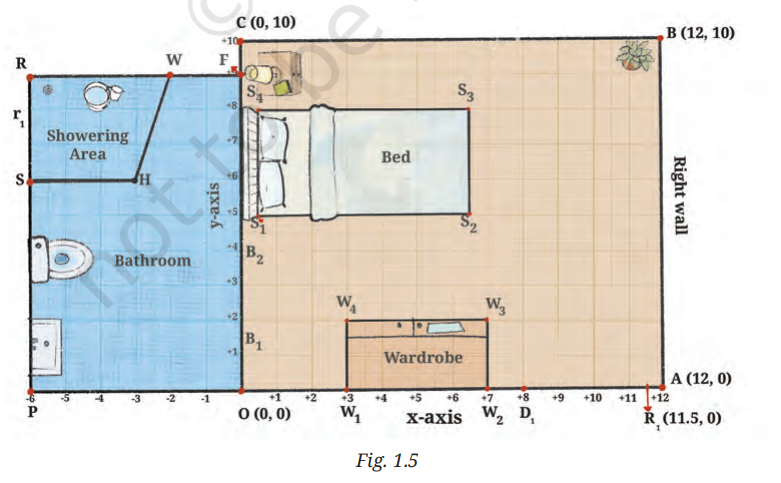
Image source- NCERT
(i) Where will the fourth foot of the table be?
The three feet of the rectangular table are:
- A = (8, 9)
- B = (11, 9)
- C = (11, 7)
Since opposite sides of a rectangle are parallel and equal, the fourth corner will have:
x-coordinate = 8 (same as A)
y-coordinate = 7 (same as C)
Therefore,
Fourth foot = (8, 7)
(ii) Is this a good spot for the table?
The table occupies the rectangle:
- x = 8 to 11
- y = 7 to 9
This region lies near the upper-right side of the room and does not overlap with:
- the bed (x = 0 to 6, y = 5 to 8)
- the wardrobe (x = 3 to 7, y = 0 to 2)
- the doors
Hence there is enough free space around it.
Yes, it is a good location for the study table.
(iii) What is the width and length of the table?
Horizontal distance:
= 11 − 8 = 3 units
Vertical distance:
= 9 − 7 = 2 units
| Measurement | Value |
|---|---|
| Length | 3 units |
| Width | 2 units |
The height of the table cannot be determined from the coordinate diagram because the graph only shows length and width.
Height cannot be determined.
Q2. If the bathroom door has a hinge at B1 and opens into the bedroom, will it hit the wardrobe? Are there any changes you would suggest if the door is made wider?
Bathroom door endpoints are:
- B1 = (0, 1.5)
- B2 = (0, 4)
Door width:
= 4 − 1.5
= 2.5 units
The wardrobe occupies:
- x = 3 to 7
- y = 0 to 2
When the bathroom door opens into the bedroom, it rotates near the y-axis. The wardrobe is 3 units away from the y-axis.
Therefore the door will not touch the wardrobe.
No, the bathroom door will not hit the wardrobe.
If the door is made much wider, care should be taken that it still opens freely without obstructing movement in the room.
Q3. Look at Reiaan’s bathroom.
(i) Coordinates of O, F, R and P
| Point | Coordinates |
|---|---|
| O | (0, 0) |
| F | (0, 9) |
| R | (−2, 9) |
| P | (−6, 0) |
(ii) Shape and coordinates of showering area SHWR
From the figure:
- S = (−6, 6)
- H = (−3, 6)
- W = (−2, 9)
- R = (−6, 9)
The figure SHWR has one pair of opposite sides parallel.
Therefore it is a trapezium.
| Vertex | Coordinates |
|---|---|
| S | (−6, 6) |
| H | (−3, 6) |
| W | (−2, 9) |
| R | (−6, 9) |
(iii) Coordinates of washbasin and toilet spaces
One possible arrangement is:
Washbasin (3 ft × 2 ft)
| Corner | Coordinates |
|---|---|
| A | (−6, 0) |
| B | (−3, 0) |
| C | (−3, 2) |
| D | (−6, 2) |
Toilet (2 ft × 3 ft)
| Corner | Coordinates |
|---|---|
| E | (−6, 2) |
| F | (−4, 2) |
| G | (−4, 5) |
| H | (−6, 5) |
(Any other correct placement inside the bathroom is acceptable.)
Q4. Other Rooms in the House
(i) Dining Room Coordinates
P = (−6, 0)
A = (12, 0)
Length PA:
= 12 − (−6)
= 18 units
Given width = 15 units
Hence the upper corners are:
- Q = (−6, 15)
- B = (12, 15)
| Corner | Coordinates |
|---|---|
| P | (−6, 0) |
| A | (12, 0) |
| B | (12, 15) |
| Q | (−6, 15) |
(ii) Dining Table at the Centre
Centre of dining room:
x = (−6 + 12)/2 = 3
y = (0 + 15)/2 = 7.5
Table size:
- Length = 5 ft
- Width = 3 ft
Half length = 2.5 ft
Half width = 1.5 ft
Coordinates of the four feet:
| Point | Coordinates |
|---|---|
| T₁ | (0.5, 6) |
| T₂ | (5.5, 6) |
| T₃ | (5.5, 9) |
| T₄ | (0.5, 9) |
These points place the dining table exactly at the centre of the dining room.