NDA Exam 2026: Syllabus, Eligibility, Exam Pattern & Preparation Guide(Updated 2026)
📚 Published by: Saraswat Academy
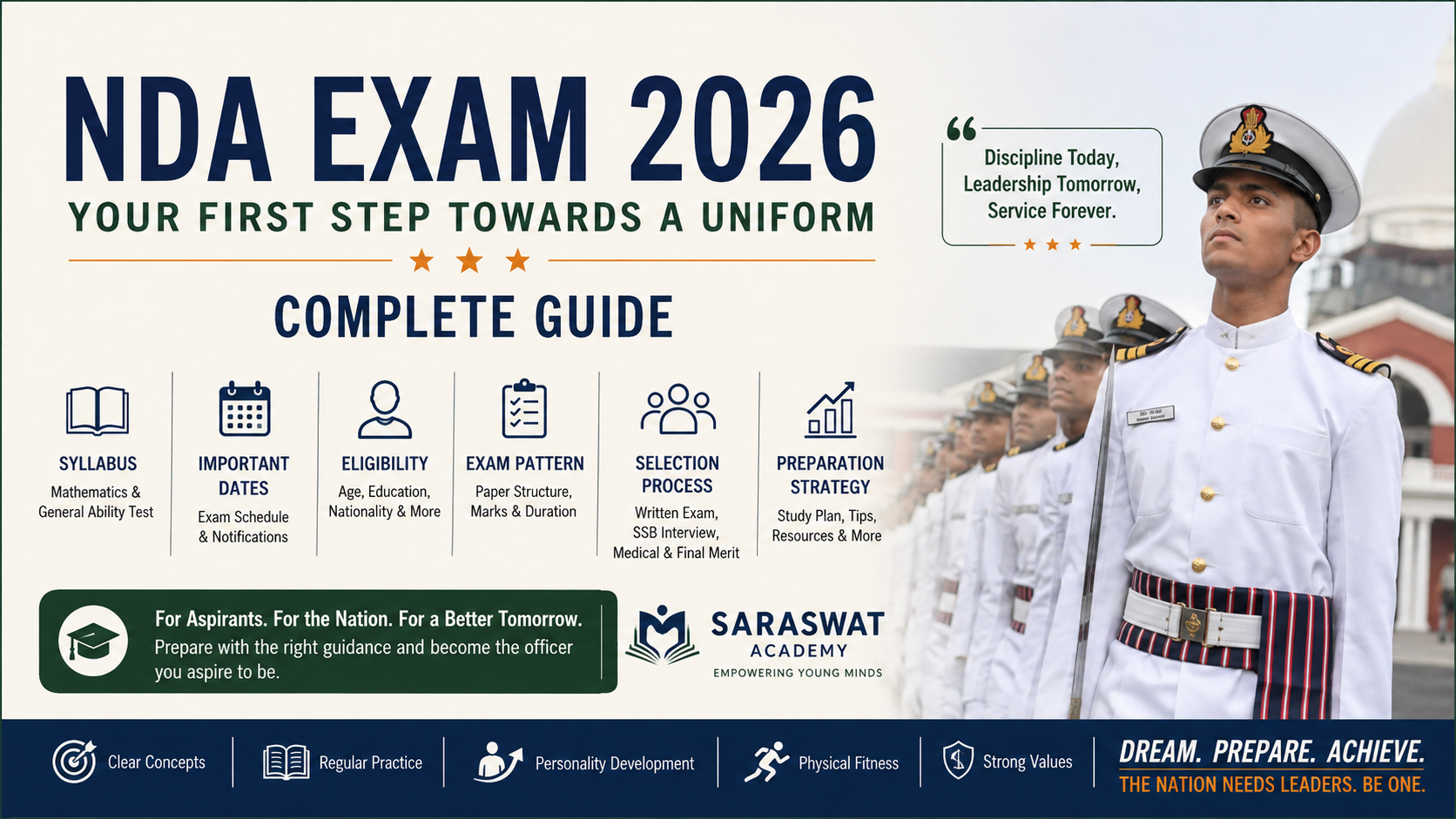
NDA Exam 2026: Complete Guide to Syllabus, Dates, Eligibility & Preparation
The National Defence Academy (NDA) Exam is one of India's most prestigious competitive examinations conducted by the Union Public Service Commission (UPSC). It provides an opportunity for young aspirants to begin their journey towards becoming commissioned officers in the Indian Army, Navy and Air Force.
If you are a Class 11 or Class 12 student dreaming of wearing the uniform and serving the nation, understanding the NDA syllabus, eligibility criteria, examination pattern and preparation strategy is extremely important.
This complete guide by Saraswat Academy explains the NDA examination in simple language and covers important information about the exam, eligibility, syllabus, selection process and preparation strategy.
What is the NDA Exam?
The National Defence Academy (NDA) and Naval Academy (NA) Examination is conducted by UPSC for admission to the Army, Navy and Air Force wings of the National Defence Academy and the 10+2 Cadet Entry Scheme of the Indian Naval Academy.
The National Defence Academy is located at Khadakwasla, Pune. It is a tri-service training academy where cadets of the Army, Navy and Air Force train together before proceeding to their respective service academies for further training.
NDA is conducted twice every year. The selection process involves a written examination followed by the Services Selection Board (SSB) assessment and medical fitness requirements.
NDA is not just an academic examination. It tests knowledge, reasoning ability, communication skills, awareness, confidence and the qualities required for a career in the Armed Forces.
Why is the NDA Exam Important?
For students who want to join the Armed Forces soon after Class 12, NDA provides one of the most direct and prestigious pathways. It combines academic education, military training, physical development and leadership development.
| Feature | Information |
|---|---|
| Conducting Body | Union Public Service Commission (UPSC) |
| Exam Name | National Defence Academy & Naval Academy Examination |
| Frequency | Twice a year |
| Mode of Written Exam | Offline / Pen-and-Paper based |
| Written Examination | Mathematics + General Ability Test |
| Total Written Marks | 900 |
| SSB Marks | 900 |
NDA Exam Dates 2026
UPSC generally conducts the NDA examination twice a year. The exact dates should always be checked in the latest UPSC notification because examination schedules can change.
| Event | NDA I 2026 | NDA II 2026 |
|---|---|---|
| Notification | 10 December 2025 | 20 May 2026 |
| Application Period | December 2025 | May–June 2026 |
| Written Examination | 12 April 2026 | 13 September 2026 |
| Examination Frequency | Twice every year | |
Important: Candidates should always verify dates, eligibility conditions and application instructions from the latest official UPSC notification before applying.
NDA Exam Pattern
The NDA written examination consists of two objective-type papers: Mathematics and the General Ability Test (GAT). Each paper is conducted for 2 hours and 30 minutes.
| Paper | Subject | Duration | Maximum Marks |
|---|---|---|---|
| Paper I | Mathematics | 2 Hours 30 Minutes | 300 |
| Paper II | General Ability Test (GAT) | 2 Hours 30 Minutes | 600 |
| Total Written Examination | 900 | ||
The written examination is followed by the SSB Test/Interview, which carries another 900 marks.
NDA Mathematics Syllabus
The Mathematics paper carries 300 marks. It tests mathematical understanding, numerical ability and problem-solving skills.
Important areas include:
| S.No. | Major Topic | Important Areas |
|---|---|---|
| 1 | Algebra | Sets, Relations, Complex Numbers, Quadratic Equations, Sequences and Series |
| 2 | Matrices & Determinants | Basic properties and applications |
| 3 | Trigonometry | Trigonometric ratios, identities, equations and applications |
| 4 | Analytical Geometry | Coordinates, straight lines, circles and conic sections |
| 5 | Differential Calculus | Functions, limits, derivatives and applications |
| 6 | Integral Calculus | Integration and applications |
| 7 | Vector Algebra | Vectors and their applications |
| 8 | Statistics | Data representation, averages and dispersion |
| 9 | Probability | Basic concepts and applications |
Students should develop strong fundamentals instead of depending only on memorisation. Regular numerical practice is essential because NDA Mathematics is a speed-and-accuracy based paper.
NDA General Ability Test (GAT) Syllabus
The GAT carries 600 marks and is divided into English and General Knowledge sections.
| Part | Subject | Marks |
|---|---|---|
| Part A | English | 200 |
| Part B | General Knowledge | 400 |
| Total | 600 | |
English – 200 Marks
The English section evaluates the candidate's understanding of English and ability to use the language correctly.
- Grammar
- Vocabulary
- Comprehension
- Sentence Formation
- Synonyms and Antonyms
- Sentence Improvement
- Error Detection
- Usage of Words
General Knowledge – 400 Marks
The General Knowledge section covers several areas of science, social science and current affairs.
- Physics
- Chemistry
- General Science
- History
- Geography
- Current Events
- Defence-related awareness
NDA Eligibility Criteria
Eligibility is one of the most important things an aspirant should check before beginning preparation. UPSC specifies the exact age and educational requirements in every examination notification.
| Eligibility Factor | Requirement |
|---|---|
| Nationality | Candidates must satisfy the nationality conditions specified by UPSC. |
| Gender | Eligible unmarried male and female candidates can apply. |
| Marital Status | Candidates must be unmarried as prescribed in the notification. |
| Age | Generally around 16½ to 19½ years, with the exact date-of-birth window specified separately in each notification. |
| Army Wing | Class 12 passed or appearing from a recognised board. |
| Air Force & Naval Wings | Class 12 passed or appearing with Physics, Chemistry and Mathematics. |
Note: The exact age window and other conditions must be checked against the notification for the particular NDA examination you intend to take.
Can Arts Students Apply for NDA?
Yes. Students from the Arts stream can apply for the Army Wing provided they satisfy the other eligibility requirements.
However, candidates who want to apply for the Air Force or Naval Wings need to have studied the required science subjects, including Physics and Mathematics, at the Class 12 level.
| Stream | Army Wing | Air Force / Navy |
|---|---|---|
| Science with PCM | Yes | Yes |
| Commerce | Yes | No, if required Physics & Mathematics are not studied |
| Arts | Yes | No, if required Physics & Mathematics are not studied |
Can Girls Give the NDA Exam?
Yes. Eligible unmarried female candidates can apply for the NDA examination. Female candidates are included in the NDA selection process subject to the applicable eligibility, vacancy, medical and physical standards.
The inclusion of female candidates has opened the NDA pathway to more young aspirants who wish to pursue a career as officers in India's Armed Forces.
NDA Selection Process
Clearing the written examination is only one stage of the NDA selection process. Candidates must successfully clear subsequent stages.
- UPSC Written Examination
- Services Selection Board (SSB) Assessment
- Medical Examination
- Final Selection / Merit
- Training
The SSB process evaluates a candidate's personality, leadership potential, communication, decision-making ability, teamwork and other officer-like qualities.
How to Prepare for the NDA Exam?
NDA preparation should ideally begin well before the examination. A student should develop a balanced routine covering academics, current affairs, English, mathematics, physical fitness and personality development.
1. Build Strong Mathematical Fundamentals
Mathematics carries 300 marks, so candidates should first strengthen their fundamentals. Begin with concepts and then gradually move towards timed practice.
2. Follow the NDA Syllabus
Do not prepare randomly. Divide the syllabus into manageable topics and maintain a checklist of completed, pending and weak areas.
3. Practise Previous Year Questions
Previous year papers help candidates understand the nature of questions, difficulty level, recurring concepts and time pressure.
4. Improve English Every Day
Read English newspapers, editorials and quality articles. Learn new vocabulary and practise grammar questions regularly.
5. Develop Current Affairs Awareness
Make current affairs a daily habit. Focus particularly on national and international events, defence developments, science and technology, sports, geography and important government initiatives.
6. Take Mock Tests
Mock tests are important for developing examination temperament. After every mock test, analyse mistakes rather than simply checking the score.
7. Work on Physical Fitness
NDA aspirants should not wait until the written examination is over to start taking physical fitness seriously. A disciplined routine involving running, basic strength exercises, flexibility and healthy habits can help build physical readiness.
8. Develop Confidence and Communication Skills
SSB preparation should not be treated as memorising interview answers. Candidates should develop genuine communication, awareness, teamwork, confidence and decision-making abilities.
Simple NDA Daily Study Plan
| Activity | Suggested Focus |
|---|---|
| Mathematics | Concepts + Numerical Practice |
| English | Grammar + Vocabulary + Reading |
| Science | Physics + Chemistry + General Science |
| Social Science | History + Geography |
| Current Affairs | Daily News + Important Events |
| Previous Year Questions | Topic-wise and full-length practice |
| Physical Fitness | Running + Strength + Flexibility |
Consistency beats last-minute preparation. Studying for a few focused hours every day is generally more effective than studying for long hours only a few days before the examination.
Is the NDA Exam Tough?
The NDA examination is certainly competitive, but it is not impossible. The difficulty comes from the combination of a broad syllabus, objective questions, time pressure, negative marking and the subsequent SSB selection process.
A student who starts preparation early, understands concepts, practises regularly, follows current affairs and works consistently on personality and fitness can build a strong foundation for NDA.
The most important qualities are discipline, consistency, accuracy, self-confidence and willingness to improve.
NDA Preparation at Saraswat Academy
At Saraswat Academy, our approach to competitive examination preparation focuses on building strong academic fundamentals along with regular practice and examination-oriented learning.
Students preparing for NDA can benefit from a structured approach covering Mathematics, English, General Science, Social Science, Current Affairs, practice questions and mock-test preparation.
Our objective is not simply to make students memorise answers. We encourage students to understand concepts, practise regularly and develop the confidence required to face competitive examinations.
For students currently studying in Classes 9 to 12, starting preparation early can provide a significant advantage because the fundamentals required for NDA can be developed gradually instead of being rushed at the last moment.
Frequently Asked Questions About NDA Exam
| Question | Answer |
|---|---|
| Can girls give the NDA exam? | Yes. Eligible unmarried female candidates can apply for the NDA examination. Selection is subject to the applicable UPSC eligibility conditions, vacancies, medical requirements and physical standards. |
| Can Arts students apply for NDA? | Yes. Arts students can apply for the Army Wing if they fulfil the prescribed eligibility conditions. For the Air Force and Naval Wings, candidates must have studied the required subjects, including Physics and Mathematics, at Class 12 level. |
| Can Commerce students apply for NDA? | Yes. Commerce students can apply for the Army Wing if they meet the eligibility requirements. For the Air Force and Naval Wings, the prescribed Class 12 subjects, including Physics and Mathematics, are required. |
| How many times is NDA conducted in a year? | UPSC generally conducts the NDA and Naval Academy Examination twice every year, commonly known as NDA I and NDA II. |
| How many marks is the NDA written exam? | The NDA written examination carries a total of 900 marks. Mathematics is worth 300 marks, while the General Ability Test carries 600 marks. |
| How many marks is the SSB Interview? | The SSB Test/Interview carries a total of 900 marks. |
| Is NDA preparation possible after Class 12? | Yes. Students who meet the eligibility requirements can prepare after Class 12. However, they should carefully check the age and educational conditions mentioned in the relevant UPSC notification. Beginning preparation during Classes 11 and 12 can provide more time for systematic preparation. |
| Is NDA Mathematics difficult? | NDA Mathematics can be challenging because candidates need to solve objective questions accurately within a limited time. A strong conceptual foundation, regular numerical practice and timed mock tests can significantly improve performance. |
| Is NDA suitable for Class 11 students? | Yes. Class 11 is a good stage to begin NDA preparation. Students can gradually strengthen Mathematics, English, Science, General Knowledge and current-affairs awareness alongside their regular school studies. |
Final Words for NDA Aspirants
Becoming an officer through NDA is a demanding but highly rewarding goal. The journey requires much more than preparing for an examination. It requires discipline, consistency, physical fitness, awareness, confidence and a genuine desire to serve the nation.
Start with the basics, follow the syllabus, practise previous year questions, analyse your mistakes and maintain a disciplined daily routine.
Dream big, prepare consistently and let your daily discipline take you closer to the uniform.
Saraswat Academy is committed to helping students build strong academic foundations and prepare confidently for competitive examinations.
Important Official Resources
Disclaimer: NDA eligibility, vacancies, dates, syllabus details and other examination conditions may be revised by UPSC or the Government of India. Candidates should always read the latest official UPSC notification before applying.
Popular Articles
Explore more useful articles, career guides and interesting facts to keep learning with Saraswat Academy.
NDA Exam 2026: Syllabus, Eligibility & Preparation
Explore NDA eligibility, exam pattern, syllabus and preparation tips for aspiring defence officers.
Read Article →National Education Policy (NEP) 2020
Understand the key features of NEP 2020 and its impact on India's education system.
Read Article →Discovery of Zero: History & Interesting Facts
Discover the fascinating history of zero and its importance in mathematics.
Read Article →Nobel Prize: History, Story & Interesting Facts
Learn about the Nobel Prize, its history and the achievements it celebrates.
Read Article →Examination System: History, Story & Interesting Facts
Learn about the examination system, its history and the achievements it celebrates.
Read Article →Best Career Options for Students in India after class 12: A Complete Guide
Explore the top career paths available to students after completing class 12.
Read Article →About the Author