CIVICS (Democratic Politics-II) - 10 - Social Science solution
Class 10 - Chapter 2: Federalism
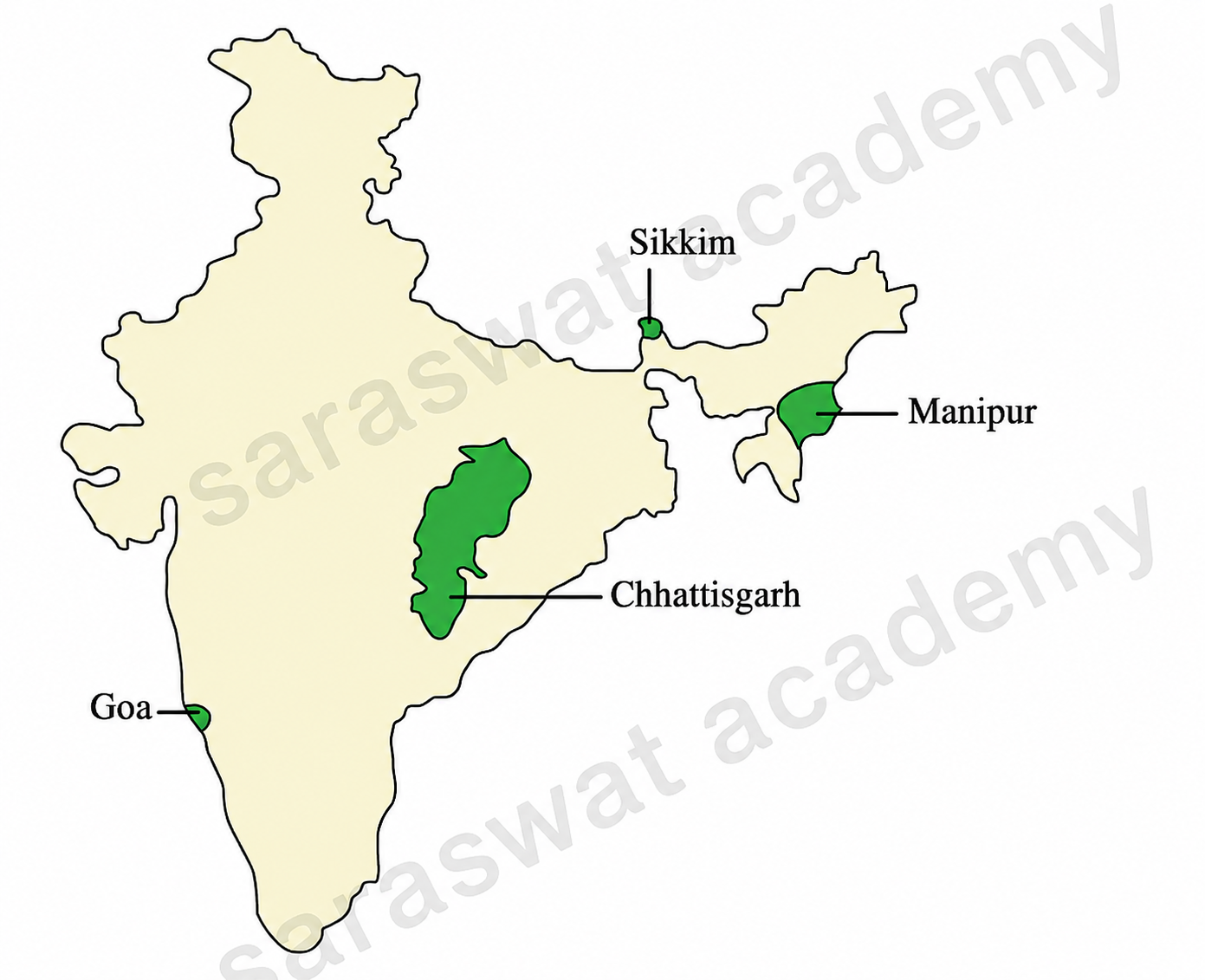
1. Locate the following States on a blank outline political map of India.
Answer:
2. Identify and shade three federal countries (other than India) on a blank outline political map of the world.
Answer:
Any three federal countries can be identified and shaded:
- United States of America (USA)
- Canada
- Australia
Other examples include Switzerland, Belgium, Germany and Brazil.
3. Point out one feature in the practice of federalism in India that is similar to and one feature that is different from that of Belgium.
Answer:
Similarity
Both India and Belgium follow a federal system in which powers are constitutionally divided between different levels of government.
Difference
Belgium has a special Community Government based on language groups, whereas India does not have such a separate community government. India mainly follows a Union-State-Local government structure.
4. What is the main difference between a federal form of government and a unitary one? Explain with an example.
Answer:
Federal Government
In a federal system, powers are divided between the central government and state governments by the Constitution.
Example: India, USA, Canada and Australia.
Unitary Government
In a unitary system, all powers are concentrated in the central government, and regional governments work under its authority.
Example: Sri Lanka and the United Kingdom.
Main Difference
| Federal Government | Unitary Government |
|---|---|
| Powers are constitutionally divided. | Powers are concentrated at the centre. |
| States enjoy constitutional authority. | Regional units derive powers from the centre. |
5. State any two differences between the local government before and after the Constitutional Amendment in 1992.
Answer:
| Before 1992 Amendment | After 1992 Amendment |
|---|---|
| Local bodies were not constitutionally recognised. | Local bodies received constitutional status. |
| Regular elections were not compulsory. | Regular elections every five years became mandatory. |
| Women had limited representation. | Reservation for women and weaker sections was introduced. |
6. Fill in the blanks.
(i) Since the United States is a coming together type of federation, all the constituent States have equal powers and States are strong vis-à-vis the federal government.
(ii) But India is a holding together type of federation and some States have more power than others.
(iii) In India, the Central government has more powers.
7. Here are three reactions to the language policy followed in India. Give an argument and an example to support any one of these positions.
Answer:
I agree with Sangeeta's view that the policy of accommodation has strengthened national unity.
India recognises linguistic diversity and allows states to use their own official languages. The Constitution does not impose any one language on all citizens. This policy has reduced linguistic conflicts and promoted unity in diversity.
Example: Tamil Nadu uses Tamil, Maharashtra uses Marathi and West Bengal uses Bengali, yet all remain united within the Indian Union.
8. The distinguishing feature of a federal government is:
Answer: (d) Governmental power is divided between different levels of government.
Explanation:
The most important feature of federalism is the constitutional division of powers between the central and state governments.
9. Group the following subjects under Union, State and Concurrent Lists.
A. Defence
B. Police
C. Agriculture
D. Education
E. Banking
F. Forests
G. Communications
H. Trade
I. Marriages
Answer:
| List | Subjects |
|---|---|
| Union List | Defence, Banking, Communications |
| State List | Police, Agriculture, Trade |
| Concurrent List | Education, Forests, Marriages |
10. Examine the following pairs that give the level of government in India and the powers of the government at that level. Which of the following pairs is not correctly matched?
| Option | Level of Government | Power |
|---|---|---|
| (a) | State Government | State List |
| (b) | Central Government | Union List |
| (c) | Central and State Governments | Concurrent List |
| (d) | Local Governments | Residuary Powers |
Answer: (d) Local Governments – Residuary Powers
Explanation:
Residuary powers belong to the Central Government, not to local governments.
11. Match List I with List II.
| List I | List II |
|---|---|
| 1. Union of India | A. Prime Minister |
| 2. State | C. Governor |
| 3. Municipal Corporation | D. Mayor |
| 4. Gram Panchayat | B. Sarpanch |
Matching: 1-A, 2-C, 3-D, 4-B
Correct Option: (c)
12. Consider the following two statements.
A. In a federation, the powers of the federal and provincial governments are clearly demarcated.
B. India is a federation because the powers of the Union and State Governments are specified in the Constitution and they have exclusive jurisdiction on their respective subjects.
C. Sri Lanka is a federation because the country is divided into provinces.
D. India is no longer a federation because some powers of the States have been devolved to local government bodies.
Answer:
Statement A is correct.
Statement B is correct.
Statement C is incorrect because Sri Lanka follows a unitary system of government.
Statement D is incorrect because India continues to be a federal country despite decentralisation.
Correct Option: (c) A and B only
Important Exam Points
- Federalism means division of powers between different levels of government.
- India is a "holding together" federation.
- USA is a "coming together" federation.
- The 73rd and 74th Constitutional Amendments strengthened local self-government.
- India follows a policy of linguistic accommodation.
- Union, State and Concurrent Lists divide legislative powers in India.
- Residuary powers belong to the Central Government.