Class 9 Mathematics · Ganita Manjari Part 1
Class 9 Maths Chapter 5 – Exercise Set 5.6 Solutions
Question 1 — In a circle with centre O, the central angle AOB is 60°. If the radius of the circle is 12 cm, what is the length of the chord AB?
Given: $OA=OB=12$ cm and $\angle AOB=60^\circ$.
Since $OA=OB$, $\triangle AOB$ is isosceles. Its two remaining angles are equal:
$$\angle OAB=\angle OBA=\frac{180^\circ-60^\circ}{2}=60^\circ.$$Thus the triangle is equilateral.
Answer: $\boxed{AB=12\text{ cm}}$.
Question 2 — Let A and B be two points on a circle with centre O.
(i) Are there points X, Y on the circle, on the same side of AB, such that ∠AXB is different from ∠AYB?
If $X$ and $Y$ lie on the same side of chord $AB$, they see the same chord in the same segment. Therefore the subtended angles are equal:
$$\angle AXB=\angle AYB.$$So two such points cannot give different angles.
(ii) Is it true that if ∠AXB = ∠AYB, then X and Y lie on the same side of the circle?
No. Equal angles subtended by the same chord can occur at points on different arcs/sides in the circle. Therefore equality of the angles alone does not imply that $X$ and $Y$ are on the same side.
(iii) If ∠AXB = ∠AYB, and X and Y do not lie on the circle, does the circle through A, B and X also pass through Y?
When the equal-angle condition is taken in the appropriate same-side configuration, the converse of the concyclicity theorem applies. Thus the four points are concyclic, so the circle through $A,B,X$ also passes through $Y$.
Question 3 — Find x in Fig. 5.26.
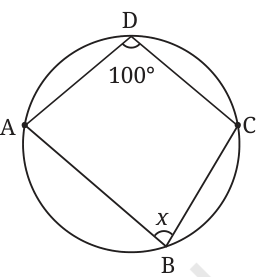
The four relevant points lie on the same circle, so the quadrilateral is cyclic. The angle opposite the given $100^\circ$ angle is $x$.
$$x+100^\circ=180^\circ.$$ $$\boxed{x=80^\circ}.$$Answer: $x=80^\circ$.