Mathematics solution NCERT
Class 10 - Chapter 6: Triangles
Exercise 6.3
Question 1: State which pairs of triangles in Fig. are similar. Write the similarity criterion used by you for answering the question and also write the pairs of similar triangles in the symbolic form.
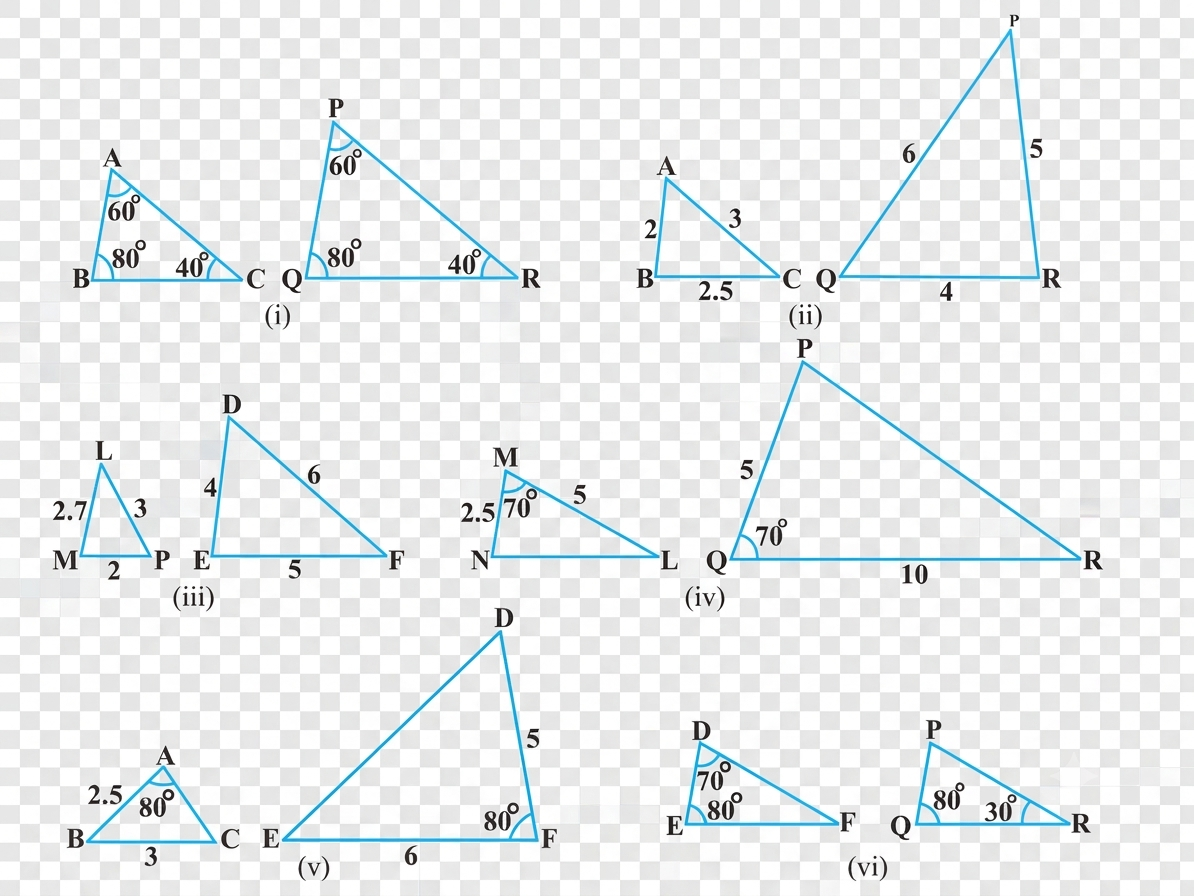
(i) Triangles ΔABC and ΔPQR
Given Angle Measurements:
- ∠A = 60°, ∠P = 60°
- ∠B = 80°, ∠Q = 80°
- ∠C = 40°, ∠R = 40°
Step-by-step Verification:
Comparing corresponding angles of ΔABC and ΔPQR:
∠A = ∠P = 60°
∠B = ∠Q = 80°
∠C = ∠R = 40°
Since all three pairs of corresponding angles are equal, the triangles are similar by the AAA (Angle-Angle-Angle) similarity criterion.
Hence: ΔABC ~ ΔPQR
(ii) Triangles ΔABC and ΔPQR
Given Side Lengths:
- ΔABC: AB = 2, BC = 2.5, AC = 3
- ΔPQR: PQ = 6, QR = 4, PR = 5
Step-by-step Verification:
Let's check the ratio of corresponding side combinations to see if they are proportional:
AB / QR = 2 / 4 = 1 / 2
BC / PR = 2.5 / 5 = 1 / 2
AC / PQ = 3 / 6 = 1 / 2
Since all corresponding side ratios are equal:
AB / QR = BC / PR = AC / PQ = 1 / 2
Hence
The corresponding sides of the two triangles are proportional, meaning the triangles are similar by the SSS (Side-Side-Side) similarity criterion.
When writing the symbolic form, ensure the order matches the corresponding proportional sides (A matches to Q, B matches to R, C matches to P).
ΔABC ~ ΔQRP
(iii) Triangles ΔLMP and ΔDEF
Given Side Lengths:
- ΔLMP: MP = 2, LP = 3, LM = 2.7
- ΔDEF: DE = 4, DF = 6, EF = 5
Step-by-step Verification:
Let's check the ratios of the corresponding sides:
MP / DE = 2 / 4 = 1 / 2
LP / DF = 3 / 6 = 1 / 2
LM / EF = 2.7 / 5 = 0.54
Since MP / DE = LP / DF ≠ LM / EF, the corresponding sides are not proportional.
Hence
The triangles are not similar.
(iv) Triangles ΔMNL and ΔPQR
Given Measurements:
- ΔMNL: MN = 2.5, ML = 5, ∠M = 70°
- ΔPQR: PQ = 5, QR = 10, ∠Q = 70°
Step-by-step Verification:
1. Check the ratios of the sides including the given angles:
MN / PQ = 2.5 / 5 = 1 / 2
ML / QR = 5 / 10 = 1 / 2
Therefore, MN / PQ = ML / QR = 1 / 2
2. Check the included angles:
∠M = ∠Q = 70°
Hence
Since two sides of one triangle are proportional to two sides of another triangle and their included angles are equal, the triangles are similar by the SAS (Side-Angle-Side) similarity criterion.
ΔMNL ~ ΔQPR
(v) Triangles ΔABC and ΔDEF
Given Measurements:
- ΔABC: AB = 2.5, BC = 3, ∠A = 80°
- ΔDEF: DF = 5, EF = 6, ∠F = 80°
Step-by-step Verification:
In ΔDEF, the given angle ∠F (80°) is correctly included between the known sides DF and EF.
However, in ΔABC, the given angle ∠A (80°) is not the included angle between the known sides AB and BC (the included angle would be ∠B).
Hence
Since the SAS criterion requires the angle to be strictly between the two proportional sides, these triangles cannot be proven similar. Therefore, they are not similar.
(vi) Triangles ΔDEF and ΔPQR
Given Angle Measurements:
- ΔDEF: ∠D = 70°, ∠E = 80°
- ΔPQR: ∠Q = 80°, ∠R = 30°
Step-by-step Verification:
1. Find the missing third angle of ΔDEF using the Angle Sum Property (sum = 180°):
∠F = 180° - (70° + 80°) = 180° - 150° = 30°
2. Compare corresponding angles between ΔDEF and ΔPQR:
∠D = 70° (We can find ∠P = 180° - (80° + 30°) = 70°, so ∠D = ∠P)
∠E = ∠Q = 80°
∠F = ∠R = 30°
Hence
Since the corresponding angles are equal, the triangles are similar by the AA (Angle-Angle) similarity criterion.
ΔDEF ~ ΔPQR
Question 2: In Fig, ΔODC ~ ΔOBA, ∠BOC = 125° and ∠CDO = 70°. Find ∠DOC, ∠DCO and ∠OAB.
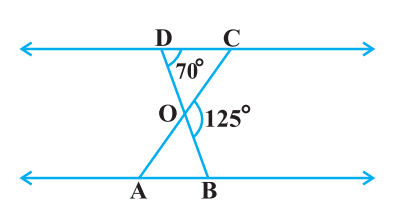
Solution:
1. To find ∠DOC:
We can see that DOB is a straight line segment.
Therefore, ∠DOC and ∠BOC form a linear pair of angles (their sum is 180°):
∠DOC + ∠BOC = 180°
∠DOC + 125° = 180°
∠DOC = 180° - 125°
∠DOC = 55°
2. To find ∠DCO:
In triangle ODC (ΔODC), the sum of all interior angles is 180°:
∠CDO + ∠DOC + ∠DCO = 180°
70° + 55° + ∠DCO = 180°
125° + ∠DCO = 180°
∠DCO = 180° - 125°
∠DCO = 55°
3. To find ∠OAB:
It is given that ΔODC ~ ΔOBA.
Since corresponding angles of similar triangles are equal, we match the corresponding vertices (Vertex C corresponds to Vertex A):
∠OAB = ∠DCO
Since we already calculated ∠DCO = 55°:
∠OAB = 55°
Final Answer: ∠DOC = 55°, ∠DCO = 55°, and ∠OAB = 55°.
Question 3: Diagonals AC and BD of a trapezium ABCD with AB || DC intersect each other at the point O. Using a similarity criterion for two triangles, show that OA / OC = OB / OD.
Proof:
Step 1: Identify the triangles to compare.
We will consider triangle OAB (ΔOAB) and triangle OCD (ΔOCD).
Step 2: Establish equal angles between the triangles.
- ∠AOB = ∠COD (Vertically opposite angles are equal)
- ∠OAB = ∠OCD (Alternate interior angles are equal, since AB || DC and AC is the transversal line)
- ∠OBA = ∠ODC (Alternate interior angles are equal, since AB || DC and BD is the transversal line)
Step 3: Apply the similarity criterion.
Since all three pairs of corresponding angles are equal, by the AAA (Angle-Angle-Angle) similarity criterion:
ΔOAB ~ ΔOCD
Step 4: Establish the side proportionality.
We know that the corresponding sides of similar triangles are proportional. Therefore:
OA / OC = OB / OD
(Hence Proved)
Question 4: In Fig, QR / QS = QT / PR and ∠1 = ∠2. Show that ΔPQS ~ ΔTQR.
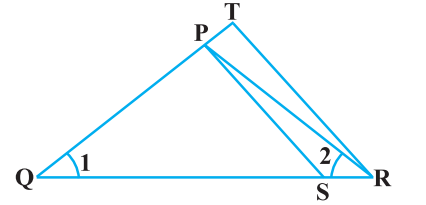
Proof:
Step 1: Use the angle relationship to find equal sides.
In triangle PQR (ΔPQR), it is given that:
∠1 = ∠2
Since the angles opposite to these sides are equal, their opposite sides must also be equal:
PR = PQ --- (Equation 1)
Step 2: Substitute the value into the given side ratio.
The given ratio is:
QR / QS = QT / PR
Substituting PR = PQ from Equation 1 into this ratio, we get:
QR / QS = QT / PQ
By rearranging the terms, this can be written as:
PQ / QS = QT / QR --- (Equation 2)
Step 3: Compare ΔPQS and ΔTQR.
- PQ / QS = QT / QR (Proved in Equation 2)
- ∠PQS = ∠TQR (Common angle, since ∠1 is shared by both triangles)
Hence
By the SAS (Side-Angle-Side) similarity criterion, the triangles are similar:
ΔPQS ~ ΔTQR
(Hence Proved)
Question 5: S and T are points on sides PR and QR of ΔPQR such that ∠P = ∠RTS. Show that ΔRPQ ~ ΔRTS.
Proof:
Compare triangle RPQ (ΔRPQ) and triangle RTS (ΔRTS):
- ∠RPQ = ∠RTS (Given in the question)
- ∠PRQ = ∠TRS (Common angle, since Vertex R is shared by both triangles)
Hence
Since two pairs of corresponding angles are equal, by the AA (Angle-Angle) similarity criterion:
ΔRPQ ~ ΔRTS
(Hence Proved)
Question 6: In Fig, if ΔABE ≅ ΔACD, show that ΔADE ~ ΔABC.
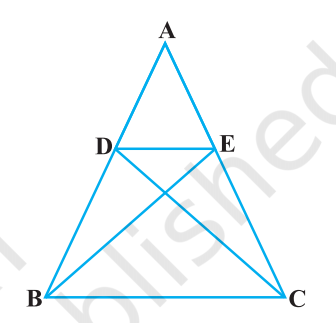
Proof:
Step 1: Extract information from the given congruence.
It is given that ΔABE ≅ ΔACD.
By CPCT (Corresponding Parts of Congruent Triangles), we get:
- AB = AC --- (Equation 1)
- AD = AE --- (Equation 2)
Step 2: Set up a proportional side ratio.
Dividing Equation 2 by Equation 1 gives:
AD / AB = AE / AC --- (Equation 3)
Step 3: Compare ΔADE and ΔABC.
- AD / AB = AE / AC (Proved in Equation 3)
- ∠DAE = ∠BAC (Common angle, since Vertex A is shared by both triangles)
Hence
Since two sides are proportional and their included angles are equal, by the SAS (Side-Angle-Side) similarity criterion:
ΔADE ~ ΔABC
(Hence Proved)
Question 7: In Fig, altitudes AD and CE of ΔABC intersect each other at the point P. Show that:
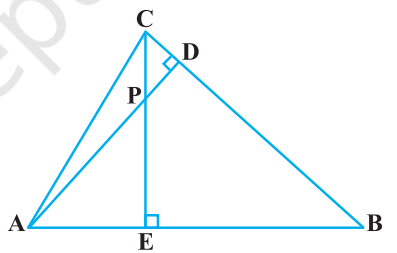
Note: Since AD and CE are altitudes, ∠AEC = ∠AEB = 90° and ∠ADC = ∠ADB = 90°.
(i) ΔAEP ~ ΔCDP
In ΔAEP and ΔCDP:
- ∠AEP = ∠CDP = 90° (Altitudes form right angles)
- ∠APE = ∠CPD (Vertically opposite angles are equal)
Therefore, by the AA similarity criterion: ΔAEP ~ ΔCDP
(ii) ΔABD ~ ΔCBE
In ΔABD and ΔCBE:
- ∠ADB = ∠CEB = 90° (Altitudes form right angles)
- ∠ABD = ∠CBE (Common angle, Vertex B is shared)
Therefore, by the AA similarity criterion: ΔABD ~ ΔCBE
(iii) ΔAEP ~ ΔADB
In ΔAEP and ΔADB:
- ∠AEP = ∠ADB = 90° (Altitudes form right angles)
- ∠PAE = ∠DAB (Common angle, Vertex A is shared)
Therefore, by the AA similarity criterion: ΔAEP ~ ΔADB
(iv) ΔPDC ~ ΔBEC
In ΔPDC and ΔBEC:
- ∠PDC = ∠BEC = 90° (Altitudes form right angles)
- ∠PCD = ∠BCE (Common angle, Vertex C is shared)
Therefore, by the AA similarity criterion: ΔPDC ~ ΔBEC
Question 8: E is a point on the side AD produced of a parallelogram ABCD and BE intersects CD at F. Show that ΔABE ~ ΔCFB.
Proof:
Compare triangle ABE (ΔABE) and triangle CFB (ΔCFB):
- ∠BAE = ∠BCF (Opposite angles of a parallelogram are equal, so ∠A = ∠C)
- ∠AEB = ∠CBF (Alternate interior angles are equal, since AE is an extension of AD, AD || BC, and BE is the transversal line)
Hence
Since two pairs of corresponding angles are equal, by the AA (Angle-Angle) similarity criterion:
ΔABE ~ ΔCFB
(Hence Proved)
Question 9: In Fig, ABC and AMP are two right triangles, right angled at B and M respectively. Prove that:
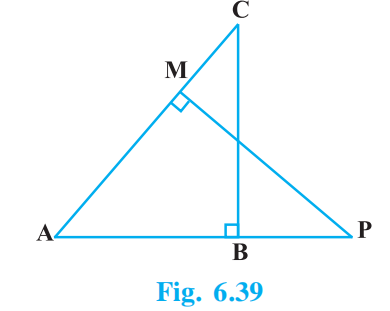
(i) ΔABC ~ ΔAMP
Proof:
Compare triangle ABC (ΔABC) and triangle AMP (ΔAMP):
- ∠ABC = ∠AMP = 90° (Given that both are right angles)
- ∠BAC = ∠MAP (Common angle, Vertex A is shared by both triangles)
Therefore, by the AA similarity criterion, the triangles are similar:
ΔABC ~ ΔAMP
(Hence Proved)
(ii) CA / PA = BC / MP
Proof:
From part (i), we established that ΔABC ~ ΔAMP.
We know that the corresponding sides of similar triangles are proportional. By matching corresponding side pairs:
- Side CA corresponds to side PA.
- Side BC corresponds to side MP.
Therefore:
CA / PA = BC / MP
(Hence Proved)
Question 10: CD and GH are respectively the bisectors of ∠ACB and ∠EGF such that D and H lie on sides AB and FE of ΔABC and ΔEFG respectively. If ΔABC ~ ΔFEG, show that:
Preliminary Step: Establish Angle Relationships
It is given that ΔABC ~ ΔFEG. Therefore, their corresponding angles are equal:
- ∠A = ∠F
- ∠B = ∠E
- ∠ACB = ∠FGE
Since CD bisects ∠ACB, then ∠ACD = ∠BCD = (1/2) ∠ACB.
Since GH bisects ∠FGE, then ∠FGH = ∠EGH = (1/2) ∠FGE.
Since ∠ACB = ∠FGE, their halves are also equal:
∠ACD = ∠FGH and ∠BCD = ∠EGH --- (Equation 1)
(i) CD / GH = AC / FG
Proof:
Compare triangle ACD (ΔACD) and triangle FGH (ΔFGH):
- ∠A = ∠F (Corresponding angles of similar triangles ΔABC and ΔFEG)
- ∠ACD = ∠FGH (Proved in Equation 1)
By the AA similarity criterion, ΔACD ~ ΔFGH.
Since corresponding sides of similar triangles are proportional, we get:
CD / GH = AC / FG
(Hence Proved)
(ii) ΔDCB ~ ΔHGE
Proof:
Compare triangle DCB (ΔDCB) and triangle HGE (ΔHGE):
- ∠B = ∠E (Corresponding angles of similar triangles ΔABC and ΔFEG)
- ∠BCD = ∠EGH (Proved in Equation 1)
Therefore, by the AA similarity criterion:
ΔDCB ~ ΔHGE
(Hence Proved)
(iii) ΔDCA ~ ΔHGF
Proof:
Compare triangle DCA (ΔDCA) and triangle HGF (ΔHGF):
- ∠A = ∠F (Corresponding angles of similar triangles ΔABC and ΔFEG)
- ∠ACD = ∠FGH (Proved in Equation 1)
Therefore, by the AA similarity criterion:
ΔDCA ~ ΔHGF
(Hence Proved)
Question 11: In Fig, E is a point on side CB produced of an isosceles triangle ABC with AB = AC. If AD ⊥ BC and EF ⊥ AC, prove that ΔABD ~ ΔECF.
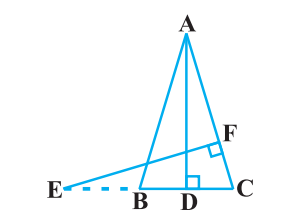
Proof:
Step 1: Use the property of the isosceles triangle.
In triangle ABC (ΔABC), it is given that:
AB = AC
We know that angles opposite to equal sides in a triangle are equal. Therefore:
∠ABC = ∠ACB
This can also be written in terms of the points on the segments as:
∠ABD = ∠ECF --- (Equation 1)
Step 2: Compare ΔABD and ΔECF.
- ∠ADB = ∠EFC = 90° (Given that AD ⊥ BC and EF ⊥ AC)
- ∠ABD = ∠ECF (Proved in Equation 1)
Hence
Since two pairs of corresponding angles are equal, by the AA (Angle-Angle) similarity criterion:
ΔABD ~ ΔECF
(Hence Proved)
Question 12: Sides AB and BC and median AD of a triangle ABC are respectively proportional to sides PQ and QR and median PM of ΔPQR (see Fig. 6.41). Show that ΔABC ~ ΔPQR.
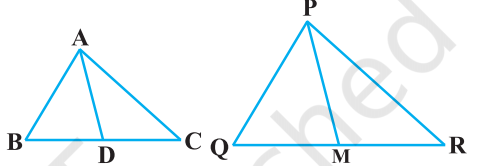
Proof:
Step 1: Express the given proportionality.
It is given that:
AB / PQ = BC / QR = AD / PM --- (Equation 1)
Step 2: Use the property of medians.
Since AD is the median of ΔABC, D is the mid-point of BC, so BC = 2 × BD.
Since PM is the median of ΔPQR, M is the mid-point of QR, so QR = 2 × QM.
Substituting these into Equation 1:
AB / PQ = (2 × BD) / (2 × QM) = AD / PM
AB / PQ = BD / QM = AD / PM
Step 3: Establish intermediate similarity.
In ΔABD and ΔPQM, since all three pairs of corresponding sides are proportional, by the SSS similarity criterion:
ΔABD ~ ΔPQM
Since corresponding angles of similar triangles are equal:
∠B = ∠Q --- (Equation 2)
Step 4: Prove final similarity for the main triangles.
Now compare ΔABC and ΔPQR:
- AB / PQ = BC / QR (Given in the question)
- ∠B = ∠Q (Proved in Equation 2)
By the SAS (Side-Angle-Side) similarity criterion:
ΔABC ~ ΔPQR
(Hence Proved)
Question 13: D is a point on the side BC of a triangle ABC such that ∠ADC = ∠BAC. Show that CA2 = CB × CD.
Proof:
Compare triangle ABC (ΔABC) and triangle DAC (ΔDAC):
- ∠BAC = ∠ADC (Given in the question)
- ∠ACB = ∠DCA (Common angle, Vertex C is shared by both triangles)
Step 1: Apply similarity.
Since two pairs of corresponding angles are equal, by the AA similarity criterion:
ΔABC ~ ΔDAC
Step 2: Set up the side ratios.
We know that corresponding sides of similar triangles are proportional. Matching the sides gives:
CB / CA = CA / CD
Step 3: Cross-multiply.
CA × CA = CB × CD
CA2 = CB × CD
(Hence Proved)
Question 14: Sides AB and AC and median AD of a triangle ABC are respectively proportional to sides PQ and PR and median PM of another triangle PQR. Show that ΔABC ~ ΔPQR.
Construction:
Extend median AD to a point E such that AD = DE. Join CE.
Similarly, extend median PM to a point L such that PM = ML. Join RL.
Proof:
Step 1: Prove quadrilaterals are parallelograms.
In quadrilateral ABEC, the diagonals AE and BC bisect each other at D (since AD = DE by construction, and BD = DC because AD is a median). Therefore, ABEC is a parallelogram.
Thus, opposite sides are equal: AC = BE and AB = CE.
Similarly, PQRL is a parallelogram, so: PR = QL and PQ = RL.
Step 2: Use the given proportional ratio.
It is given that: AB / PQ = AC / PR = AD / PM
Replacing AB with CE, and PQ with RL:
CE / RL = AC / PR = AD / PM
Multiply the last fraction's numerator and denominator by 2:
CE / RL = AC / PR = (2 × AD) / (2 × PM)
Since 2 × AD = AE and 2 × PM = PL, we get:
CE / RL = AC / PR = AE / PL
Step 3: Use SSS similarity to match split angles.
By the SSS similarity criterion, ΔACE ~ ΔPRL. Therefore, their corresponding angles are equal:
∠CAE = ∠RPL --- (Equation 1)
Similarly, by considering the other half of the parallelograms, we can prove ΔABE ~ ΔPQL, which gives:
∠BAE = ∠QPL --- (Equation 2)
Step 4: Combine the angles.
Adding Equation 1 and Equation 2:
∠CAE + ∠BAE = ∠RPL + ∠QPL
∠BAC = ∠QPR --- (Equation 3)
Step 5: Final Proof.
Now in ΔABC and ΔPQR:
- AB / PQ = AC / PR (Given in the question)
- ∠BAC = ∠QPR (Proved in Equation 3)
By the SAS similarity criterion:
ΔABC ~ ΔPQR
(Hence Proved)
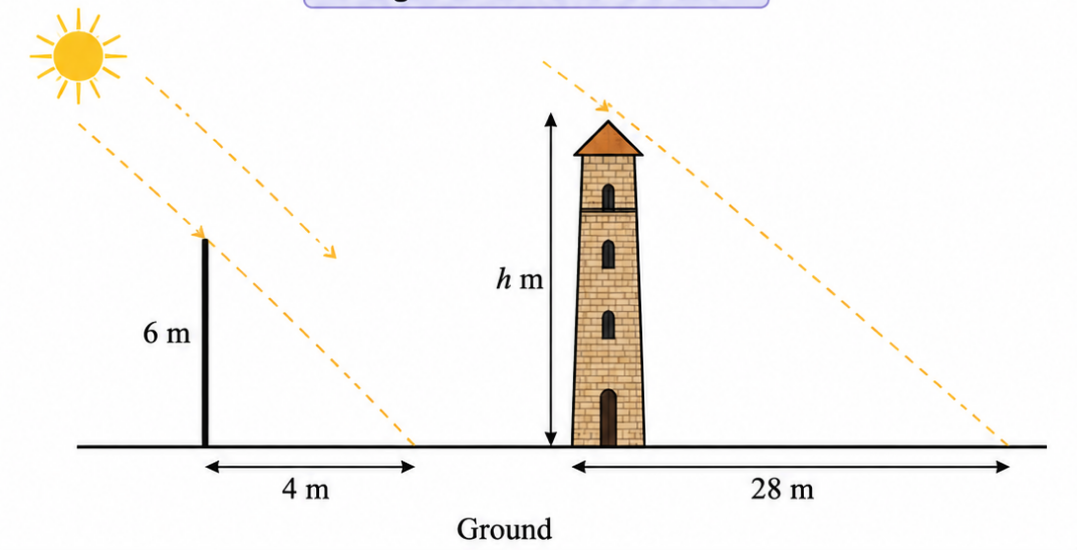
Question 15: A vertical pole of length 6 m casts a shadow 4 m long on the ground and at the same time a tower casts a shadow 28 m long. Find the height of the tower.
Solution:
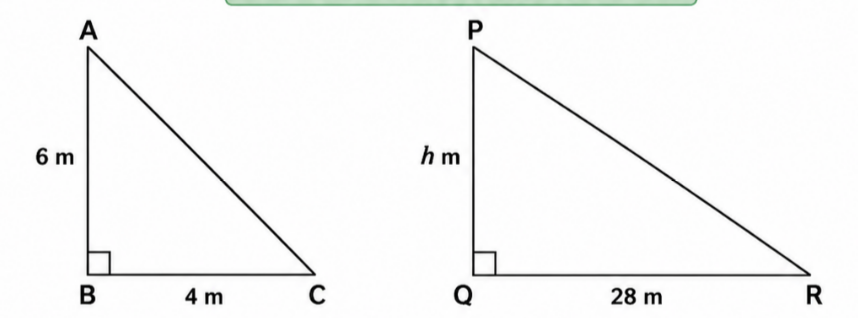
Let AB represent the vertical pole = 6 m.
Let BC represent the shadow of the pole = 4 m.
Let PQ represent the vertical tower = h m.
Let QR represent the shadow of the tower = 28 m.
Step 1: Establish similarity between the pole and tower systems.
Compare triangle ABC (ΔABC) and triangle PQR (ΔPQR):
- ∠B = ∠Q = 90° (Both the pole and tower stand vertically straight on the ground)
- ∠C = ∠R (The sun's angle of elevation is identical because the shadows are cast at the same time)
By the AA similarity criterion, the triangles are similar:
ΔABC ~ ΔPQR
Step 2: Calculate the unknown height.
Since corresponding sides of similar triangles are proportional:
AB / PQ = BC / QR
6 / h = 4 / 28
Simplify the fraction on the right side:
6 / h = 1 / 7
Cross-multiplying to solve for h:
h = 6 × 7
h = 42 m
Final Answer: The height of the tower is 42 meters.
Question 16: If AD and PM are medians of triangles ABC and PQR, respectively where ΔABC ~ ΔPQR, prove that AB / PQ = AD / PM.
Proof:
Step 1: Extract relationships from the main similarity.
It is given that ΔABC ~ ΔPQR. Therefore, their corresponding sides are proportional and angles are equal:
- AB / PQ = BC / QR --- (Equation 1)
- ∠B = ∠Q --- (Equation 2)
Step 2: Introduce the medians.
Since AD is a median, it splits BC into halves: BC = 2 × BD.
Since PM is a median, it splits QR into halves: QR = 2 × QM.
Substitute these values back into Equation 1:
AB / PQ = (2 × BD) / (2 × QM)
AB / PQ = BD / QM --- (Equation 3)
Step 3: Show similarity for the sub-triangles.
Now compare triangle ABD (ΔABD) and triangle PQM (ΔPQM):
- AB / PQ = BD / QM (Proved in Equation 3)
- ∠B = ∠Q (Proved in Equation 2)
By the SAS similarity criterion, the sub-triangles are similar:
ΔABD ~ ΔPQM
Hence
Since corresponding sides of similar triangles are proportional, we get:AB / PQ = AD / PM(Hence Proved)