Mathematics solution NCERT
Class 10 - Chapter 6: Triangles

BPT- Means basic proportionality theorem or Thales theorem is very much important for board exams.
It will be used in many questions of upcoming exercises.
Practice BPT and then start doing questions from exercise.
Almost every year BPT or Converse of BPT is asked in CBSE board exams.
Exercise 6.2
Question 1: In Fig., (i) and (ii), DE || BC. Find EC in (i) and AD in (ii).
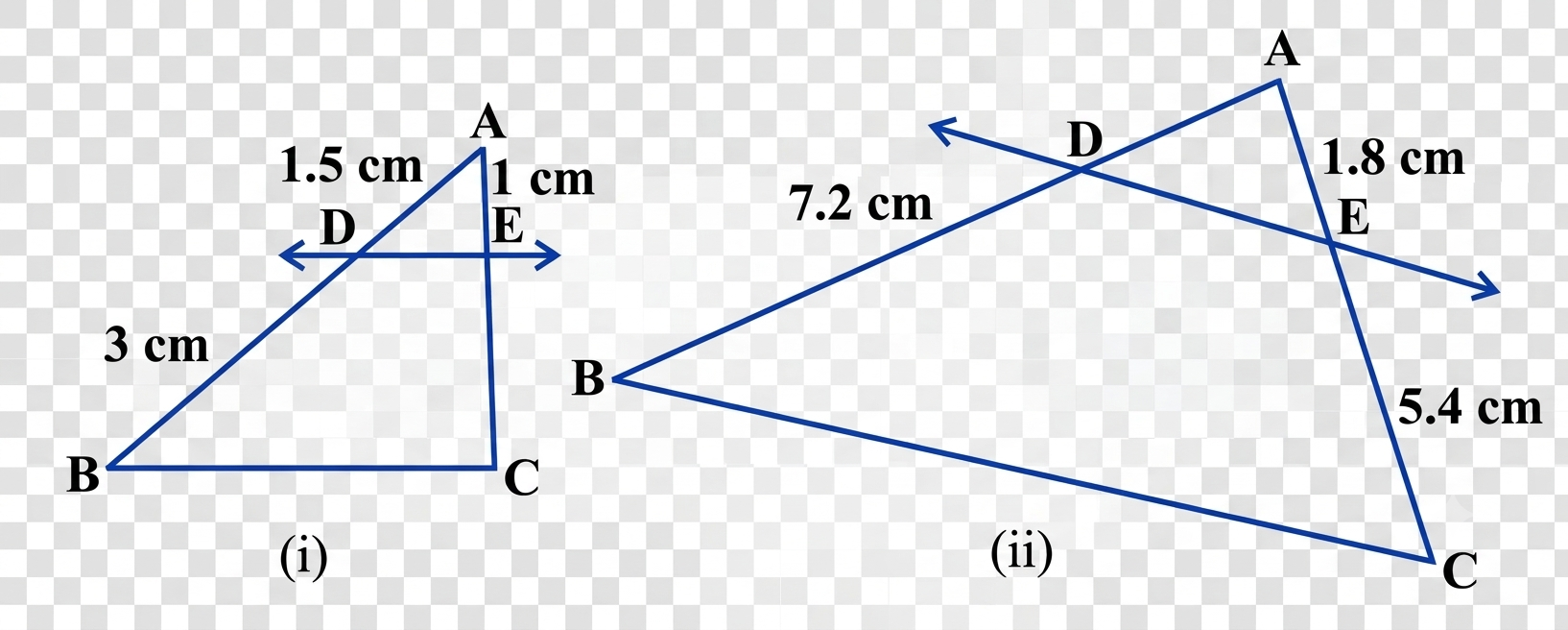
Core Principle (BPT):
If a line is parallel to one side of a triangle intersecting the other two sides, it divides the two sides in the same ratio:
AD / DB = AE / EC
(i) Find EC
Given: AD = 1.5 cm, DB = 3 cm, AE = 1 cm
Applying BPT:
1.5 / 3 = 1 / EC
1 / 2 = 1 / EC
Cross multiplying:
EC = 2 × 1
EC = 2 cm
(ii) Find AD
Given: DB = 7.2 cm, AE = 1.8 cm, EC = 5.4 cm
Applying BPT:
AD / 7.2 = 1.8 / 5.4
AD / 7.2 = 1 / 3
Cross multiplying:
AD = 7.2 / 3
AD = 2.4 cm
Question 2: E and F are points on the sides PQ and PR respectively of a ΔPQR. For each of the following cases, state whether EF || QR:
Core Principle (Converse of BPT):
If a line divides any two sides of a triangle in the same ratio, then the line is parallel to the third side. We check if PE / EQ = PF / FR.
(i) Given: PE = 3.9 cm, EQ = 3 cm, PF = 3.6 cm, FR = 2.4 cm
Left ratio: PE / EQ = 3.9 / 3 = 1.3
Right ratio: PF / FR = 3.6 / 2.4 = 1.5
Hence Since 1.3 ≠ 1.5 (PE / EQ ≠ PF / FR), EF is NOT parallel to QR.
(ii) Given: PE = 4 cm, QE = 4.5 cm, PF = 8 cm, RF = 9 cm
Left ratio: PE / QE = 4 / 4.5 = 8 / 9
Right ratio: PF / RF = 8 / 9
Since 8 / 9 = 8 / 9 (PE / QE = PF / RF), EF || QR (EF is parallel to QR).
(iii) Given: PQ = 1.28 cm, PR = 2.56 cm, PE = 0.18 cm, PF = 0.36 cm
Left ratio: PE / PQ = 0.18 / 1.28 = 18 / 128 = 9 / 64
Right ratio: PF / PR = 0.36 / 2.56 = 36 / 256 = 9 / 64
Since 9 / 64 = 9 / 64 (PE / PQ = PF / PR), EF || QR (EF is parallel to QR).
Question 3: In Fig., if LM || CB and LN || CD, prove that AM / AB = AN / AD
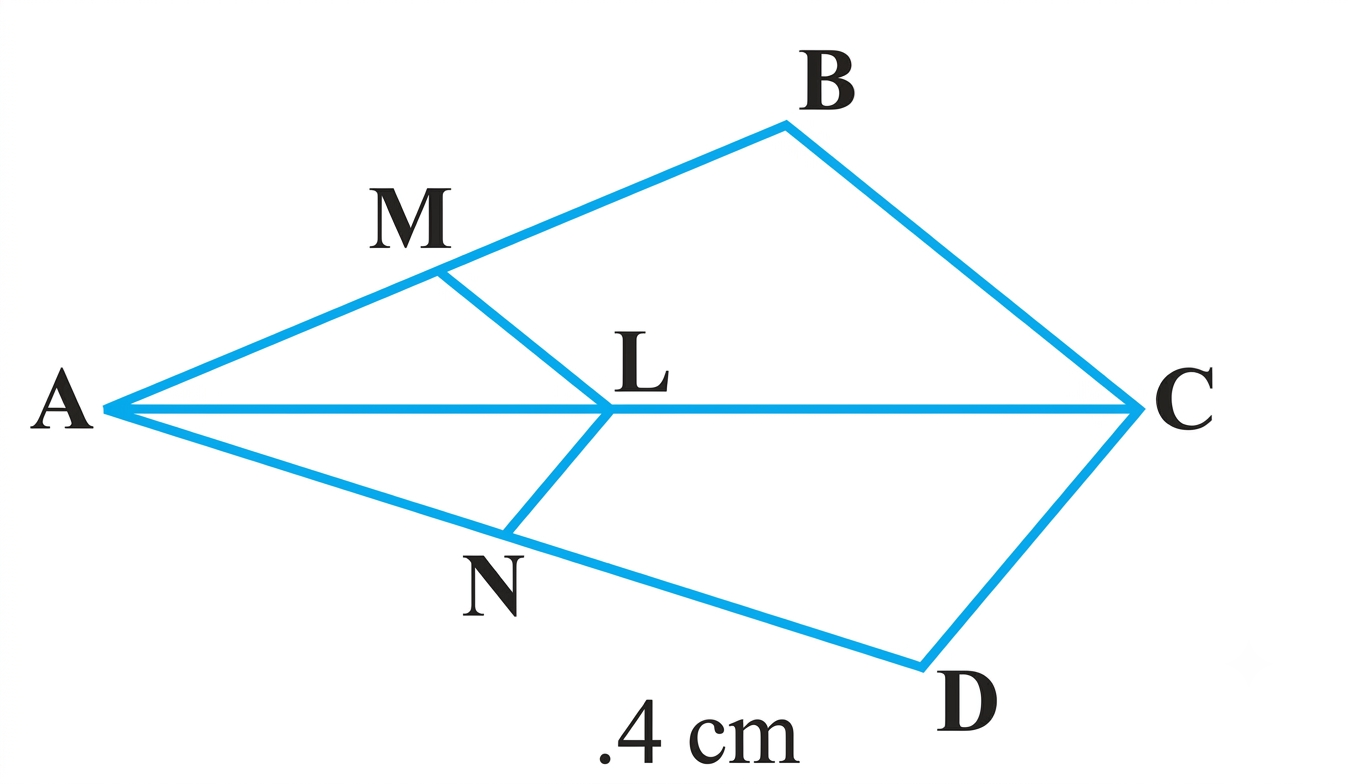
Proof:
Step 1: In ΔABC, since LM || CB, by the corollary of the Basic Proportionality Theorem:
AM / AB = AL / AC --- (Equation 1)
Step 2: In ΔADC, since LN || CD, by the corollary of the Basic Proportionality Theorem:
AN / AD = AL / AC --- (Equation 2)
Step 3: Comparing Equation 1 and Equation 2:
Both ratios are equal to the common side ratio (AL / AC). Therefore:
AM / AB = AN / AD
Hence Proved.
Question 4: In Fig., DE || AC and DF || AE. Prove that BF / FE = BE / EC
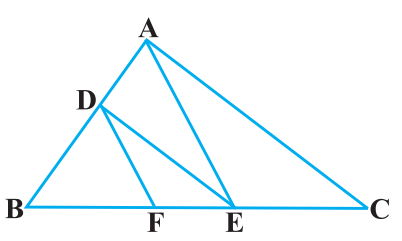
Proof:
Step 1: In ΔABC, since DE || AC, by the Basic Proportionality Theorem (BPT):
BD / DA = BE / EC --- (Equation 1)
Step 2: In ΔABE, since DF || AE, by the Basic Proportionality Theorem (BPT):
BD / DA = BF / FE --- (Equation 2)
Step 3: Comparing Equation 1 and Equation 2:
Both ratios are equal to the common side ratio (BD / DA). Therefore:
BF / FE = BE / EC
Hence Proved.
Question 5: In Fig., DE || OQ and DF || OR. Show that EF || QR.
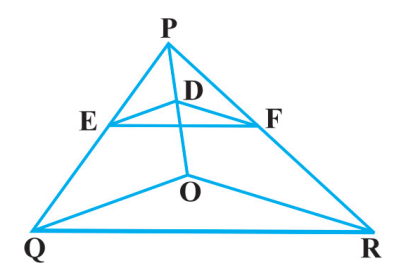
Proof:
Step 1: Consider triangle POQ (ΔPQO).
It is given that DE || OQ.
By applying the Basic Proportionality Theorem (BPT):
PE / EQ = PD / DO --- (Equation 1)
Step 2: Consider triangle POR (ΔPOR).
It is given that DF || OR.
By applying the Basic Proportionality Theorem (BPT):
PF / FR = PD / DO --- (Equation 2)
Step 3: Compare Equation 1 and Equation 2.
Since both PE / EQ and PF / FR are equal to the common ratio (PD / DO), we get:
PE / EQ = PF / FR
In triangle PQR (ΔPQR), since the line EF divides the sides PQ and PR in the same ratio, by the Converse of BPT:
EF || QR
(Hence Proved)
Question 6: In Fig. 6.21, A, B and C are points on OP, OQ and OR respectively such that AB || PQ and AC || PR. Show that BC || QR.
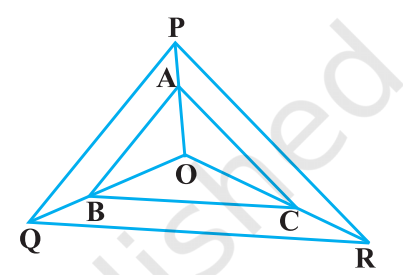
Proof:
Step 1: In triangle OPQ (ΔOPQ), since AB || PQ:
By BPT:
OA / AP = OB / BQ --- (Equation 1)
Step 2: In triangle OPR (ΔOPR), since AC || PR:
By BPT:
OA / AP = OC / CR --- (Equation 2)
Step 3: From Equation 1 and Equation 2:
OB / BQ = OC / CR
In triangle OQR (ΔOQR), since the line segment BC divides the sides OQ and OR proportionally, by the Converse of BPT:
BC || QR
(Hence Proved)
Question 7: Using Theorem 6.1 (BPT), prove that a line drawn through the mid-point of one side of a triangle parallel to another side bisects the third side.
Proof:
Let ΔABC be the given triangle.
Let D be the mid-point of side AB, which means:
AD = DB ⇒ AD / DB = 1 --- (Equation 1)
Let a line be drawn through D parallel to BC, intersecting side AC at point E (so DE || BC).
By Theorem 6.1 (BPT):
AD / DB = AE / EC
Substituting the value from Equation 1:
1 = AE / EC
By cross-multiplication:
AE = EC
Since AE equals EC, point E is the mid-point of AC. Therefore, the line segment DE bisects the third side.
(Hence Proved)
Question 8: Using Theorem 6.2 (Converse of BPT), prove that the line joining the mid-points of any two sides of a triangle is parallel to the third side.
Proof:
Let ΔABC be the triangle where D and E are the mid-points of sides AB and AC respectively.
- Since D is the mid-point of AB: AD = DB ⇒ AD / DB = 1
- Since E is the mid-point of AC: AE = EC ⇒ AE / EC = 1
Comparing both ratios:
AD / DB = AE / EC
Since the line segment DE divides the sides AB and AC in the exact same ratio, by Theorem 6.2 (Converse of BPT):
DE || BC
(Hence Proved)
Question 9: ABCD is a trapezium in which AB || DC and its diagonals intersect each other at the point O. Show that AO / BO = CO / DO.
Construction:
Draw a line segment EO through point O such that it is parallel to AB (EO || AB), meeting AD at point E.
Proof:
Step 1: Since ABCD is a trapezium with AB || DC, and we constructed EO || AB, then EO || DC by extension.
Step 2: In triangle ADC (ΔADC), since EO || DC:
By BPT:
AE / ED = AO / CO --- (Equation 1)
Step 3: In triangle ABD (ΔABD), since EO || AB:
By BPT:
AE / ED = BO / DO --- (Equation 2)
Step 4: From Equation 1 and Equation 2:
AO / CO = BO / DO
Rearranging the terms (alternendo property):
AO / BO = CO / DO
(Hence Proved)
Question 10: The diagonals of a quadrilateral ABCD intersect each other at the point O such that AO / BO = CO / DO. Show that ABCD is a trapezium.
Given:
AO / BO = CO / DO, which can be rewritten as:
AO / CO = BO / DO --- (Equation 1)
Construction:
Draw a line segment EO || AB meeting AD at E.
Proof:
Step 1: In triangle ABD (ΔABD), since EO || AB:
By BPT:
AE / ED = BO / DO --- (Equation 2)
Step 2: From Equation 1 and Equation 2:
AE / ED = AO / CO
Step 3: In triangle ADC (ΔADC), since the ratio AE / ED equals AO / CO, by the Converse of BPT:
EO || DC
We know by construction that EO || AB, and we just proved that EO || DC. Therefore:
AB || DC
Since quadrilateral ABCD has one pair of opposite sides parallel, it is by definition a trapezium.
(Hence Proved)