Mathematics solution NCERT
Class 10 - Chapter 4: Quadratic Equations
EXERCISE 4.3
1. Find the nature of the roots of the following quadratic equations. If the real roots exist, find them.
(i) $2x^2-3x+5=0$
Solution:
Here, $$ a=2,\qquad b=-3,\qquad c=5 $$ Discriminant, $$ D=b^2-4ac $$ $$ =(-3)^2-4(2)(5) $$ $$ =9-40 $$ $$ =-31 $$ Since $$ D<0 $$ the equation has no real roots.Answer:
$$ \boxed{\text{No real roots (Imaginary roots)}} $$(ii) $3x^2-4\sqrt3\,x+4=0$
Solution:
Here, $$ a=3,\qquad b=-4\sqrt3,\qquad c=4 $$ Discriminant, $$ D=b^2-4ac $$ $$ =(-4\sqrt3)^2-4(3)(4) $$ $$ 48-48 $$ $$ =0 $$ Since $$ D=0 $$ the roots are real and equal. Using $$ x=\frac{-b}{2a} $$ $$ x=\frac{4\sqrt3}{6} $$ $$ x=\frac{2\sqrt3}{3} $$Answer:
$$ \boxed{x=\frac{2\sqrt3}{3},\;\frac{2\sqrt3}{3}} $$(iii) $2x^2-6x+3=0$
Solution:
Here, $$ a=2,\qquad b=-6,\qquad c=3 $$ Discriminant, $$ D=b^2-4ac $$ $$ =(-6)^2-4(2)(3) $$ $$ 36-24 $$ $$ =12 $$ Since $$ D>0 $$ the equation has two distinct real roots. Using the quadratic formula, $$ x=\frac{-b\pm\sqrt D}{2a} $$ $$ =\frac{6\pm\sqrt{12}}4 $$ $$ =\frac{6\pm2\sqrt3}4 $$ $$ =\frac{3\pm\sqrt3}2 $$Answer:
$$ \boxed{x=\frac{3+\sqrt3}{2},\qquad x=\frac{3-\sqrt3}{2}} $$2. Find the values of $k$ for each of the following quadratic equations, so that they have two equal roots.
(i) $2x^2+kx+3=0$
Solution:
For equal roots, $$ D=0 $$ $$ b^2-4ac=0 $$ $$ k^2-4(2)(3)=0 $$ $$ k^2-24=0 $$ $$ k=\pm\sqrt{24} $$ $$ k=\pm2\sqrt6 $$Answer:
$$ \boxed{k=\pm2\sqrt6} $$(ii) $kx(x-2)+6=0$
Solution:
Expand. $$ kx^2-2kx+6=0 $$ Here, $$ a=k,\qquad b=-2k,\qquad c=6 $$ For equal roots, $$ D=0 $$ $$ (-2k)^2-4(k)(6)=0 $$ $$ 4k^2-24k=0 $$ $$ 4k(k-6)=0 $$ $$ k=0 \quad\text{or}\quad k=6 $$ Since the equation must remain quadratic, $$ k\ne0 $$ Therefore, $$ k=6 $$Answer:
$$ \boxed{k=6} $$3. Is it possible to design a rectangular mango grove whose length is twice its breadth, and the area is $800\text{ m}^2$? If so, find its length and breadth.
Solution:
Let the breadth be $$ x\text{ m} $$ Then the length is $$ 2x\text{ m} $$ Area, $$ 2x^2=800 $$ $$ x^2=400 $$ $$ x=\pm20 $$ Since length and breadth cannot be negative, $$ x=20 $$ Length, $$ 2x=40 $$Answer:
$$ \boxed{\text{Breadth}=20\text{ m}} $$ $$ \boxed{\text{Length}=40\text{ m}} $$ Hence, it is possible.4. Is the following situation possible? If so, determine their present ages.
The sum of the ages of two friends is $20$ years. Four years ago, the product of their ages was $48$.
Solution:
Let the present ages be $$ x\text{ years and }y\text{ years} $$ Given, $$ x+y=20 $$ Four years ago, $$ (x-4)(y-4)=48 $$ Substitute $$ y=20-x $$ $$ (x-4)(16-x)=48 $$ Expand. $$ 16x-x^2-64+4x=48 $$ $$ -x^2+20x-112=0 $$ $$ x^2-20x+112=0 $$ Factorise. $$ (x-12)(x-8)=0 $$ Therefore, $$ x=12 \quad\text{or}\quad x=8 $$ Hence, $$ y=8 \quad\text{or}\quad y=12 $$Answer:
$$ \boxed{12\text{ years and }8\text{ years}} $$ Hence, the situation is possible.5. Is it possible to design a rectangular park of perimeter $80$ m and area $400\text{ m}^2$? If so, find its length and breadth.
Solution:
Let the length be $$ x\text{ m} $$ Then, $$ x+b=40 $$ where $b$ is the breadth. So, $$ b=40-x $$ Area, $$ x(40-x)=400 $$ $$ 40x-x^2=400 $$ $$ x^2-40x+400=0 $$ Factorise. $$ (x-20)^2=0 $$ $$ x=20 $$ Therefore, $$ b=20 $$Answer:
$$ \boxed{\text{Length}=20\text{ m}} $$ $$ \boxed{\text{Breadth}=20\text{ m}} $$ Hence, it is possible.
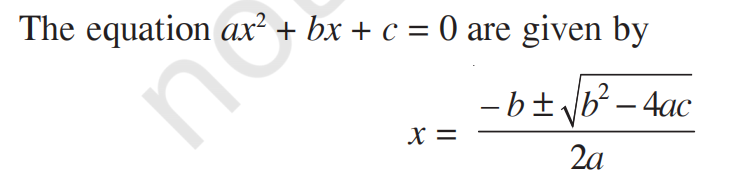
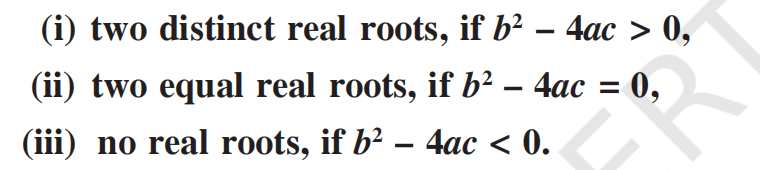
Image - NCERT