Mathematics Class- 10
CASE STUDIES(MATHEMATICS CLASS-10)
CASE STUDY-1
Partha, a software engineer, lives in Jerusalem for his work. He lives in the most convenient area of the city from where bank, hospital, post office and supermarket can be easily accessed. In the graph, the bank is plotted as A(9, 5), hospital as B(−3, −1) and supermarket as C(5, −5) such that A, B and C form a triangle.
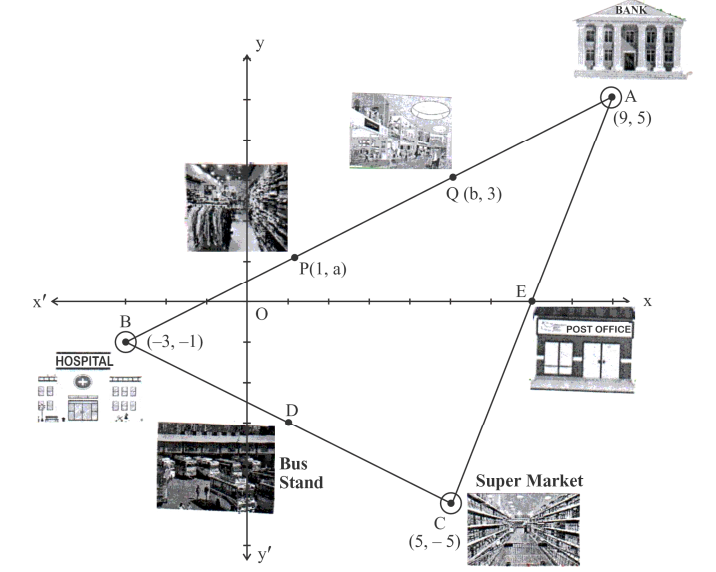
Based on the above information, answer the following questions:
(i) Find the distance between the bank and the hospital.
Given:
A(9, 5), B(−3, −1)
Distance Formula:
AB = √[(x₂ − x₁)² + (y₂ − y₁)²]
AB = √[(-3 − 9)² + (-1 − 5)²]
AB = √[(-12)² + (-6)²]
AB = √(144 + 36)
AB = √180
AB = 6√5 units
Answer: The distance between the bank and the hospital is 6√5 units.
(ii) In between the bank and the supermarket, there is a post office plotted at E which is their mid-point. Find the coordinates of E.
Given:
A(9, 5), C(5, −5)
Mid-point Formula:
E = ((x₁ + x₂)/2 , (y₁ + y₂)/2)
E = ((9 + 5)/2 , (5 + (-5))/2)
E = (14/2 , 0/2)
E = (7, 0)
Answer: The coordinates of E are (7, 0).
(iii)(a) In between the hospital and the supermarket, there is a bus stop plotted as D, which is their mid-point. If Partha wants to reach the bus stop from the bank, then how much distance does he need to cover?
Step 1: Find coordinates of D
B(−3, −1), C(5, −5)
D = ((−3 + 5)/2 , (−1 + (−5))/2)
D = (2/2 , −6/2)
D = (1, −3)
Step 2: Find distance between A and D
A(9, 5), D(1, −3)
AD = √[(1 − 9)² + (−3 − 5)²]
AD = √[(-8)² + (-8)²]
AD = √(64 + 64)
AD = √128
AD = 8√2 units
Answer: Partha needs to cover 8√2 units to reach the bus stop.
OR
(iii)(b) P and Q are two different garment shops lying between the bank and the hospital, such that BP = PQ = QA. If the coordinates of P and Q are (1, a) and (b, 3) respectively, then find the values of 'a' and 'b'.
Since BP = PQ = QA, points P and Q divide AB into three equal parts.
Coordinates of A = (9, 5)
Coordinates of B = (−3, −1)
Difference in x-coordinates = 9 − (−3) = 12
Difference in y-coordinates = 5 − (−1) = 6
One-third of 12 = 4
One-third of 6 = 2
Coordinates of P:
P = (−3 + 4, −1 + 2)
P = (1, 1)
Therefore, a = 1
Coordinates of Q:
Q = (−3 + 8, −1 + 4)
Q = (5, 3)
Therefore, b = 5
Answer:
a = 1
b = 5
CASE STUDY-2
Due to a short circuit, a fire has broken out in New Home Complex. Two buildings, namely X and Y, have mainly been affected. The fire engine has arrived and it has been stationed at a point which is in between the two buildings. A ladder at point O is fixed in front of the fire engine.
The ladder inclined at an angle 60° to the horizontal is leaning against the wall of the terrace (top) of building Y. The foot of the ladder is kept fixed and after some time it is made to lean against the terrace (top) of the opposite building X at an angle of 45° with the ground.
The height of building Y is 12√3 m.
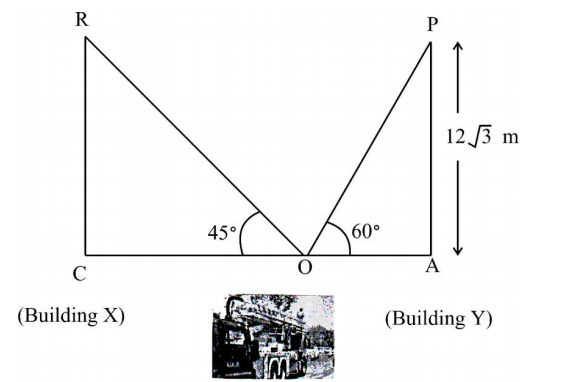
(i) Find the length of the ladder.
In right △OAP:
∠O = 60°
AP = 12√3 m
OP = Length of ladder
sin 60° = AP / OP
√3/2 = 12√3 / OP
OP = (12√3 × 2)/√3
OP = 24 m
Answer: The length of the ladder is 24 m.
(ii) Find the distance of building Y from point O, i.e. OA.
In right △OAP:
cos 60° = OA / OP
1/2 = OA / 24
OA = 12 m
Answer: The distance of building Y from point O is 12 m.
(iii)(a) Find the horizontal distance between the two buildings.
First find OC.
When the ladder leans against building X:
OR = 24 m
∠O = 45°
cos 45° = OC / OR
1/√2 = OC / 24
OC = 24/√2
OC = 12√2 m
Horizontal distance between the buildings:
CA = CO + OA
CA = 12√2 + 12
CA = 12(√2 + 1) m
Answer: The horizontal distance between the two buildings is 12(√2 + 1) m.
OR
(iii)(b) Find the height of building X.
In right △OCR:
OR = 24 m
∠O = 45°
Height of building X = CR
sin 45° = CR / OR
1/√2 = CR / 24
CR = 24/√2
CR = 12√2 m
Answer: The height of building X is 12√2 m.
CASE STUDY-3
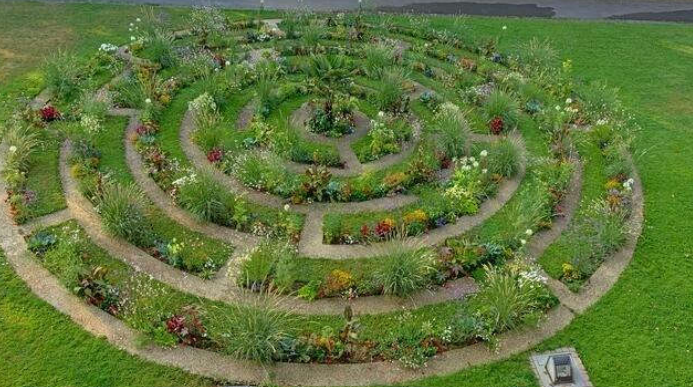
A school has decided to plant some endangered trees on 51st World Environment Day in the nearest park. The trees are planted in concentric circular rows such that each succeeding row has 20 more trees than the previous one. The first circular row has 50 trees.
Based on the above given information, answer the following questions :
Answer
This forms an Arithmetic Progression (A.P.) with:
- First term, a = 50
- Common difference, d = 20
(i) How many trees will be planted in the 10th row?
Given:
a = 50, d = 20, n = 10
Formula:
an = a + (n - 1)d
a10 = 50 + (10 - 1) × 20
= 50 + 180
= 230
Answer: 230 trees will be planted in the 10th row.
(ii) How many more trees will be planted in the 8th row than in the 5th row?
8th row:
a8 = 50 + (8 - 1) × 20
= 50 + 140
= 190
5th row:
a5 = 50 + (5 - 1) × 20
= 50 + 80
= 130
Difference:
190 - 130 = 60
Answer: 60 more trees will be planted in the 8th row than in the 5th row.
(iii)(a) If 3200 trees are to be planted in the park, then how many rows are required?
Given:
Sn = 3200, a = 50, d = 20
Formula:
Sn = n/2 [2a + (n - 1)d]
3200 = n/2 [100 + 20(n - 1)]
3200 = n/2 [100 + 20n - 20]
3200 = n/2 (20n + 80)
3200 = 10n(n + 4)
320 = n(n + 4)
n² + 4n - 320 = 0
n² + 20n - 16n - 320 = 0
n(n + 20) - 16(n + 20) = 0
(n + 20)(n - 16) = 0
n = 16 (positive value)
Answer: 16 rows are required.
OR
(iii)(b) If 3200 trees are to be planted in the park, then how many trees are still left to be planted after the 11th row?
Step 1: Find the total trees planted up to the 11th row.
S11 = 11/2 [2 × 50 + (11 - 1) × 20]
= 11/2 [100 + 200]
= 11/2 × 300
= 1650
Step 2: Find the remaining trees.
Remaining Trees = 3200 - 1650
= 1550
Answer: 1550 trees are still left to be planted after the 11th row.
CASE STUDY-4
Question
The taxi charges in a city comprise a fixed charge together with the charge for the distance covered. For a journey of 10 km the charge paid is Rs. 75 and for a journey of 15 km the charge paid is Rs. 110.
 Based on the above information, answer the following questions:
- Represent the above situation in the form of linear equations in two variables.
- Find the fixed charge and the charge for each kilometre.
- Calculate the total amount for a distance of 25 km.
(i) Represent the above situation in the form of linear equations in two variables.
Let:
- x = Fixed charge (in Rs.)
- y = Charge per kilometre (in Rs.)
For a journey of 10 km, the total fare is Rs. 75.
x + 10y = 75
For a journey of 15 km, the total fare is Rs. 110.
x + 15y = 110
Required Linear Equations:
x + 10y = 75
x + 15y = 110
(ii) Find the fixed charge and the charge for each kilometre.
Given Equations:
x + 10y = 75 .......... (1)
x + 15y = 110 .......... (2)
Subtracting equation (1) from equation (2):
(x + 15y) − (x + 10y) = 110 − 75
5y = 35
y = 7
Substituting y = 7 in equation (1):
x + 10(7) = 75
x + 70 = 75
x = 5
Answer:
| Particulars | Amount |
|---|---|
| Fixed Charge | Rs. 5 |
| Charge per Kilometre | Rs. 7 |
(iii) Calculate the total amount for a distance of 25 km.
Given:
- Fixed Charge = Rs. 5
- Charge per kilometre = Rs. 7
- Distance = 25 km
Total Fare = Fixed Charge + (Distance × Charge per km)
= 5 + (25 × 7)
= 5 + 175
= 180
Answer: The total amount for a distance of 25 km is Rs. 180.
CASE STUDY-5
Question
A test consists of 120 True/False questions. 4 marks are awarded for each correct answer while 1 mark is deducted for each incorrect answer. A student answered all the questions and scored 90 marks.
Based on the above information, answer the following questions:
(i) Represent the above situation in the form of linear equations in two variables.
(ii) How many questions did he answer correctly?
(iii) If a student attempts all the questions, then for scoring 300 marks, how many questions need to be answered incorrectly?
(i) Represent the above situation in the form of linear equations in two variables.
Let:
x = Number of correct answers
y = Number of incorrect answers
Since the student answered all 120 questions,
x + y = 120
Marks obtained = 90
4 marks are awarded for each correct answer and 1 mark is deducted for each incorrect answer.
4x - y = 90
Required Linear Equations:
x + y = 120
4x - y = 90
(ii) How many questions did he answer correctly?
Given:
x + y = 120 .......... (1)
4x - y = 90 .......... (2)
Adding equations (1) and (2):
x + y + 4x - y = 120 + 90
5x = 210
x = 42
Answer: The student answered 42 questions correctly.
(iii) If a student attempts all the questions, then for scoring 300 marks, how many questions need to be answered incorrectly?
Let:
x = Number of correct answers
y = Number of incorrect answers
Since all 120 questions are attempted,
x + y = 120 .......... (1)
For a score of 300 marks,
4x - y = 300 .......... (2)
Adding equations (1) and (2):
5x = 420
x = 84
Substituting x = 84 in equation (1):
84 + y = 120
y = 36
Answer: To score 300 marks, the student must answer 36 questions incorrectly.
CASE STUDY-6
Question
A librarian gives books on rent for reading. He takes a fixed charge for the first two days and an additional charge for each subsequent day.
Amrutha paid ₹22 for keeping a book for 6 days, while Radhika paid ₹16 for keeping the book for 4 days.

Based on the above information, answer the following questions:
(i) Represent the above situation in the form of linear equations in two variables.
(ii) Find the fixed charge and the additional charge.
(iii) Calculate the total amount paid by Amrutha and Radhika together, if both of them have kept the book for 2 more days.
(i) Represent the above situation in the form of linear equations in two variables.
Let:
x = Fixed charge for the first two days (in ₹)
y = Additional charge per day after two days (in ₹)
For Amrutha:
Book kept for 6 days
Additional days = 6 − 2 = 4
x + 4y = 22
For Radhika:
Book kept for 4 days
Additional days = 4 − 2 = 2
x + 2y = 16
Required Linear Equations:
x + 4y = 22
x + 2y = 16
(ii) Find the fixed charge and the additional charge.
Given Equations:
x + 4y = 22 .......... (1)
x + 2y = 16 .......... (2)
Subtracting equation (2) from equation (1):
(x + 4y) − (x + 2y) = 22 − 16
2y = 6
y = 3
Substituting y = 3 in equation (2):
x + 2(3) = 16
x + 6 = 16
x = 10
Answer:
| Particulars | Amount |
|---|---|
| Fixed Charge (First Two Days) | ₹10 |
| Additional Charge per Day | ₹3 |
(iii) Calculate the total amount paid by Amrutha and Radhika together, if both of them have kept the book for 2 more days.
Amrutha:
Original period = 6 days
New period = 8 days
Additional days after first two days = 8 − 2 = 6
Amount = 10 + (6 × 3)
= 10 + 18
= ₹28
Radhika:
Original period = 4 days
New period = 6 days
Additional days after first two days = 6 − 2 = 4
Amount = 10 + (4 × 3)
= 10 + 12
= ₹22
Total Amount Paid:
₹28 + ₹22 = ₹50
Answer: If both keep the book for 2 more days, they will pay a total of ₹50.
CASE STUDY-7
Question
Aditya is celebrating his birthday. He bought a packet of toffees/candies containing 120 candies.
He arranged the candies in rows such that:
- 1st row contains 3 candies
- 2nd row contains 5 candies
- 3rd row contains 7 candies
- and so on.
This arrangement forms an Arithmetic Progression (A.P.).
Based on the above information, answer the following questions:
(i) Find the common difference of the A.P.
(ii) Find the number of candies placed in the 7th row.
(iii) Find the total number of rows of candies.
OR
Find the difference in the number of candies placed in the 9th and 4th rows.
(i) Find the common difference of the A.P.
Given A.P.:
3, 5, 7, 9, ...
Common Difference (d) = Second Term − First Term
d = 5 − 3
d = 2
Answer: The common difference of the A.P. is 2.
(ii) Find the number of candies placed in the 7th row.
Given:
First Term (a) = 3
Common Difference (d) = 2
n = 7
Formula:
an = a + (n − 1)d
a7 = 3 + (7 − 1) × 2
= 3 + 12
= 15
Answer: The number of candies in the 7th row is 15.
(iii) Find the total number of rows of candies.
Given:
Total candies = 120
a = 3, d = 2
Formula:
Sn = n/2 [2a + (n − 1)d]
120 = n/2 [2(3) + (n − 1)(2)]
120 = n/2 [6 + 2n − 2]
120 = n/2 (2n + 4)
120 = n(n + 2)
n² + 2n − 120 = 0
n² + 12n − 10n − 120 = 0
n(n + 12) − 10(n + 12) = 0
(n + 12)(n − 10) = 0
n = 10 (positive value)
Answer: The total number of rows of candies is 10.
OR
Find the difference in the number of candies placed in the 9th and 4th rows.
Number of candies in the 9th row:
a9 = 3 + (9 − 1) × 2
= 3 + 16
= 19
Number of candies in the 4th row:
a4 = 3 + (4 − 1) × 2
= 3 + 6
= 9
Difference:
19 − 9 = 10
Answer: The difference between the number of candies in the 9th row and the 4th row is 10.
CASE STUDY-8
Question
A person standing on a lighthouse/building of height 20 m observes two ships in the sea. The angles of depression of the two ships are 60° and 45° respectively.
The ships are on the same straight line and one ship is farther from the observer than the other.
Based on the above information, answer the following questions:
(i) If a person observes a ship whose angle of depression is 60°, then how far is the ship from him?
(ii) If a person observes another ship whose angle of depression is 45°, then how far is the ship from him?
(iii) If the angle of depression changes from 60° to 30°, then how far will the ship be from the observer if the observer is at a height of 20 m?
OR
At a time when a person observes two ships whose angles of depression are 60° and 45°, find the distance between the two ships.
(i) If the angle of depression is 60°, then how far is the ship from the observer?
Given:
Height of lighthouse (OC) = 20 m
Angle of depression = 60°
Angle of elevation from ship = 60°
In right △OCA:
tan 60° = OC / AC
√3 = 20 / AC
AC = 20 / √3
AC = 20√3 / 3 m
Answer: The ship is 20√3/3 m away from the lighthouse horizontally.
(ii) If the angle of depression is 45°, then how far is the ship from the observer?
Given:
Height of lighthouse (OC) = 20 m
Angle of depression = 45°
In right △OCB:
tan 45° = OC / BC
1 = 20 / BC
BC = 20 m
Answer: The ship is 20 m away from the lighthouse horizontally.
(iii) If the angle of depression changes from 60° to 30°, then how far will the ship be from the observer?
Given:
Height of lighthouse (OC) = 20 m
Angle of depression = 30°
In right △OCD:
tan 30° = OC / CD
1/√3 = 20 / CD
CD = 20√3 m
Answer: The ship will be 20√3 m away from the lighthouse horizontally.
OR
Find the distance between the two ships when the angles of depression are 60° and 45°.
Distance of nearer ship from lighthouse:
AC = 20√3 / 3 m
Distance of farther ship from lighthouse:
BC = 20 m
Distance between the ships:
AB = BC − AC
AB = 20 − 20√3/3
AB = (60 − 20√3)/3
AB = 20(3 − √3)/3 m
Answer: The distance between the two ships is 20(3 − √3)/3 m.
CASE STUDY-9
Question
A car manufacturing company planned to produce 1800 cars in the 4th year and 2600 cars in the 8th year. Assume that the production increases uniformly by a fixed number every year.
The yearly production therefore forms an Arithmetic Progression (A.P.).
Based on the above information, answer the following questions:
(i) Find the production in the 1st year.
(ii) Find the production in the 12th year.
(iii) Find the total production in the first 10 years.
OR
In which year will the production reach 15000 cars?
(i) Find the production in the 1st year.
Let:
First year production = a
Common difference = d
Given:
a4 = 1800
a8 = 2600
Using the formula:
an = a + (n - 1)d
a + 3d = 1800 .......... (1)
a + 7d = 2600 .......... (2)
Subtracting (1) from (2):
4d = 800
d = 200
Substituting d = 200 in equation (1):
a + 600 = 1800
a = 1200
Answer: Production in the 1st year = 1200 cars.
(ii) Find the production in the 12th year.
Given:
a = 1200
d = 200
n = 12
Using the formula:
a12 = a + (n - 1)d
a12 = 1200 + (12 - 1) × 200
= 1200 + 2200
= 3400
Answer: Production in the 12th year = 3400 cars.
(iii) Find the total production in the first 10 years.
Given:
a = 1200
d = 200
n = 10
Using the formula:
Sn = n/2 [2a + (n - 1)d]
S10 = 10/2 [2(1200) + (10 - 1)(200)]
= 5 [2400 + 1800]
= 5 × 4200
= 21000
Answer: Total production in the first 10 years = 21,000 cars.
OR
In which year will the production reach 15000 cars?
Given:
a = 1200
d = 200
an = 15000
Using the formula:
an = a + (n - 1)d
15000 = 1200 + (n - 1) × 200
13800 = (n - 1) × 200
n - 1 = 69
n = 70
Answer: The production will reach 15,000 cars in the 70th year.
CASE STUDY-10
Question
Ayush starts walking from his house to office. Instead of going directly to the office, he first goes to a bank, then to his daughter's school and finally reaches the office.
The coordinates are:
- House H(2, 4)
- Bank B(5, 8)
- School S(13, 14)
- Office O(13, 26)
(All distances are in kilometres.)
Based on the above information, answer the following questions:
(i) What is the distance between the house and the bank?
(ii) What is the distance between the daughter's school and the bank?
(iii) What is the total distance travelled by Ayush to reach the office?
OR
What is the extra distance travelled by Ayush?
(i) What is the distance between the house and the bank?
Given:
H(2, 4), B(5, 8)
Distance Formula:
HB = √[(5 - 2)2 + (8 - 4)2]
= √[32 + 42]
= √(9 + 16)
= √25
= 5 km
Answer: The distance between the house and the bank is 5 km.
(ii) What is the distance between the daughter's school and the bank?
Given:
B(5, 8), S(13, 14)
Distance Formula:
BS = √[(13 - 5)2 + (14 - 8)2]
= √[82 + 62]
= √(64 + 36)
= √100
= 10 km
Answer: The distance between the bank and the daughter's school is 10 km.
(iii) What is the total distance travelled by Ayush to reach the office?
Distance from School to Office:
S(13, 14), O(13, 26)
SO = √[(13 - 13)2 + (26 - 14)2]
= √(0 + 144)
= 12 km
Total Distance Travelled:
HB + BS + SO
= 5 + 10 + 12
= 27 km
Answer: Ayush travelled a total distance of 27 km.
OR
What is the extra distance travelled by Ayush?
Direct distance from House to Office:
H(2, 4), O(13, 26)
HO = √[(13 - 2)2 + (26 - 4)2]
= √[112 + 222]
= √(121 + 484)
= √605
≈ 24.60 km
Extra Distance Travelled:
= Actual Distance − Direct Distance
= 27 − √605
≈ 27 − 24.60
≈ 2.40 km
Answer: Ayush travelled approximately 2.40 km extra.
CASE STUDY-11
Question
A group of students of Class X visited India Gate on an educational trip. The teacher informed them that India Gate (AB) is approximately 42 m high.
Based on the above information, answer the following questions:
(i) What is the angle of elevation if they are standing at C which is 42 m away from the monument AB?
(ii) They want to see the tower at an angle of elevation of 60°. At what distance should they stand from the monument?
(iii) If AC = 84 m, then find the value of cos θ.
OR
If θ = 30°, find the value of BC.
(i) What is the angle of elevation if they are standing at C which is 42 m away from the monument?
Given:
AB = 42 m (Height of India Gate)
BC = 42 m (Distance from the monument)
In right ΔABC:
tan θ = AB / BC
tan θ = 42 / 42
tan θ = 1
θ = 45°
Answer: The angle of elevation is 45°.
(ii) They want to see the tower at an angle of 60°. At what distance should they stand?
Given:
AB = 42 m
θ = 60°
Using:
tan 60° = AB / BC
√3 = 42 / BC
BC = 42 / √3
BC = 14√3 m
Answer: They should stand at a distance of 14√3 m from the monument.
(iii) If AC = 84 m, then find the value of cos θ.
Given:
AB = 42 m
AC = 84 m
Using Pythagoras Theorem:
BC² = AC² − AB²
BC² = 84² − 42²
BC² = 7056 − 1764
BC² = 5292
BC = 42√3
Now,
cos θ = BC / AC
cos θ = (42√3)/84
cos θ = √3/2
Answer:
cos θ = √3/2
OR
If θ = 30°, find the value of BC.
Given:
AB = 42 m
θ = 30°
Using:
tan 30° = AB / BC
1/√3 = 42 / BC
BC = 42√3 m
Answer:
BC = 42√3 m